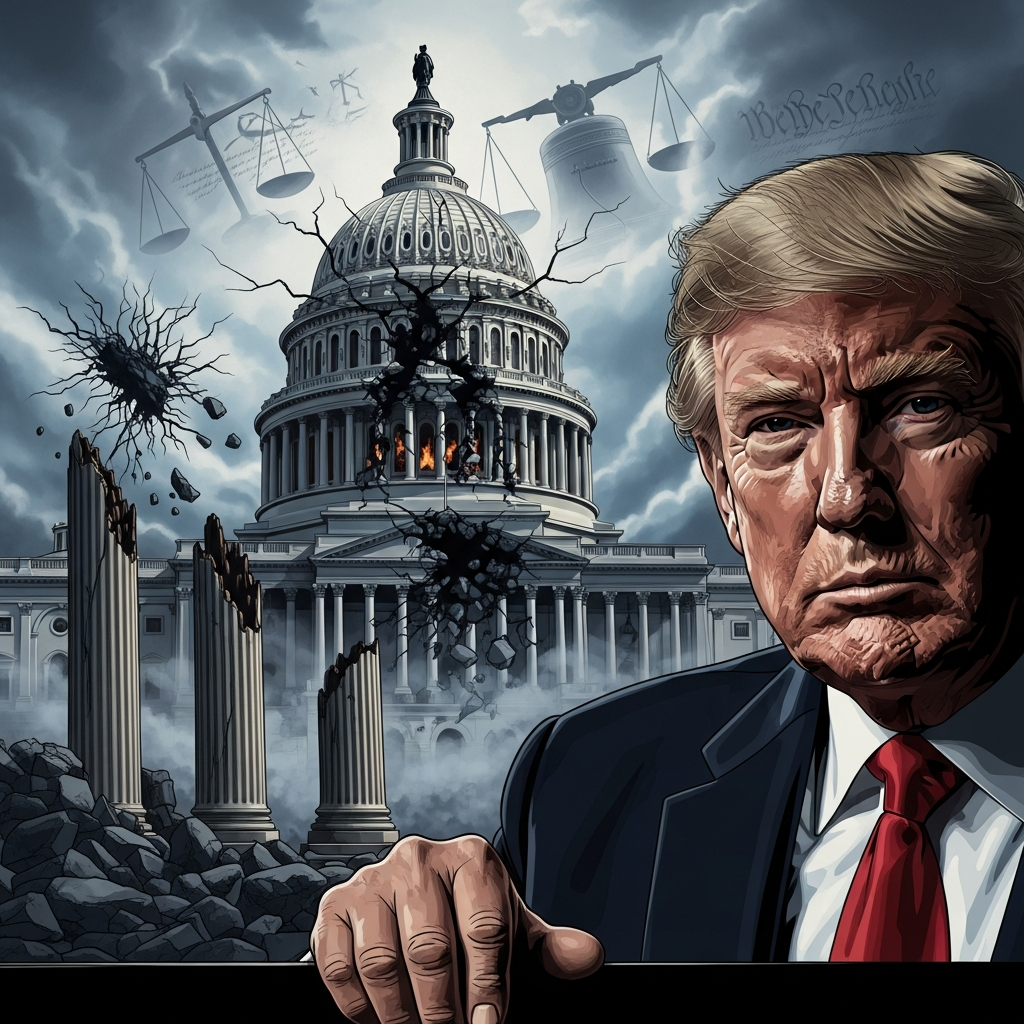
Recent analyses from leading global democracy watchdogs paint a stark picture: the United States is experiencing an unprecedented decline in democratic health. These comprehensive reports suggest that under President Trump, the nation has witnessed a rapid and alarming erosion of its foundational democratic principles, moving at a speed comparable to, and in some cases surpassing, that of emerging autocracies worldwide.
This urgent assessment, spearheaded by institutions like the V-Dem Institute, Bright Line Watch, and Freedom House, raises critical questions about the future of American governance and its standing on the global stage. Experts from these organizations warn that the developments observed are pushing the U.S. system dangerously close to a state of autocracy, a trajectory its founders explicitly sought to prevent.
A Democracy in Peril? Unpacking the Global Assessments
Three major reports released this month deliver a unified message: American democracy is facing severe challenges. These studies, drawing on extensive data and expert surveys, indicate a significant deterioration in the country’s democratic framework since President Trump’s return to the White House.
V-Dem Institute’s Alarming Findings
The V-Dem (Varieties of Democracy) Institute, based at Sweden’s University of Gothenburg, released its annual report with particularly stark conclusions. V-Dem, which compiles data from over 4,000 scholars globally, downgraded the U.S. significantly in its democracy ranking, plummeting from 20th to 51st out of 179 countries. This places the U.S. between Slovakia and Greece, marking its lowest democratic level since 1965, the year the Voting Rights Act was passed.
Staffan Lindberg, V-Dem’s founding director, highlighted the speed of this decline. He described it as the “most rapid decline ever in the history of the United States and one of the most rapid in the world,” likening the pace of change to some coups d’état. Lindberg pointed out that the democratic rollback under Trump in just one year was equivalent to what took Indian Prime Minister Narendra Modi and Turkish President Recep Tayyip Erdogan 10 years, and Hungarian Prime Minister Viktor Orbán four years, to accomplish. The report also notes that freedom of expression, a key democratic indicator, has fallen to its lowest point since the end of World War II.
Bright Line Watch and Freedom House Corroborate Concerns
Further reinforcing these grave assessments, Bright Line Watch, which surveys over 500 U.S. scholars, concluded that the U.S. system now falls nearly midway between a liberal democracy and a dictatorship. This finding underscores a growing consensus among experts regarding the shift in the American political landscape.
Concurrently, Freedom House, a Washington D.C.-based democracy think-tank, reported similar concerns. Their analysis indicated that among free countries, the U.S. registered one of the largest declines in political rights and civil liberties last year, joining nations like Bulgaria and Italy in this alarming trend. These collective findings suggest a systemic and rapid weakening of democratic institutions and norms within the United States.
The “Authoritarian Playbook”: Specific Actions Under Scrutiny
According to these reports, the decline in U.S. democracy is not an abstract phenomenon but a direct result of specific actions taken by the Trump administration. These actions, often described as following an “authoritarian playbook,” target the fundamental checks and balances of governance.
Concentrated Executive Power and Legal Overreach
V-Dem specifically cited the Trump administration’s concentration of executive power as a primary driver of the downgrade. This includes numerous instances of:
Overstepping Laws: The administration has been accused of disregarding the rule of law and violating judicial orders, particularly through agencies like the Department of Homeland Security.
Circumventing Congress: The Republican-led Congress is criticized for “abdicating its constitutional role” in 2025, effectively ceding significant legislative, fiscal, and oversight powers to the executive branch. This includes the Trump administration unilaterally reallocating federal funding, such as a reported $10 billion to a “Board of Peace,” and slashing billions in grants without congressional approval, thus taking over the “power of the purse.” The Senate is also noted for routinely confirming “unqualified Trump nominees,” further diminishing legislative checks.
Attacks on the Judiciary: The reports detail direct attacks on the courts by President Trump and a pressure campaign against judges ruling against the administration, including alleged “impeachment resolutions and misconduct complaints.” Executive orders were reportedly used to punish major law firms for representing political opponents.
Mass Pardons: The administration granted mass pardons to over 1,500 individuals involved in the January 6, 2021, Capitol storming, a move critics say undermined the rule of law.
Attacks on Media, Speech, and Civil Liberties
Beyond institutional changes, the reports highlight deliberate efforts to suppress dissent and control information. This includes:
Attacks on the News Media: Direct and consistent attacks on news organizations and freedom of speech are cited as key factors in the democratic decline.
Suppression of Dissent: The administration is accused of actively working to dismantle civil rights achievements and equality initiatives, aiming to silence left-wing dissenters.
Threats to Electoral Integrity
While election quality has not been the primary factor in the current downgrade, concerns are growing regarding future electoral processes. The reports note that the states’ powers to administer their own elections remain a “lone bright spot.” However, actions taken in 2025 raise significant concerns about the integrity of the 2026 midterms. An executive order issued by Trump reportedly sought to override state election laws by restricting mail-in voting and mandating voter IDs nationwide, although many provisions of this order have faced legal challenges and blocks in federal court.
White House Response and Counterarguments
The White House has vehemently dismissed these findings. Spokeswoman Olivia Wales characterized V-Dem’s analysis as “a ridiculous claim made by an irrelevant, blatantly biased organization.” She staunchly defended President Trump, portraying him as a champion for freedom and democracy and “the most transparent and accessible president ever.” Wales even quipped that Trump’s return to office “saved the legacy media from going out of business.”
President Trump himself has consistently rejected criticisms that he seeks to rule as an autocrat. Despite publicly acknowledging that “a lot of people are saying maybe we like a dictator,” he has maintained, “I don’t like a dictator. I’m not a dictator.”
Global Ramifications: Eroding Democratic Solidarity
The implications of these domestic developments extend far beyond U.S. borders, according to experts. Yana Gorokhovskaia, director for strategy and design for Freedom House, notes that Trump’s policies abroad are also undermining the country’s democratic standing internationally.
Historically, the U.S. State Department would frequently call out election fraud in other countries. However, under the Trump administration, this stance has shifted. The State Department now reportedly comments on foreign elections only when the U.S. has a “clear and compelling interest.” Gorokhovskaia argues that this change leads to a “loss of democratic solidarity globally” and blurs the crucial distinction between democracies and autocracies. A striking example of this shift is Secretary of State Marco Rubio’s public endorsement of Hungary’s autocratic leader, Viktor Orbán, for a fifth term, an individual whom President Trump has publicly admired as a “strongman.”
A Glimmer of Hope? Judicial Pushback and Potential for Reversal
Despite the alarming trajectory, the reports also highlight elements within the U.S. system that are pushing back against these trends. John Carey, co-director of Bright Line Watch, pointed out that the courts have served as a crucial counterweight, potentially preventing an even further slide toward autocracy.
Carey cited a recent Supreme Court ruling against the president on tariffs as evidence that Trump has “not fully captured that set of referees,” referring to the judiciary as “the most important set.” Brendan Nyhan, another Bright Line co-director, adds that while “what we’re seeing is the authoritarian playbook,” there’s no guarantee the effects are permanent. He suggests that Trump’s ability to operate in this manner could be constrained after the midterms or by a successor in 2028. Furthermore, the V-Dem report itself offers a glimmer of hope, noting that approximately 70 percent of autocratizations witnessed in the modern era have ultimately been reversed. This suggests that while the current situation is grave, it is not necessarily irreversible.
Frequently Asked Questions
What specific actions by the Trump administration led to the U.S. democracy downgrade?
The V-Dem Institute and other reports cite several key actions. These include a rapid concentration of executive power, overstepping laws, violations of judicial orders, and unilaterally reallocating federal funding without congressional approval. The Republican-controlled Congress is also criticized for abdicating its oversight role. Furthermore, direct attacks on the news media, freedom of speech, and efforts to suppress dissent and dismantle civil rights initiatives contributed significantly to the downgrade. These actions collectively weakened the system of checks and balances critical to a functioning democracy.
How do the courts act as a check on executive power in this context?
According to Bright Line Watch, the judiciary, particularly the Supreme Court, has acted as a crucial counterweight against executive overreach. Experts like John Carey highlight that specific court rulings against the president, such as a recent decision on tariffs, demonstrate that the executive branch has “not fully captured that set of referees.” While attempts have been made to pressure judges or bypass judicial orders, the courts have, in some instances, upheld their constitutional role, preventing an even steeper decline in democratic norms and safeguarding the rule of law.
What are the long-term implications of these reported democratic declines for the U.S. and its global standing?
The reported democratic declines carry profound long-term implications, both domestically and internationally. Internally, a continued erosion of checks and balances, civil liberties, and electoral integrity could fundamentally alter the nature of American governance, moving it closer to an autocratic model. Globally, the U.S.’s diminished democratic standing weakens its credibility as a promoter of democracy abroad. This could lead to a loss of “democratic solidarity,” blurring the distinction between democracies and autocracies, and potentially emboldening authoritarian regimes worldwide, as evidenced by shifts in State Department policy and endorsements of autocratic leaders.
The assessments from V-Dem, Bright Line Watch, and Freedom House serve as an urgent call for attention to the state of U.S. democracy. While the White House disputes these findings, the consistent and detailed concerns from leading global institutions underline a critical moment in American political history. The speed and scope of the alleged democratic backsliding, juxtaposed with the resilience shown by the judiciary, indicate a dynamic and highly consequential period for the nation’s democratic future and its role in the world.