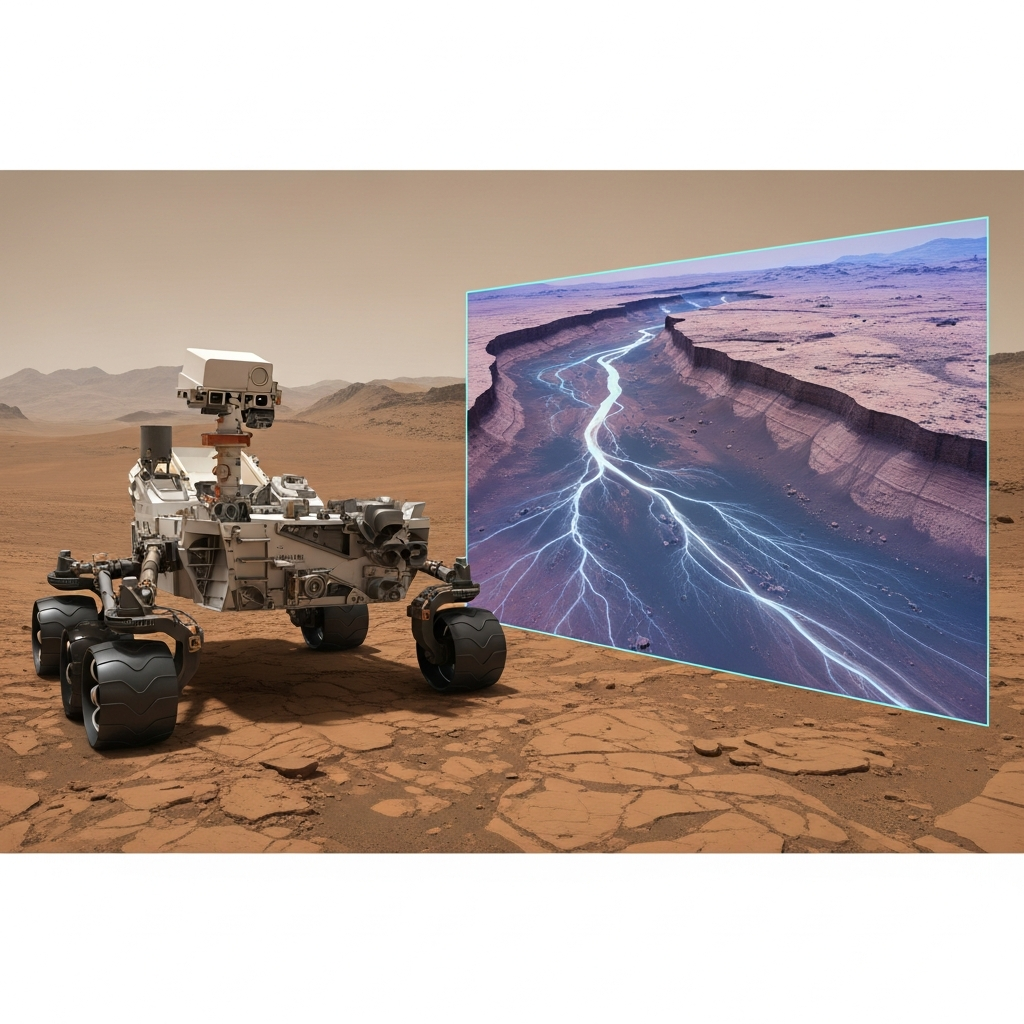
NASA’s Perseverance rover has made a stunning discovery on the Red Planet, uncovering evidence of a vast, ancient river system hidden deep beneath the surface of Jezero Crater. This groundbreaking finding pushes back the timeline for sustained water on Mars by hundreds of millions of years. It significantly bolsters the hope of finding evidence of past microbial life. Researchers believe this newly identified Perseverance Mars river system could hold the keys to understanding the planet’s early habitability and even life’s origins.
Peering Beneath the Martian Surface: A Revolutionary Discovery
Since its landing in Jezero Crater in 2021, the Perseverance rover has been meticulously exploring the Martian landscape. Its mission: to seek signs of ancient life and collect rock samples for future return to Earth. The latest revelation, however, comes from an unexpected depth. Using its advanced ground-penetrating radar, RIMFAX (Radar Imager for Mars’ Subsurface Experiment), Perseverance detected compelling evidence of a buried river delta. This ancient formation lies up to 115 feet (35 meters) below the crater floor.
The radar data unveiled layered sedimentary deposits. These are characteristic geological signatures of a delta, formed where a river once flowed into a larger body of water, likely an ancient lake within Jezero Crater. Scientists estimate this submerged river system is between 3.7 and 4.2 billion years old. This makes it substantially older than the previously identified surface features, like Jezero’s Western Delta, which formed about 3.5 to 3.7 billion years ago. This discovery suggests a much longer period of water activity on early Mars.
How RIMFAX Unlocked Mars’ Buried Secrets
The Radar Imager for Mars’ Subsurface Experiment (RIMFAX) is a vital instrument aboard Perseverance. It works by sending radar pulses downwards into the Martian ground. These pulses penetrate the surface and then reflect off different underground features. By analyzing the timing and strength of these reflections, scientists can create a three-dimensional map of the subsurface geology. During its traverses across Jezero Crater, RIMFAX gathered data along a 3.8-mile (6.1 km) stretch. This deep scan, conducted over 250 Martian days, provided the deepest insights into the crater’s buried past yet.
Emily Cardarelli, a UCLA planetary scientist and lead author of the research published in Science Advances, emphasized the significance of these findings. She noted that the features mapped by RIMFAX indicate an ancient, water-rich environment within Jezero Crater. Such conditions are crucial for the preservation of biosignatures – chemical or physical evidence that would point to past life.
A Wetter, Warmer Ancient Mars: Implications for Habitability
The presence of such an ancient and extensive Perseverance Mars river system reinforces a long-held scientific theory: Mars was once a much wetter planet. Billions of years ago, it likely possessed a thicker atmosphere and a warmer climate, allowing liquid water to flow freely across its surface. This environment would have been far more hospitable than the cold, arid planet we observe today.
Jezero Crater itself is a prime target for astrobiological research. Scientists believe it once hosted a large lake, fed by rivers that carved channels across its crater walls. The new discovery suggests that these hydrological processes were not just surface-level events. Instead, they involved deep, sustained water flow over extended periods. This continuous presence of water would have provided numerous opportunities for microbial life to emerge and thrive.
Mars’ Undisturbed Geological Archive: A Window to Life’s Origins
One of the most remarkable aspects of this discovery lies in Mars’ unique geological preservation. Unlike Earth, where geological processes like heating, compression, and water alteration often erase ancient river signatures, Mars’ crust remains largely undisturbed. Emily Cardarelli highlighted this, stating that Mars is essentially “frozen in time.” This pristine geological archive offers an unparalleled opportunity to study early planetary history and the conditions that might have fostered life.
This research holds profound implications not just for the search for Martian life, but potentially for understanding life’s genesis on Earth. If Mars yields definitive proof of extraterrestrial life, it could provide crucial insights into how life originates in the universe. Some theories even propose that ancient asteroid impacts might have exported early Martian life to Earth. In this scenario, Mars could be a key to understanding our own origins.
The Hunt for Biosignatures: From Riverbeds to Rock Samples
The discovery of this ancient Perseverance Mars river system directly impacts the ongoing search for biosignatures. On Earth, river deltas are known hotspots for concentrating sediments and creating ideal niches where microbial life can flourish and be preserved. The more evidence we find of a long-duration, water-rich past, the higher the chances of finding traces of ancient Martian organisms.
Perseverance has already been busy collecting rock core samples. These samples are crucial for Earth-based laboratory analysis, which is the ultimate goal of the Mars Sample Return mission. One particular rock sample, nicknamed “Sapphire Canyon” from the “Cheyava Falls” rock within the “Bright Angel” formation, is especially intriguing.
The “Cheyava Falls” Clue: Potential Evidence of Ancient Life
Detailed analysis of the Cheyava Falls rock by Perseverance’s SHERLOC instrument revealed complex macromolecular organic carbon, distinct “poppy seeds” (iron and phosphorus accumulations), and “leopard spots” (dark rims with bleached interiors). On Earth, similar features are often associated with microbial activity metabolizing organic matter and facilitating specific redox reactions. Joel Hurowitz, a lead scientist on the team, places this at “Step 3 on the Confidence of Life Detection (CoLD) scale.” This means it’s a plausible biological signal from a plausible host environment, but not definitive proof. The next critical step – Step 4, ruling out all known non-biological processes – requires returning the Sapphire Canyon sample to Earth for advanced isotopic and organic geochemical analyses.
The Broader Context: Mars’ Watery Past Unfolding
This latest finding from Perseverance adds to a growing body of evidence for ancient water on Mars. Other missions have contributed to this comprehensive picture. NASA’s Curiosity rover, for example, operating in Gale Crater, recently revealed that ancient sand dunes were saturated by underground water billions of years ago. This subsurface water left behind minerals capable of preserving traces of organic material. Curiosity’s observations of “boxwork” formations also suggest that Mars’ ancient water table was considerably higher than once thought.
These parallel discoveries from different rovers paint a compelling picture. Mars did not simply dry out after its surface lakes and rivers vanished. Instead, it likely retained substantial subsurface water for extended periods. This underground water could have provided stable environments, potentially sheltering microbial life long after surface conditions became inhospitable.
The Road Ahead: Mars Sample Return Mission
The true definitive answers to whether life ever existed on Mars lie with the Mars Sample Return mission. The rock core samples, meticulously collected by Perseverance from Jezero Crater – including those from the ancient river delta system and the intriguing Cheyava Falls rock – are slated for return to Earth in the 2030s. Once these samples are in terrestrial laboratories, scientists can employ a suite of advanced instruments. These instruments can conduct highly sensitive analyses impossible to perform remotely on the rover. This ambitious undertaking represents humanity’s best chance to answer one of its most profound questions: Are we alone in the universe?
Frequently Asked Questions
What did Perseverance find buried in Jezero Crater?
NASA’s Perseverance rover uncovered a vast, ancient river delta system buried up to 115 feet (35 meters) beneath the surface of Mars’ Jezero Crater. This discovery, made using the RIMFAX ground-penetrating radar, revealed layered sedimentary deposits characteristic of where a river once flowed into a lake. This particular river system is estimated to be between 3.7 and 4.2 billion years old, predating previously known surface deltas.
How did Perseverance detect this ancient river system?
Perseverance detected the buried river system using its Radar Imager for Mars’ Subsurface Experiment (RIMFAX). This instrument sends radar pulses into the Martian ground and records the reflections. By analyzing these reflections over a 3.8-mile (6.1 km) traverse, scientists created a 3D map of the subsurface. This allowed them to identify the distinct geological signatures of the ancient, submerged delta.
Why is the discovery of an older river system on Mars important for the search for life?
The discovery of a 3.7 to 4.2-billion-year-old river system significantly extends the known window for sustained water on Mars. Water is considered essential for life, and a long-duration, water-rich environment increases the probability of life having emerged. River deltas on Earth are excellent at preserving biosignatures, so a Martian delta of this age offers a prime location for finding evidence of past microbial life. It also provides valuable insights into Mars’ ancient climate and potential habitability.