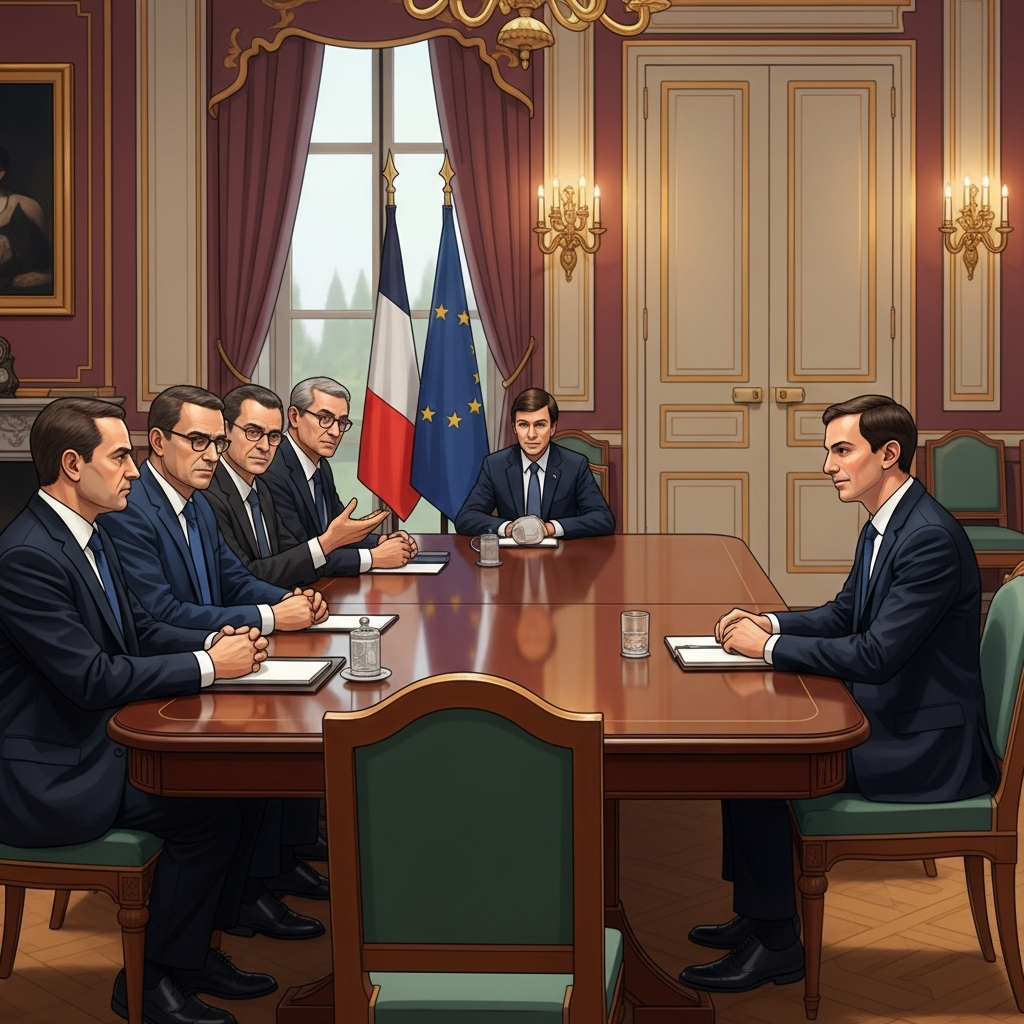
A new wave of diplomatic tension has engulfed transatlantic relations. France has formally summoned U.S. Ambassador Charles Kushner. This urgent action follows controversial statements from the U.S. State Department regarding the tragic death of French far-right activist Quentin Deranque. Paris views these comments as an unacceptable interference in its domestic affairs and a blatant attempt to politicize a national tragedy.
The move, scheduled for Monday at 7:00 pm GMT, marks a significant escalation. It highlights deep fissures in the alliance between two historically close nations. Beyond the immediate catalyst, the summons will also address ongoing disputes, including U.S. sanctions on French and European Union officials.
Diplomatic Storm Ignited by Activist’s Death
The catalyst for this latest diplomatic incident is the death of Quentin Deranque, a 23-year-old far-right activist. He succumbed to severe head injuries in Lyon last week. His death followed an alleged altercation with hard-left activists. This clash occurred on the sidelines of a student meeting. Left-wing lawmaker Rima Hassan was a keynote speaker at the event.
Déranque’s killing has ignited intense political tensions across France. This comes at a critical time, ahead of the 2027 presidential election. A tribute march for Deranque in Lyon drew over 3,000 participants. Heavy security was deployed to prevent further unrest. French President Emmanuel Macron publicly appealed for calm amidst the heightened emotion. The incident has drawn comparisons to “France’s Charlie Kirk moment,” referencing a similar case of political violence in the U.S.
US Accusations of “Violent Radical Leftism”
The U.S. State Department and the Donald Trump administration quickly reacted to Deranque’s death. They issued a series of statements that provoked immediate outrage in Paris. The State Department’s Bureau of Counterterrorism posted on X, stating, “reports, corroborated by the French Minister of the Interior, that Quentin Deranque was killed by left-wing militants, should concern us all.” This message was later shared in French by the official U.S. embassy account.
Further escalating the rhetoric, the State Department’s Under Secretary for Public Diplomacy, Sarah Rogers, made a strong statement on X. She declared Deranque’s killing demonstrated “why we treat political violence – terrorism – so harshly.” Rogers asserted that “Once you decide to kill people for their opinions instead of persuade them, you’ve opted out of civilisation.” The U.S. administration formally labeled the incident “terrorism” in France. This direct accusation of “violent radical leftism” and its role in Deranque’s death was deemed a threat to public safety. The U.S. also pledged to monitor the situation and expected perpetrators to be brought to justice.
France Rejects “Instrumentalization” and External Interference
French Foreign Affairs Minister Jean-Noël Barrot swiftly condemned the U.S. statements. He explicitly rejected any “instrumentalization of this tragedy.” Barrot emphasized that Deranque’s death “has plunged a French family into mourning” and should not be used for “political ends.” He delivered a sharp rebuke to Washington, stating, “We have no lessons to learn, particularly on the issue of violence, from the international reactionary movement.”
The French Ministry for Europe and Foreign Affairs scheduled the summons for Monday, February 22, at 7:00 pm (1800 GMT). This highlights the urgency and severity with which France views the matter. The French government insists the incident concerns its “national community.” It firmly rejects external commentary that politicizes such a sensitive domestic affair.
International Repercussions and Macron’s Stance
The fallout from Deranque’s death extended beyond U.S.-France relations. It also sparked a diplomatic spat with Italy. Right-wing Italian Prime Minister Giorgia Meloni, known for her close ties with Donald Trump, described the killing as “a wound for all of Europe.” President Macron swiftly criticized Meloni. He admonished her for commenting on France’s internal affairs, underscoring France’s consistent stance against foreign interference.
Broader Frictions: Sanctions and Sovereignty Concerns
The summoning of Ambassador Charles Kushner is not solely about the Deranque case. Minister Barrot indicated other pressing issues would be on the agenda. These include recent U.S. decisions to impose sanctions on key European figures. Among them is Thierry Breton, a former European Union commissioner. Breton was responsible for supervising social media rules. Another target is Nicolas Guillou, a French judge at the International Criminal Court (ICC).
Barrot characterized these sanctions as “unjustified and unjustifiable.” He views them as direct attacks on the autonomy of the European Union and the independence of the international justice system. Reports suggest President Macron has personally written to Donald Trump. He reportedly requested the lifting of these specific sanctions, further illustrating the depth of the disagreement. This signals a broader challenge to multilateral institutions and European sovereignty.
A History of Diplomatic Spats with Ambassador Kushner
This is not the first time Charles Kushner, father of President Trump’s son-in-law Jared Kushner, has faced France’s diplomatic displeasure. In August of the previous year, he was summoned over a letter sent to President Macron. That letter alleged France was not doing enough to combat antisemitism. France vehemently rejected these allegations. It stated they “run counter to international law” and “fall short of the quality of the transatlantic partnership.”
President Macron himself publicly criticized Kushner’s conduct in a September interview. He described it as “out of line” for a diplomat. Macron emphasized that French ambassadors are not permitted to make such public remarks about other nations. He argued that it risks diplomatic relations. He also questioned the proper use of U.S. taxpayer money for such statements. Notably, Kushner did not personally attend that prior meeting. Instead, French officials met with a representative from the U.S. embassy.
Legal Proceedings and France’s Domestic Response
The investigation into Quentin Deranque’s death is actively progressing. The Lyon public prosecutor’s office has taken significant steps. Seven individuals have been handed preliminary charges. Prosecutors have requested charges of intentional homicide, aggravated violence, and criminal conspiracy. Six of the accused face all three counts. The seventh faces charges of complicity in intentional homicide, aggravated violence, and criminal conspiracy.
Further complicating the political landscape, a parliamentary assistant to a radical left-wing Member of Parliament has also been charged with complicity. This specific detail highlights the potential for broad political ramifications. It underscores the ongoing sensitivity and political divisions surrounding the incident, influencing public discourse ahead of the upcoming election.
Frequently Asked Questions
Why did France summon US Ambassador Charles Kushner?
France summoned U.S. Ambassador Charles Kushner primarily to protest controversial statements made by the U.S. State Department and the Trump administration regarding the death of far-right activist Quentin Deranque. The U.S. characterized Deranque’s death as “terrorism” caused by “violent radical leftism,” which France views as unacceptable political interference and an “instrumentalization” of a national tragedy. Additionally, the summons will address U.S. sanctions imposed on EU Commissioner Thierry Breton and ICC Judge Nicolas Guillou, which France deems “unjustified and unjustifiable.”
What are the broader implications of this diplomatic dispute for US-France relations?
This diplomatic dispute signals increased strain in US-France relations, particularly under the Trump administration. It highlights a disregard for diplomatic protocol and national sovereignty from the U.S. side, according to French officials. The repeated summonings of Ambassador Kushner, including a prior incident regarding antisemitism allegations, indicate a pattern of friction. These tensions could undermine transatlantic partnership and cooperation on other international issues, reflecting deep ideological and procedural disagreements between the two nations.
How might the activist’s death and US comments affect France’s political landscape leading up to the 2027 election?
Quentin Deranque’s death and the subsequent U.S. comments have significantly amplified political tensions within France, especially between far-right and far-left factions. The incident has galvanized far-right groups, as evidenced by large tribute marches. U.S. statements, which explicitly blame “radical leftism,” could further polarize the electorate. This creates a volatile environment in the run-up to the 2027 presidential election, potentially influencing voter sentiment and increasing rhetoric surrounding political violence and national identity. President Macron’s calls for calm reflect concern over this domestic instability.
Conclusion: Navigating a Strained Alliance
The latest summoning of U.S. Ambassador Charles Kushner signifies a critical juncture in U.S.-France relations. The U.S. State Department’s strong public pronouncements on Quentin Deranque’s death have deeply offended French sensibilities regarding sovereignty and diplomatic protocol. This incident, combined with ongoing disputes over sanctions and previous accusations of antisemitism, paints a picture of a transatlantic alliance under significant stress. As France prepares for its next presidential election, the domestic impact of such highly charged events, both internally and externally, will continue to be a defining factor. The episode underscores the delicate balance required to maintain international partnerships amidst differing political ideologies and priorities.
References
- www.theguardian.com
- www.cbsnews.com
- www.aljazeera.com
- <a href="https://www.lemonde.fr/en/france/article/2026/02/22/france-summons-us-ambassador-over-comments-on-slain-far-right-activist67507467.html”>www.lemonde.fr
- www.the-independent.com