NASA’s highly anticipated Artemis II mission has achieved a significant milestone, successfully completing a crucial “wet dress rehearsal” for its powerful Space Launch System (SLS) moon rocket. This pivotal test brings humanity’s return to the Moon’s vicinity closer than ever, with NASA officials now eyeing a potential March launch window. The success of this rehearsal is a testament to the meticulous work of engineers and sets the stage for a historic journey around the Moon.
Artemis II Wet Dress Rehearsal: A Deep Dive into Readiness
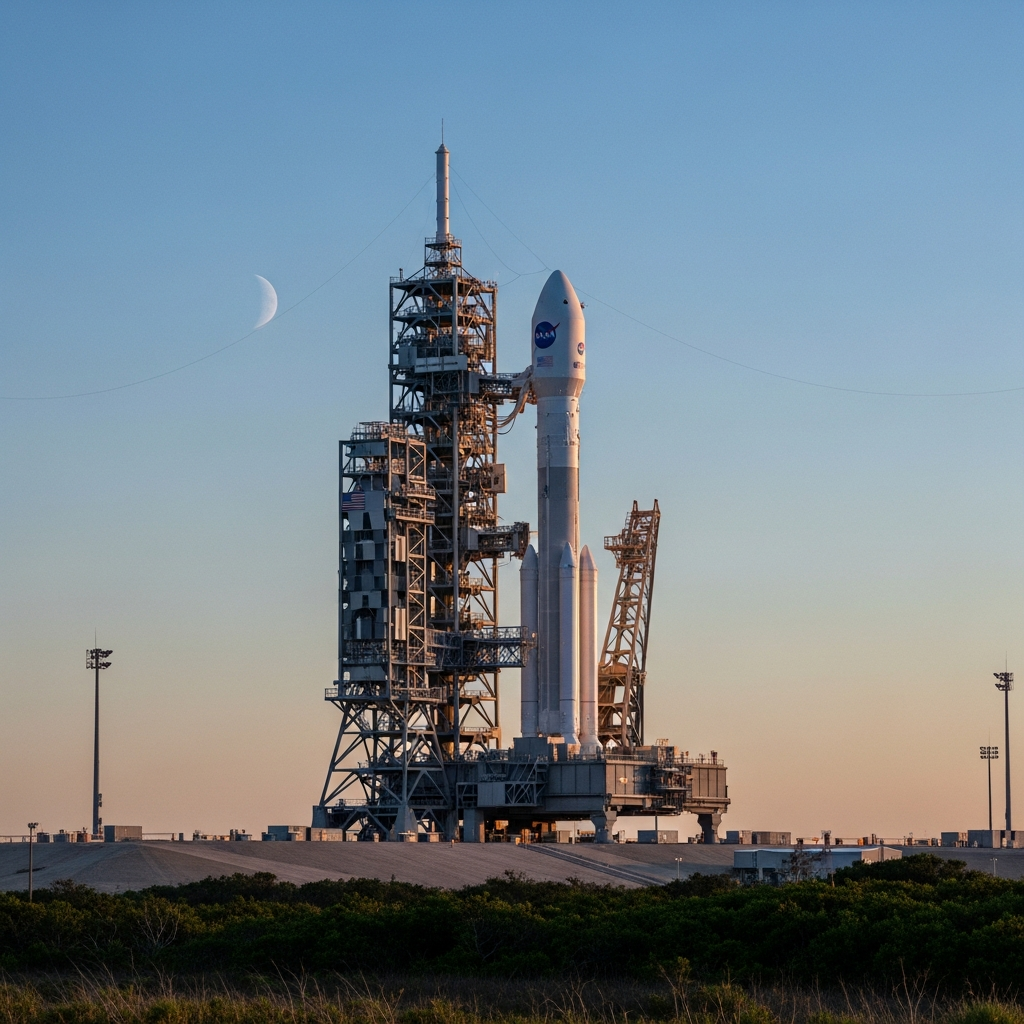
On February 19, the Space Launch System (SLS) rocket underwent its second comprehensive wet dress rehearsal at Kennedy Space Center. This full-scale simulation mirrored critical launch day operations, minus the actual crew boarding and liftoff. Teams worked tirelessly for over 50 hours, meticulously preparing the towering rocket for the test.
A core component of the rehearsal involved loading more than 700,000 gallons of super-cold liquid oxygen and liquid hydrogen propellant into the SLS rocket’s massive core stage and its upper stage. The closeout crew also practiced sealing the Orion spacecraft’s hatches, mimicking procedures they would perform just hours before launch. Mission teams successfully executed two final countdowns, pushing the timeline all the way to T-29 seconds.
Lori Glaze, acting associate administrator of Exploration Systems Development Mission Directorate, confirmed the successful completion of these vital procedures. She highlighted that the SLS rocket was fully tanked precisely within the planned timeline. Glaze also praised the successful demonstration of crew module closeout activities and the overall launch countdown. This comprehensive test signals a major step forward for the Artemis II launch.
Overcoming Technical Hurdles and Fine-Tuning Systems
The journey to this successful rehearsal wasn’t without its challenges. An earlier wet dress rehearsal in early February had revealed a liquid hydrogen leak. NASA’s Artemis II Mission Management Team Chair, John Honeycutt, noted that the initial hardware feedback was invaluable. “Remediation activities that we took turned out really well,” he stated, confirming the effectiveness of the fixes.
Launch Director Charlie Blackwell-Thompson provided further details, explaining the leak originated from an eight-inch seal in the rocket’s fueling area. Both this eight-inch seal and an adjacent four-inch seal were promptly replaced. A subsequent confidence test on February 12 aimed to verify these new seals by partially filling the core stage tank. While this test initially faced an issue with ground support equipment limiting hydrogen delivery, it was quickly resolved. Engineers purged the line, inspected the equipment, and replaced a suspected filter.
During the February 19 rehearsal itself, teams experienced a brief loss of ground communications in the Launch Control Center. This required a temporary switch to backup systems. Blackwell-Thompson clarified that this communication issue was promptly identified, had no connection to the critical loading of cryogenic propellants, and the faulty equipment has since been addressed. Despite these minor hurdles, officials expressed growing confidence in the readiness of the Space Launch System (SLS) and Orion spacecraft.
The Historic Crew: Preparing for Deep Space
The four pioneering astronauts selected for the Artemis II mission are Reid Wiseman, Christina Koch, Jeremy Hansen, and Victor Glover. This diverse crew is set to embark on an unprecedented journey. On February 20, they were due to enter quarantine, a crucial step in their final preparations.
The crew observed a portion of the February 19 wet dress rehearsal directly from Launch Control at NASA’s Kennedy Space Center. Lori Glaze reported that the astronauts are “very, very excited” about the potential March liftoff. Their schedule includes returning to Houston before flying back to Florida approximately five days prior to the anticipated launch. Their direct involvement and observation underscore the mission’s nearing reality.
Unpacking the Significance of Artemis II
The Artemis II mission is far more than just another test flight; it’s a monumental step in human space exploration. Designed as a 10-day journey around the Moon, it will serve as a critical test flight for the Orion spacecraft and its systems with a human crew onboard. This mission is an essential precursor to the much-anticipated Artemis III, which aims to land humans on the lunar surface.
Historically, Artemis II carries immense weight. It will mark the first time humans have ventured into the vicinity of the Moon in over five decades, since the Apollo missions concluded in 1972. This journey signifies humanity’s renewed commitment to deep space exploration, pushing the boundaries of what’s possible and laying the groundwork for sustained lunar presence and eventual missions to Mars. The data collected from this crewed moon mission will be invaluable for future endeavors.
Launch Windows and Future Steps
While the successful wet dress rehearsal has significantly boosted confidence, an official launch date for NASA Artemis II remains unconfirmed. NASA officials have indicated that early March is a strong possibility, with March 6 identified as the earliest potential liftoff. However, this is contingent on final work still pending at the launch pad.
Lori Glaze emphasized the importance of transparency, stating that there is “still pending work” before a firm launch date can be committed. A multi-day flight readiness review is scheduled for the following week, where mission managers will meticulously scrutinize all data and preparations.
Currently, NASA is considering several potential launch windows. These include dates in March: 6, 7, 8, 9, and 11. Additionally, alternative dates in April are on the table: 1, 3, 4, 5, and 6. The meticulous review process ensures that every system is thoroughly checked and every possible contingency planned for, prioritizing the safety and success of this historic undertaking.
Frequently Asked Questions
What was the purpose and outcome of the recent Artemis II wet dress rehearsal?
The recent Artemis II wet dress rehearsal, conducted on February 19, was a comprehensive simulation of launch day operations for the Space Launch System (SLS) rocket and Orion spacecraft. Its purpose was to verify the rocket’s systems, including fueling procedures and countdown sequences, with human operators. The outcome was highly successful: engineers fully loaded over 700,000 gallons of propellant, practiced crew module closeout activities, and completed two countdowns to T-29 seconds. This demonstrated the effectiveness of prior repairs and significantly advanced the mission’s readiness.
Who are the astronauts on the historic Artemis II mission, and where will they go?
The four astronauts assigned to the historic Artemis II mission are Reid Wiseman (Commander), Christina Koch, Jeremy Hansen (Canadian Space Agency), and Victor Glover. They are preparing to embark on a 10-day journey around the Moon. This mission will mark the first time humans have flown into the lunar vicinity in over 50 years, since the Apollo program. The crew will test the Orion spacecraft’s systems with humans aboard, orbiting the Moon in a “free return” trajectory before splashing down back on Earth.
When is the earliest potential launch date for Artemis II, and what factors could affect it?
The earliest potential launch date for NASA’s Artemis II mission is March 6. However, this date is tentative and contingent upon the completion of all remaining work at the launch pad and a successful multi-day flight readiness review. While the recent wet dress rehearsal was successful, officials noted there is “still pending work” to be finalized. Other potential launch dates in March include the 7th, 8th, 9th, and 11th, with additional windows available in early April. The final commitment to a date will follow the comprehensive review of all mission data and preparations.
Looking Ahead to a New Era of Lunar Exploration
The successful completion of the Artemis II wet dress rehearsal signifies a monumental stride for NASA and its international partners. With crucial tests behind them and a highly capable crew ready for deep space, the dream of returning humans to the Moon’s vicinity is on the cusp of reality. As the flight readiness review approaches, anticipation builds for what promises to be a truly historic Artemis II launch, ushering in a new era of lunar exploration and setting the stage for future missions to Mars.