February 19, 2026, marked a whirlwind of activity for the Trump administration, with President Donald Trump addressing a spectrum of pressing issues from international diplomacy and national security to domestic policy and cultural controversies. This day’s developments underscored the administration’s multifaceted agenda, revealing key stances on global conflicts, economic strategies, and even the search for extraterrestrial life. From high-stakes negotiations with Iran to a contested architectural landmark in Washington D.C., the day offered a comprehensive look into the priorities and challenges facing the White House.
Geopolitical Crossroads: Iran Tensions and the Board of Peace
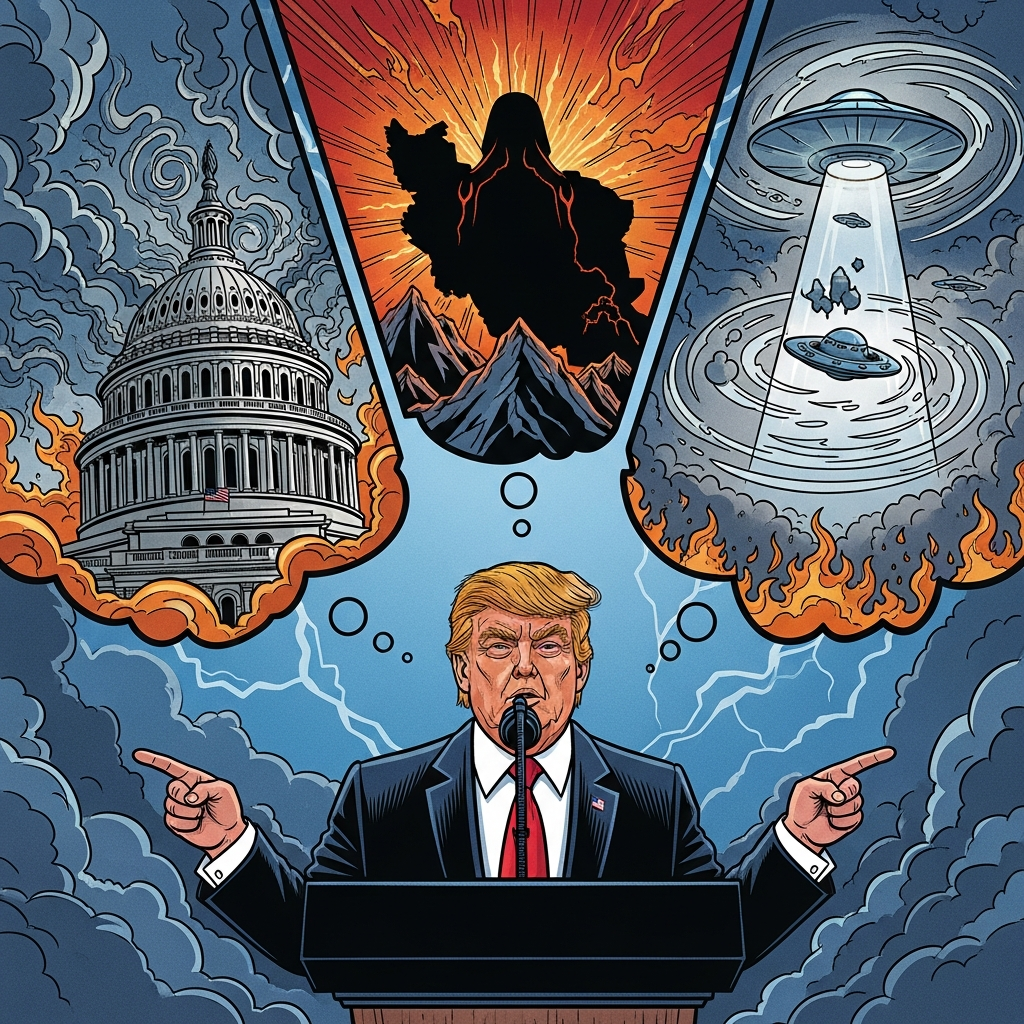
President Trump issued a stark ultimatum regarding Iran, extending his timeline for a decision on potential military action to “10-15 days, pretty much maximum.” He asserted that the U.S. would either achieve a deal or face “unfortunate” consequences for Tehran. This move came amidst intelligence that the U.S. military was prepared for strikes as early as that weekend, highlighting the precariousness of the situation. Earlier indirect talks between the U.S. and Iran in Oman were described as “more constructive,” hinting at a complex diplomatic dance beneath the surface of the President’s public warnings.
Central to the day’s international focus was the inaugural meeting of the “Board of Peace” in Washington D.C., a new entity President Trump envisions as “looking over” the United Nations. This ambition signals a potential shift in global governance, with the U.S. pledging a significant $10 billion to the board. Further financial commitments for Gaza relief were announced, totaling over $7 billion from nations like Qatar ($1 billion), the UAE, Saudi Arabia, Kazakhstan, Azerbaijan, Morocco, Bahrain, Uzbekistan, and Kuwait, alongside FIFA’s pledge of over $75 million for “soccer-related” projects.
Stabilizing Gaza: A New International Force and Development Vision
The Board of Peace gathering also delved deeply into the post-conflict stabilization and reconstruction of the Gaza Strip. Five countries—Indonesia, Morocco, Kazakhstan, Kosovo, and Albania—committed troops to an International Stabilization Force (ISF) destined for Gaza, with Egypt and Jordan offering substantial help, including troop training and support for a new 5,000-member “transitional” Palestinian police force. U.S. Army Maj. Gen. Jasper Jeffers indicated the ISF would eventually comprise 20,000 soldiers and 12,000 Palestinian police, with initial deployment to Rafah, where the first rebuilt neighborhood is planned.
Gaza administrator Ali Shaath outlined an urgent stabilization agenda, detailing widespread destruction, acute humanitarian needs, and fragile law and order. He emphasized restoring security through a professional civilian police force and reviving the economy with decent job creation. Israeli Foreign Minister Gideon Sa’ar underscored the necessity of dismantling Hamas, demilitarizing Gaza, and de-radicalizing Palestinian society, drawing a stark contrast with many other Middle Eastern representatives who advocated for a two-state solution. Former UK Prime Minister Tony Blair hailed Trump’s peace plan as “the only hope” for Gaza, echoing sentiments about the region’s “vast” development potential. American billionaire Marc Rowan, a Board of Peace executive, touted Gaza’s coastline and destroyed infrastructure as worth “at least $50 billion” and “$115 billion of value” respectively, envisioning Rafah’s reconstruction within three years and Gaza’s integration into an “Abrahamic gateway” by year ten.
Domestic Priorities: Shutdown, Economy, and Election Integrity
On the domestic front, the administration grappled with a lingering shutdown stalemate over Department of Homeland Security funding. President Trump had not yet engaged directly with Democratic leaders, with House Minority Leader Hakeem Jeffries stating Democrats awaited the administration’s response. Meanwhile, Trump renewed his call for sweeping healthcare legislation, advocating for federal subsidies directly to patients. Despite acknowledging long odds, he maintained “people loved it” and blamed Democrats for obstructing progress.
The President also proclaimed a victory on economic fronts, telling a Georgia crowd, “I’ve won affordability.” This assertion came despite a recent CNN poll showing 55% of respondents believed his policies worsened economic conditions. He opened his remarks fixated on tariffs and voter ID, expressing frustration over Supreme Court challenges to his trade policies and pushing for stricter voting laws, including proof of citizenship and ending mail-in ballots. Trump controversially claimed Republicans “won’t lose a race for 50 years” if such measures were enacted, though he allowed for military and illness-related exceptions for mail-in voting.
Addressing Controversies: UFOs and the Independence Arch
In a move that captured global attention, President Trump announced he would direct government agencies, including the Pentagon, to release files related to extraterrestrial life and UFOs (Unidentified Aerial Phenomena or UAPs). This directive followed former President Barack Obama’s recent comments on the statistical likelihood of alien life, which Trump suggested may have revealed classified information.
Domestically, a lawsuit filed by three Vietnam War veterans and an architectural historian, backed by the progressive group Public Citizen, sought to block the construction of President Trump’s proposed “Independence Arch” in Washington D.C. Intended to commemorate the nation’s 250th anniversary, the arch was envisioned as a grander American version of Paris’s Arc de Triomphe. The plaintiffs argued the landmark would “dishonor their military and foreign service” by obstructing the symbolic view between Arlington National Cemetery and the Lincoln Memorial. White House spokesperson Davis Ingle defended the arch, claiming it would “enhance the visitor experience” for veterans and families of the fallen. The project still faced multiple reviews, including those requiring public input under environmental and historic preservation acts, despite likely approval from D.C.-based commissions reportedly packed with Trump allies.
Political Campaigns and Broader Global Context
President Trump’s visit to Rome, Georgia, for an economic speech at the Coosa Steel Corporation, where he was warmly received, also served as a stage for his intense focus on local politics. He endorsed Clay Fuller, a former prosecutor, in the crowded special election to fill Marjorie Taylor Greene’s vacant U.S. House seat. This intervention highlighted Trump’s ongoing influence within the Republican party and his efforts to secure a loyal ally, aiming to avoid a runoff and bolster Speaker Mike Johnson’s slim majority.
Internationally, the broader context of Trump’s administration was echoed through various reports. At the Munich Security Conference, Trump faced bipartisan U.S. condemnation over his policies, particularly his reliance on “tariffs and unpredictability.” A report from the conference emphasized Europe’s “painful realisation” about needing greater military independence from a U.S. seen as abandoning liberal democratic norms. Simultaneously, Trump continued to push for a swift resolution to the conflict in Ukraine, reportedly placing blame on President Volodymyr Zelenskyy for hindering peace efforts ahead of US-brokered trilateral talks in Geneva.
Hillary Clinton, speaking at the Munich Security Conference, accused the Trump administration of a “cover-up” regarding the release of Jeffrey Epstein files, alleging the DOJ was “slow-walking” disclosures. Trump, for his part, claimed “total exoneration” in the already released files, dismissing the Clintons’ upcoming depositions as “their problem.” These events, combined with criticism against California Governor Gavin Newsom and concerns about John Paulson’s factory relocation to China, painted a picture of an administration deeply engaged in both domestic and international controversies, consistently challenging established norms and institutions.
Frequently Asked Questions
What were President Trump’s key announcements regarding Iran on February 19, 2026?
President Trump extended his ultimatum for a decision on military action against Iran to “10-15 days, pretty much maximum,” stating that the U.S. would either achieve a deal or Iran would face “unfortunate” consequences. This declaration came as the U.S. military was reportedly prepared to strike Iran within days, intensifying diplomatic pressure while also hinting at a diplomatic path forward following previously described “more constructive” talks.
How did the inaugural “Board of Peace” meeting address the reconstruction and stabilization of Gaza?
The Board of Peace, envisioned by President Trump as an entity overseeing the United Nations, secured over $17 billion in pledges for Gaza reconstruction and relief, including $10 billion from the U.S. and significant funds from Middle Eastern nations and FIFA. Five countries committed troops to an International Stabilization Force for Gaza, and plans were outlined for a new 5,000-member Palestinian police force. The board’s vision includes a focus on Rafah for initial reconstruction and eventually integrating Gaza into a wider “Abrahamic gateway.”
What controversies surrounded President Trump’s domestic agenda on this date?
Domestically, President Trump faced criticism over a stalled Department of Homeland Security funding bill, with no direct negotiations yet with Democrats. He championed a new healthcare plan and claimed success on “affordability” despite opposing poll data. His administration also faced a lawsuit from Vietnam veterans attempting to block the construction of his proposed “Independence Arch,” citing symbolic obstruction of view near Arlington National Cemetery. Additionally, he celebrated an FBI raid on voter data in Fulton County, Georgia, and called for strict voter ID laws, igniting debates over election integrity.