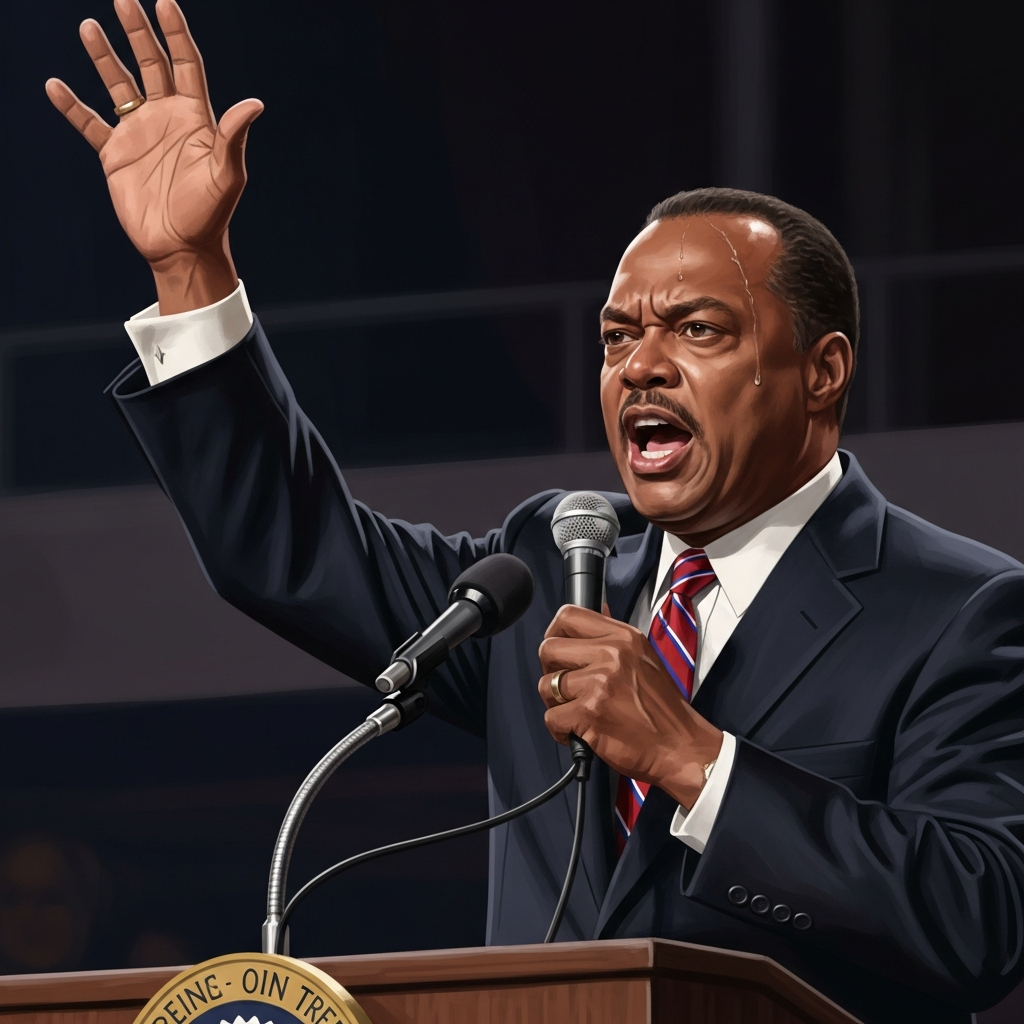
The world mourns the passing of Reverend Jesse Louis Jackson Sr., a transformative civil rights leader, charismatic preacher, and groundbreaking presidential candidate, who died on Tuesday at the age of 84. His family confirmed his peaceful passing, surrounded by loved ones. Reverend Jackson leaves an indelible mark on American history, having championed justice, equality, and human dignity for over six decades.
Diagnosed with Parkinson’s disease in 2015, his condition was later revised in April 2025 to progressive supranuclear palsy (PSP). This neurological disorder significantly impacted his movement and overall health in his later years. Despite these challenges, his unwavering commitment to social change never faded. His life story is a testament to the power of perseverance and the enduring fight for a more just society.
A Legacy Forged in the Civil Rights Movement
Born in 1941 in Greenville, South Carolina, Jesse Jackson grew up under the harsh realities of segregation. This early environment fueled his passion for activism. His first direct act of civil disobedience occurred in 1960 when, denied access to a white-only public library in Greenville, he led a sit-in that resulted in his arrest. This pivotal experience propelled him deeper into the burgeoning civil rights movement.
Jackson quickly distinguished himself with his powerful oratory and natural leadership. He joined Dr. Martin Luther King Jr.’s Southern Christian Leadership Conference (SCLC), becoming a vital figure in the organization. Notably, he was present with King in Memphis, Tennessee, in April 1968, when the civil rights icon was tragically assassinated. This moment forever shaped Jackson’s path, intensifying his resolve to continue the struggle for racial and economic justice.
From Operation Breadbasket to the Rainbow PUSH Coalition
Following King’s assassination, Jesse Jackson stepped into a prominent leadership role. He headed the SCLC’s Operation Breadbasket in Chicago, an initiative focused on securing economic gains for Black communities. Through strategic boycotts and negotiations, Operation Breadbasket successfully pressured businesses to invest in minority communities and hire Black workers. A notable early success included a boycott of Country Delight dairy, which quickly led to 44 new jobs for Black workers.
In 1971, Jackson founded his own organization, initially called Operation PUSH (People United to Serve Humanity), which later evolved into the Rainbow PUSH Coalition. This powerful non-profit became his primary vehicle for advocating for civil rights and economic justice globally. A hallmark of his advocacy was the empowering “I Am Somebody” recitation, a call-and-response chant designed to instill self-worth and pride in marginalized communities. The Rainbow PUSH Coalition continued to be a significant force, driving voter registration, advocating for fair wages, and pushing for corporate accountability.
The Historic Presidential Campaigns and the “Rainbow Coalition”
Jesse Jackson broke significant barriers in American politics with his two historic bids for the Democratic presidential nomination. In 1984, he launched his first campaign under the theme “Our Time Has Come,” capturing approximately 3.5 million votes in the primaries. His 1988 campaign, fueled by the slogan “Keep Hope Alive,” garnered even greater support, securing 7 million votes and finishing second to Michael Dukakis. These campaigns were groundbreaking. They energized and registered millions of Black voters nationwide, fundamentally shifting the political landscape.
Jackson’s vision extended beyond traditional racial lines. He passionately articulated the concept of a “Rainbow Coalition” – a broad alliance of diverse ethnic, religious, and socioeconomic groups. He envisioned a movement that transcended racial battlegrounds to achieve economic common ground and moral higher ground for all Americans. His powerful speeches, especially his tear-inducing address at the 1988 Democratic National Convention, resonated deeply, inspiring a generation to believe in the possibility of a more inclusive and equitable society.
A Global Advocate and Diplomatic Trailblazer
Jesse Jackson’s influence reached far beyond domestic activism. He emerged as an astute international diplomat, undertaking several high-profile missions. In 1983, he successfully negotiated the release of a U.S. pilot held captive in Syria. His diplomatic efforts also secured the freedom of 22 Americans and 26 political prisoners in Cuba. These actions underscored his global commitment to human rights and his capacity for impactful international advocacy. Even in his later years, his dedication remained steadfast. In 2021, he was arrested twice while protesting against the U.S. Senate’s filibuster rule, continuing his fight for voting rights and democratic engagement.
Jackson was also a vocal and unwavering supporter of marriage equality and the LGBTQ+ community, even during times when such stances were neither easy nor popular. The Human Rights Campaign (HRC) lauded his commitment, highlighting his belief that “our liberation is bound together.” He publicly declared, “Marriage is based on love and commitment – not on sexual orientation. I support the right for any person to marry the person of their choosing,” demonstrating his expansive view of human rights.
Enduring Influence and a Complex Legacy
Tributes have poured in from across the political spectrum, underscoring Jesse Jackson’s profound impact. Former President Barack Obama hailed him as a “true giant,” crediting Jackson’s presidential campaigns for laying the foundation for his own path to the highest office. Obama noted that his wife, Michelle, gained her first exposure to political organizing at the Jacksons’ kitchen table. Former President Donald Trump remembered him as “a good man” with “lots of personality, grit, and ‘street smarts’.” Former President Bill Clinton and Hillary Clinton recognized him as a friend who “championed human dignity.” Civil rights leaders like Reverend Al Sharpton described him as a “consequential and transformative leader” who instilled a belief in self-worth, famously telling people, “He told us we were somebody and made us believe.”
Jackson’s legacy, while celebrated, also carries complexities. His dramatic accounts of being with Dr. King at the time of his assassination, and his subsequent wearing of a blood-stained turtleneck, generated resentment and controversy among some King family members and movement leaders, who questioned his veracity. Administrative improprieties within SCLC led to his suspension in 1971, prompting his resignation and the formation of PUSH. His campaigns to pressure corporations, while effective, were sometimes labeled “shakedowns” by critics, even as figures like Burger King president Jeffrey Campbell acknowledged being swayed by Jackson’s arguments for economic fairness.
Despite these nuances, his indelible impact on empowering Black leaders and uniting diverse communities remains undisputed. His vision and activism inspired countless individuals and shaped the course of American political and social history.
Frequently Asked Questions
What was the Rainbow PUSH Coalition, and what were its primary goals?
The Rainbow PUSH Coalition is a non-profit organization founded by Rev. Jesse Jackson. Initially established as Operation PUSH (People United to Serve Humanity) in 1971, it later evolved into its current form. Its primary goals include advocating for social justice, civil rights, and economic empowerment for marginalized communities. The coalition focuses on issues such as voter registration, education, fair wages, corporate accountability, and promoting human rights on both domestic and international fronts, continuing Jesse Jackson’s legacy of fighting for equality and dignity.
How did Jesse Jackson’s early activism influence other civil rights movements, such as the Nashville sit-ins?
Jesse Jackson’s early activism, particularly his arrest during a sit-in at a segregated library in Greenville, South Carolina, in 1960, served as a direct inspiration for other civil rights movements. Notably, it impacted the Nashville Student Movement’s local sit-in campaign. Students from Nashville’s Historically Black Colleges and Universities, guided by James Lawson, observed these non-violent protests. Days after Jackson’s protest, over 120 Nashville students initiated their own large-scale sit-ins at local lunch counters, which ultimately led to desegregation in the city. Jackson himself engaged directly with Nashville, visiting multiple times to rally support and discuss critical issues.
What lasting impact did Jesse Jackson’s presidential campaigns have on American politics and future leaders?
Jesse Jackson’s historic presidential campaigns in 1984 and 1988 had a profound and lasting impact on American politics. They significantly energized and registered millions of Black voters, demonstrating the power of the Black electorate and demanding greater inclusion in the political process. His campaigns also introduced the concept of the “Rainbow Coalition,” advocating for a broad, diverse alliance of marginalized groups, which influenced future progressive movements. Former President Barack Obama notably stated that Jackson’s campaigns “laid the foundation” for his own path to the presidency, empowering generations of Black leaders to envision themselves in roles previously considered inaccessible and fundamentally transforming the landscape of American political ambition.
A Life of Unwavering Commitment
Jesse Louis Jackson Sr. is survived by his devoted wife, Jacqueline, and their six children, including former U.S. congressman Jesse Jackson Jr. His family, in a statement, honored him as a “servant leader” who tirelessly championed the oppressed, the voiceless, and the overlooked across the globe. They urged others to continue fighting for the values of justice, equality, and love that defined his extraordinary life. His journey from a segregated town in South Carolina to the international stage is a powerful testament to his unwavering commitment. As the nation reflects on his passing, his lifelong call to “keep our eyes on the prize” continues to resonate, inspiring future generations to strive for a truly just and equitable world.