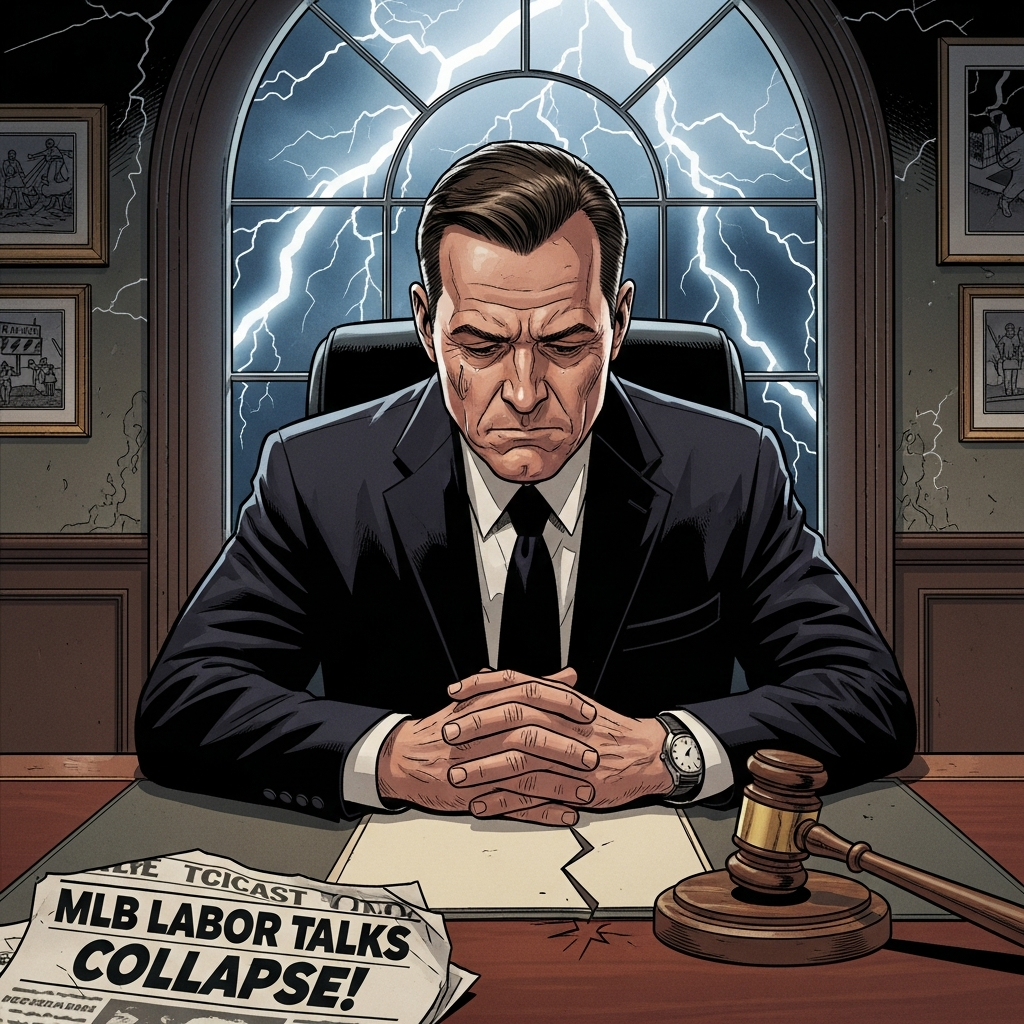
Major League Baseball finds itself on the brink of a profound leadership crisis. Tony Clark, the long-standing executive director of the Major League Baseball Players Association (MLBPA), abruptly resigned in February 2026. This stunning departure sends shockwaves through the baseball world. It leaves the powerful player union without a clear leader just months before what promises to be an intensely contentious collective bargaining agreement (CBA) negotiation. The unforeseen exit stems from a swirling controversy involving personal conduct and serious financial investigations. This situation creates unprecedented challenges for players as they prepare for a potential “bloodbath” labor dispute.
The Shockwave: Clark’s Abrupt Departure
Tony Clark’s resignation on Tuesday, February 17, 2026, after 12 years at the helm, caught many by surprise. He was the first former Major League player to ever lead the MLBPA. This unexpected news immediately plunged the union into uncertainty. It shattered the stability it had maintained since Clark took over following the death of Michael Weiner in 2013.
A Decade of Leadership Ends Abruptly
Clark’s tenure, marked by both highs and lows, ended on a notably sour note. His annual spring training tour, scheduled to begin that very Tuesday at the Cleveland Guardians’ facility in Goodyear, Arizona, was abruptly canceled. Media members who expected to interview him found themselves without answers. This sudden vacuum in MLBPA leadership has left player representatives and the rank-and-file frustrated, feeling abandoned at a critical juncture. The union needed his presence and strategic vision more than ever as the December 1 deadline for the current CBA rapidly approaches.
Behind the Resignation: A Web of Investigations
The initial reports of Clark’s departure quickly escalated into a full-blown scandal. ESPN’s Jeff Passan later revealed the shocking reasons behind his exit. An internal union investigation uncovered an “inappropriate relationship” between Clark and his sister-in-law. She had been an MLBPA employee since 2023. This serious breach of conduct forced his hand.
Unpacking the Financial Allegations
Adding to the gravity of the situation, Clark was reportedly embroiled in two separate, ongoing financial investigations concerning the MLBPA. These probes cast a shadow over his management and raised questions about potential self-enrichment and misuse of union funds:
Players Way Investigation: This federal inquiry centered on a youth baseball organization partially owned by the MLBPA. Reports from 2025 indicated that Players Way received over $3 million in union funding across five years. However, it allegedly failed to organize a commensurate number of events. Accusations of misappropriation, self-dealing, and nepotism arose, with claims that the money enriched Clark directly or rewarded his inner circle as “consultants.” As of Tuesday morning, Players Way’s online presence was virtually defunct, raising further red flags.
OneTeam Partners Scrutiny: The second financial investigation involved OneTeam Partners, a sports-licensing company co-owned by the MLBPA, NFLPA, and other unions. Allegations focused on improper self-enrichment by Clark through equity in this venture.
These financial impropriety claims had circulated for some time. Marcus Semien, a Mets second baseman and executive subcommittee member, expressed he wasn’t surprised by Tony Clark’s resignation given these existing investigations.
A Union in Turmoil: Leadership Vacuum Before Crucial Talks
Clark’s exit leaves the MLBPA in an extremely precarious position. The current Collective Bargaining Agreement (CBA) expires on December 1, 2026. Negotiations are anticipated to be among the most contentious in recent memory. A lockout by team owners is widely expected. Predictions suggest these CBA negotiations could extend well into 2027, potentially resulting in missed games.
Player Reactions and Union Resilience
Union officials held an urgent call with the eight-player executive subcommittee and all 30 team representatives on Tuesday afternoon. While no interim executive director was immediately voted upon, a decision was expected swiftly. Despite the upheaval, some players voiced confidence in the union’s fundamental strength. Detroit Tigers ace Tarik Skubal, also on the executive subcommittee, affirmed, “It doesn’t really change the state of the union. I think we’re still as strong as ever.” He emphasized that the union’s effectiveness ultimately rests with its members. However, many players expressed frustration about the timing and manner of Clark’s sudden departure.
The Looming CBA Battleground
The upcoming CBA negotiations promised to be difficult even before Clark’s resignation. A major flashpoint will be the growing payroll disparity across MLB. The Los Angeles Dodgers’ 2026 luxury tax payroll, for example, is projected to eclipse $500 million. Meanwhile, teams like the Miami Marlins remain under $80 million in total payroll. This imbalance fuels calls from owners and the league for a salary cap.
Salary Cap: The Ultimate Showdown
A salary cap, common in other major sports leagues, has long been a non-negotiable “line in the sand” for the MLBPA. Clark was expected to fiercely defend this stance. His past handling of the 2022 CBA negotiations, which some players criticized for conceding too much ground, had already made him a polarizing figure. Now, the union faces this critical battle without its established leader. The absence of a strong, unified voice at the top could significantly impact their bargaining leverage against a determined ownership group.
The Search for a New Leader
With CBA negotiations approaching rapidly, a comprehensive search for a new executive director is highly improbable. The union needs stability and direction immediately. This urgency points towards the likely appointment of an interim leader.
Who Steps Up to the Plate?
Several names have emerged as potential interim options:
Bruce Meyer: The deputy executive director and chief negotiator has a litigation background. He successfully spearheaded the last round of negotiations. However, in 2024, a contingent of players reportedly sought his removal, favoring Harry Marino, who successfully unionized minor leaguers.
Kevin Slowey: The union’s managing director of player services is a former MLB pitcher. His reputation in clubhouses is generally better than Meyer’s, due to his player background and increasing front-facing role within the MLBPA.
Angels reliever Brent Suter, an executive subcommittee member, hinted he had an inkling of who might take the reins. Whichever candidate steps into this role faces an immense challenge. They must address the union’s internal issues, unify the players, and quickly prepare for what could be the most contentious labor dispute in decades.
Impact on the Future of MLB Labor Peace
Tony Clark’s resignation could not have come at a worse time. The MLBPA leadership crisis significantly complicates the path to labor peace. A lockout appears almost inevitable, risking missed games and a protracted dispute that could harm the sport. While the union remains ideologically unified in its core principles, the lack of established leadership creates immediate tactical and morale challenges. Player frustration over Clark’s exit adds another layer of complexity. The next leader must navigate not only external pressures from owners but also internal divisions and mistrust fueled by the recent controversies. This entire situation is a stark reminder that effective, trustworthy leadership is paramount for any organization, especially one as powerful and consequential as the MLBPA.
Frequently Asked Questions
Why did Tony Clark resign from the MLBPA?
Tony Clark resigned as MLBPA Executive Director following an internal union investigation. This probe uncovered an “inappropriate relationship” between Clark and his sister-in-law, who was also an MLBPA employee since 2023. Additionally, his departure coincided with ongoing federal investigations into alleged financial improprieties within the union. These included claims of self-dealing and misuse of funds related to “Players Way,” a youth baseball organization, and alleged improper enrichment through equity in OneTeam Partners, a sports-licensing company partially owned by the MLBPA.
How will Tony Clark’s resignation affect upcoming MLB CBA negotiations?
Tony Clark’s resignation leaves the MLBPA in a critical leadership vacuum just months before the current Collective Bargaining Agreement (CBA) expires on December 1, 2026. This greatly complicates the union’s position in what are already anticipated to be contentious negotiations. Without an established leader, the union faces challenges in maintaining unity, developing a cohesive bargaining strategy, and leveraging player interests against owners who are expected to push aggressively for a salary cap. The situation increases the likelihood of a protracted lockout extending into the 2027 season and potentially leading to missed games.
Who are the potential candidates to lead the MLBPA in the interim?
With CBA negotiations rapidly approaching, the MLBPA is likely to appoint an interim leader rather than conduct a full job search. Two main candidates have emerged from internal discussions: Bruce Meyer, the current deputy executive director and chief negotiator, known for his litigation background and role in previous negotiations; and Kevin Slowey, the union’s managing director of player services, a former MLB player who generally holds a better reputation within clubhouses. The choice will be crucial for guiding the union through this turbulent period.