A startling accusation from the United States government claims China conducted a secret underground nuclear weapons test in 2020. This contested assertion has ignited global debate. It also fuels a controversial push by Washington to potentially resume its own nuclear testing. The allegations emerged during a period of escalating geopolitical tensions. They come amidst a vacuum in international arms control agreements.
The implications are profound. They challenge long-standing global norms against nuclear detonations. This article delves into the US claims, independent expert assessments, and the broader context of nuclear arms control. It explores what this could mean for international stability.
The Allegation: US Points to a Secret 2020 Test
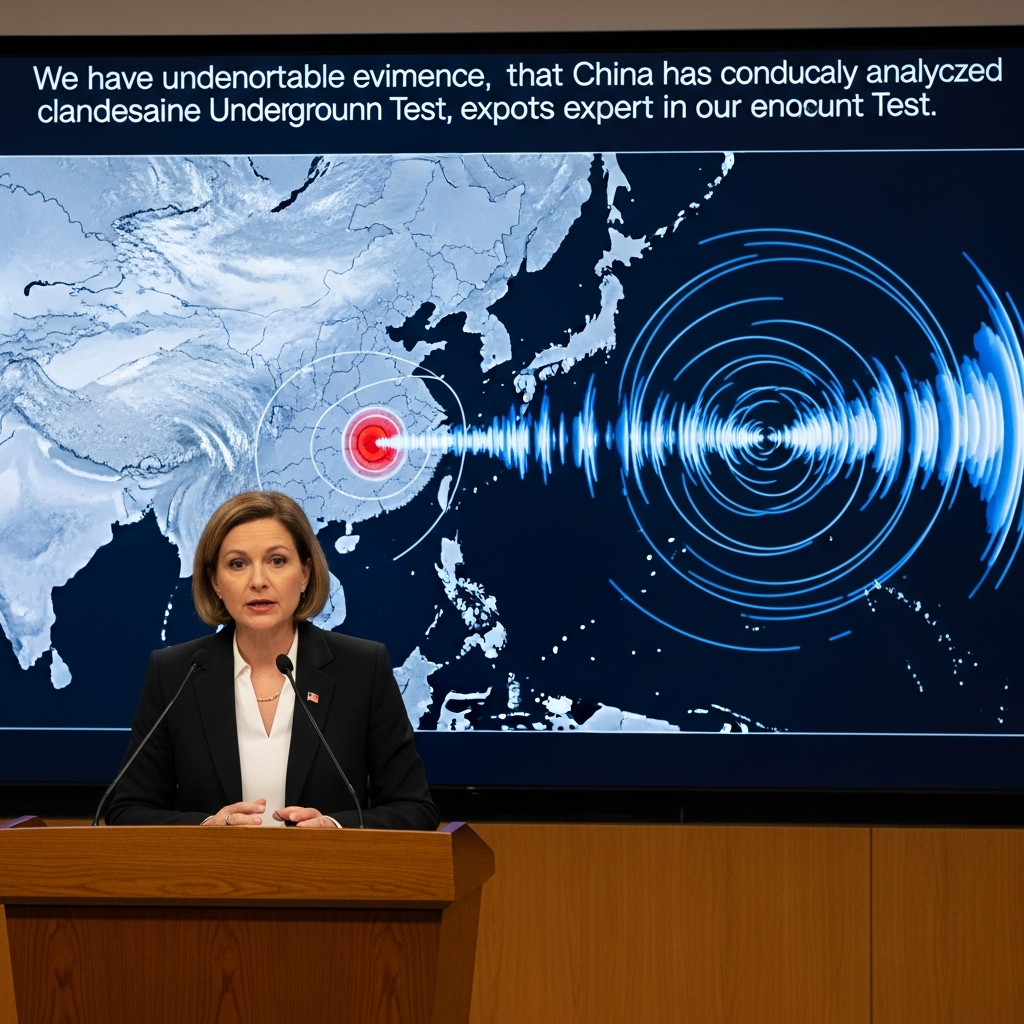
The Trump administration first publicly accused China of conducting an undeclared nuclear test in 2020. This claim has now been buttressed with specific details. Assistant Secretary of State for Arms Control and Nonproliferation Christopher Yeaw disclosed new information. He stated that the US detected a “singular explosion” on June 22, 2020. This seismic event registered a magnitude of 2.75. It occurred near China’s main nuclear test site, Lop Nur.
Yeaw emphasized the low probability of a natural cause. He suggested the event was “very little possibility that it is anything other than an explosion, a singular explosion.” Undersecretary of State Thomas DiNanno had initially made similar accusations. DiNanno suggested China was preparing for tests yielding “hundreds of tons.” US officials further alleged China employed “decoupling” operations. This technique aims to conceal an explosion’s true magnitude. Nations typically undertake such risky operations only for “significant gain,” Yeaw noted. The US maintains it will return to testing on an “equal basis” if China continues “opaque” nuclear activities. This implies a tit-for-tat approach to perceived escalations.
Why the US is Concerned About China’s Nuclear Activities
The US claims emerge against a backdrop of increasing concern over China’s nuclear program. Beijing is rapidly expanding its nuclear arsenal. Pentagon estimates show China’s warhead count surging. It grew from around 200 in 2019 to nearly 600 today. The goal is reportedly 1,000 by 2030. This expansion aims for parity with the US and Russia. Satellite imagery reveals significant activity at Lop Nur. New tunnels and personnel housing suggest China is heavily investing in the site. Experts like Tong Zhao of the Carnegie Endowment take the US claims seriously. He finds them consistent with Lop Nur’s active status. China also has significantly less nuclear test data compared to the US. This could motivate testing for lower-yield weapons or new hypersonic designs.
Independent Scrutiny: A Lack of Conclusive Evidence
Despite the strong US assertions, independent experts and international monitoring bodies remain cautious. Many have found no conclusive evidence to support the claims. Robert Floyd, Executive Secretary of the Comprehensive Nuclear-Test-Ban Treaty Organization (CTBTO), issued a direct statement. He confirmed the CTBTO’s monitoring system “did not detect any event consistent with the characteristics of a nuclear weapon test explosion” at the time. This assessment has remained unchanged after detailed analyses.
Ben Dando, head of seismology at NORSAR, a Norwegian monitoring organization, also weighed in. He confirmed seismic wave ratios were consistent with an explosion. However, he highlighted the signal’s weakness and its recording at a single station. This makes a natural event a possibility. Dando concluded there isn’t “strong conclusive evidence” to confirm or deny a nuclear test. The CTBTO detected “two very small seismic events, 12 seconds apart.” Yet, they stated it was “not possible to assess the cause of these events with confidence” with the available data. China’s Foreign Ministry has “forcefully denied” the allegations. Spokesperson Lin Jian labeled them “completely groundless.” He accused the US of fabricating pretexts to resume its own nuclear tests. China’s ambassador on nuclear disarmament, Shen Jian, reaffirmed Beijing’s commitment to its moratorium on nuclear testing.
Understanding “Decoupling” and Test Detection
The US claims China used “decoupling.” This technique involves conducting an explosion in a large, empty cavity. The goal is to absorb much of the blast’s energy. This makes the explosion appear significantly smaller seismically. While effective for small explosions, global monitoring systems are highly sophisticated. They make a full-scale, undetected nuclear test highly improbable, even with decoupling. The definition of an “explosive test” itself is crucial. The Comprehensive Nuclear-Test-Ban Treaty (CTBT) doesn’t explicitly define “explosion.” This could create a “gray area” for very small nuclear chain reactions. However, major powers generally adhere to a voluntary moratorium on any yield-producing tests.
Geopolitical Chessboard: Arms Control in a New Era
These accusations surface at a critical juncture for global arms control. The New Strategic Arms Reduction Treaty (New START) expired on February 5. This was the world’s last binding nuclear arms control agreement. Former US President Donald Trump reportedly refused Moscow’s offer to extend it. He argued for a “better agreement” that includes China. Beijing has shown little interest in joining such trilateral talks.
Both the US and China have signed the CTBT, which prohibits nuclear testing. However, neither nation has ratified it. This means the treaty is not officially in force for them. The US last conducted a full-scale nuclear test in 1992. China’s last test was in 1996. While full-scale detonations have ceased, work on nuclear weapons continues. The US maintains its arsenal through supercomputer simulations and “sub-critical” experiments. These explode small amounts of plutonium without triggering a chain reaction. China and Russia are believed to have similar programs. The US concerns extend beyond the 2020 allegation. They include China’s alleged plans for tests in the “hundreds of tons” yield range. These could be for “one-point safety” to prevent accidental detonations. Or, more ominously, for developing new weapons for advanced systems like hypersonic missiles.
The US allegations are also set against a context of historical skepticism towards some claims from the previous administration. The initial reader comments on the original article show widespread distrust. This highlights the importance of rigorous verification and independent assessments.
The Stakes: A Dangerous Path Towards a New Nuclear Arms Race
The alleged Chinese test and the US response signal a potential unraveling of global norms against nuclear testing. Arms control experts express grave concern. Jeffrey Lewis, an arms control expert, warns of a dangerous “snowball effect.” A resumption of testing could lead to bigger tests, more numerous nuclear weapons, and a new Cold War era.
The US Pentagon is reportedly considering options to add more nuclear weapons to America’s missiles, bombers, and submarines. This reflects a strategic shift towards matching perceived advancements by rivals. The absence of a robust arms control framework, coupled with these serious accusations, creates a highly unstable environment. The world faces the prospect of a new, unregulated nuclear arms race. This elevates the risk of miscalculation and conflict. Transparency and renewed diplomatic efforts are critically needed to prevent such an outcome.
Frequently Asked Questions
What are the key allegations made by the US regarding China’s alleged secret nuclear test?
The US government, primarily through Assistant Secretary of State Christopher Yeaw and Undersecretary of State Thomas DiNanno, alleges that China conducted a “yield-producing” nuclear explosion on June 22, 2020. This seismic event, measuring magnitude 2.75, occurred near China’s Lop Nur nuclear test site. The US claims China used “decoupling” to conceal the test’s true magnitude and that such risks are taken only for “significant gain,” indicating a deliberate and concealed nuclear explosive test. These claims also form the basis for US consideration of resuming its own nuclear testing.
How do international monitoring bodies like the CTBTO and NORSAR respond to these US claims?
Both the Comprehensive Nuclear-Test-Ban Treaty Organization (CTBTO) and NORSAR, a Norwegian monitoring organization, have expressed caution and found no conclusive evidence to support the US allegations. The CTBTO stated its monitoring system “did not detect any event consistent with the characteristics of a nuclear weapon test explosion” at the alleged time. NORSAR confirmed seismic waves consistent with an explosion but noted the signal was weak, recorded at a single station, and could have been a natural event, concluding there isn’t “strong conclusive evidence” to confirm a nuclear test.
What are the broader implications of these accusations for global nuclear arms control?
These accusations carry significant implications for global nuclear arms control. They arise after the expiration of the New START treaty, leaving a vacuum in arms control agreements. The US claims, coupled with China’s rapid expansion of its nuclear arsenal, threaten to unravel long-standing global norms against nuclear testing. Experts warn of a potential “snowball effect,” leading to a new nuclear arms race reminiscent of the Cold War, increasing global instability and the risk of miscalculation. The situation underscores an urgent need for renewed diplomatic engagement and transparency.
The ongoing controversy surrounding China’s alleged secret nuclear test highlights a critical moment in international security. The convergence of a rapidly expanding Chinese nuclear arsenal, the expiration of key arms control treaties, and the US’s strong accusations creates a precarious environment. While conclusive independent evidence remains elusive, the mere existence of these allegations escalates tensions and threatens to dismantle decades of efforts to prevent nuclear proliferation. Moving forward, global stability hinges on transparent dialogue, verifiable evidence, and a renewed commitment to preventing a dangerous nuclear arms race.