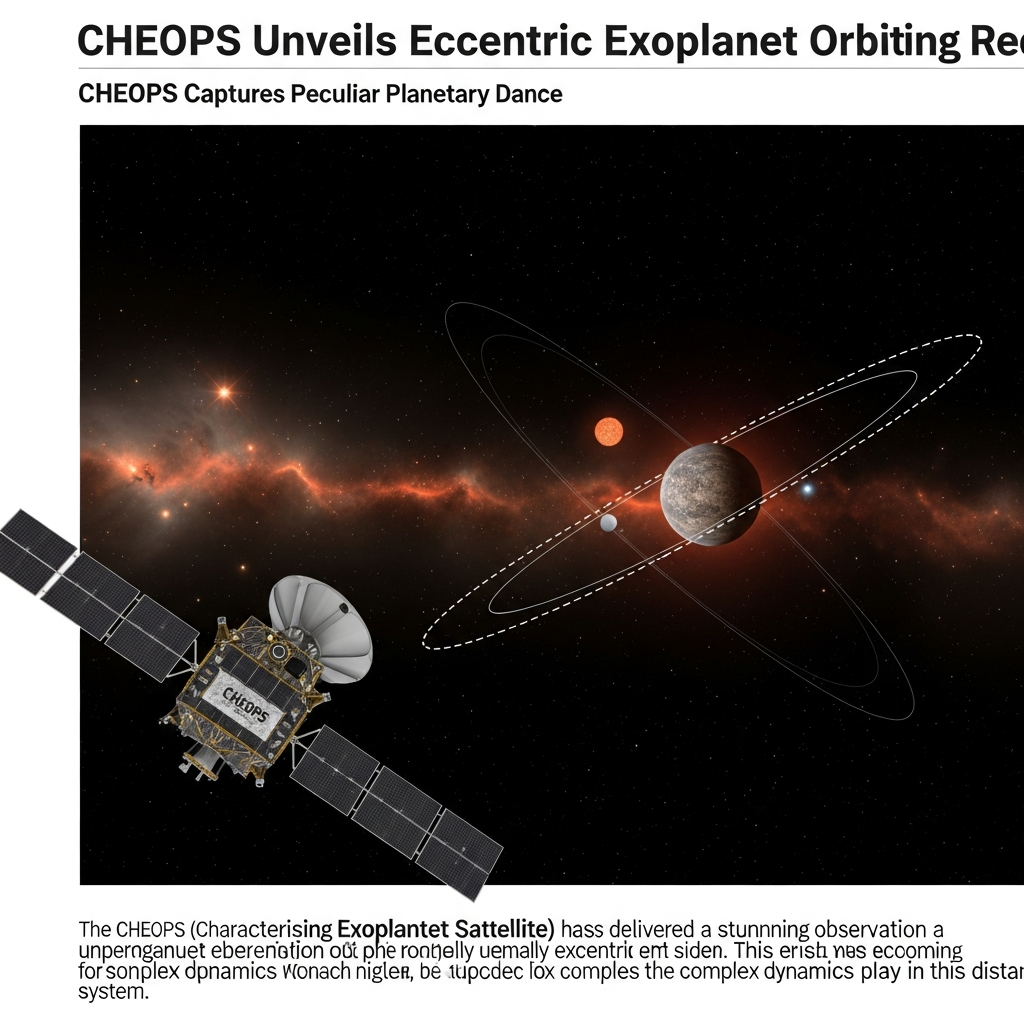
The universe continues to unveil its mysteries, constantly pushing the boundaries of our scientific understanding. A groundbreaking discovery by the European Space Agency’s CHaracterising ExOPlanet Satellite (CHEOPS) is doing just that, revealing a rocky exoplanet in an unexpected location. This distant world, part of a four-planet system, is defying long-held theories about how planets form and evolve.
Astronomers have identified an unusual celestial arrangement around the nearby red dwarf star LHS 1903. Its outermost planet, instead of being a gas giant as conventional wisdom would suggest, is a small, dense rocky exoplanet. This startling finding offers the strongest observational hint yet that planets can emerge even in gas-poor conditions, a scenario previously considered impossible. It dramatically reshapes our understanding of planetary birth across the cosmos.
The Cosmic Anomaly: A Rocky World Where Giants Should Be
The LHS 1903 system presents an “inside-out” configuration that has left astronomers puzzled and excited. Located 116.3 light-years away in the constellation of Lynx, the host star LHS 1903 (also known as TOI-1730 or G 107-55) is a small M-dwarf. It’s significantly cooler and less luminous than our Sun. This stellar neighborhood is home to a unique planetary family.
LHS 1903: A Closer Look at a Red Dwarf System
The innermost world, LHS 1903b, is a rocky planet orbiting close to its star. This aligns with our general expectations. Following it are two gas giants, LHS 1903c and LHS 1903d, a common pattern observed in many star systems. However, the surprise comes with the fourth and outermost planet, LHS 1903e. Data from the CHEOPS spacecraft, analyzed by University of Warwick astronomers like Thomas Wilson, clearly showed LHS 1903e to be a rocky world. This is precisely where a gas giant would typically be found.
Dr. Wilson highlighted the anomaly, stating, “That makes this an inside-out system, with a planet order of rocky-gaseous-gaseous-and then rocky again.” He further emphasized, “Rocky planets don’t usually form so far away from their home star.” This arrangement directly contradicts prevailing planet formation theories, prompting a significant re-evaluation among the scientific community.
Unraveling the Mystery: Why LHS 1903e Defies Expectations
Current astrophysical models paint a relatively clear picture of planet formation. Closer to a star, intense stellar radiation sweeps away lighter elements, leaving behind dense, solid cores that become rocky planets. Farther out, in cooler regions of the protoplanetary disk, gas can accumulate more easily. Developing planets in these outer zones can then accrete and retain vast gaseous atmospheres, evolving into the gas giants we observe.
The Conventional Wisdom of Planet Formation
The presence of a rocky exoplanet at the periphery of the LHS 1903 system, where cooler temperatures should favor the accumulation of gas, challenges this established narrative. LHS 1903e appears to have either failed to form a gaseous atmosphere or lost it entirely, defying the expected pattern. This remarkable finding underscores how much we still have to learn about the intricate processes governing planetary birth and evolution. Dr. Maximilian Günther, an ESA astronomer and CHEOPS project scientist, commented on the importance of such discoveries. He noted that finding clues like this is precisely what CHEOPS was designed to do, solving fundamental puzzles in astronomy.
The research team thoroughly explored various explanations for LHS 1903e’s unusual nature. They considered dramatic scenarios such as a giant impact from an asteroid or comet, which could have stripped away a previously formed gaseous atmosphere. Another possibility involved planet migration or orbital swapping, where planets might have exchanged positions during the system’s turbulent early history. After rigorous simulations and careful calculations of the planets’ orbital times, the scientists systematically ruled out these intriguing hypotheses.
A New Blueprint for Planetary Birth: Gas-Depleted Environments
The investigation instead pointed to an even more profound explanation: the planets within the LHS 1903 system may not have formed simultaneously. Rather, they could have emerged sequentially, one after another. This sequential formation model introduces a critical element: time.
Dr. Wilson elaborated on this breakthrough, suggesting, “By the time this outer planet formed, the system may have already run out of gas, which is considered vital for planet formation. Yet here is a small, rocky world, defying expectations.” This indicates that LHS 1903e formed in what astronomers call a “gas-depleted environment.” This groundbreaking observation provides the first concrete evidence that such a process is possible, opening up entirely new avenues for understanding planetary development.
This novel hypothesis suggests that the scarcity of gas, rather than its abundance, played a pivotal role in shaping LHS 1903e. It means that the universe might be far more capable of producing diverse planetary types in unexpected locations than previously thought. This significantly expands the cosmic real estate where we might eventually discover rocky worlds, even if they aren’t necessarily habitable.
Beyond LHS 1903e: Redrawing the Exoplanet Map
The discovery of LHS 1903e is not an isolated curiosity. It joins a growing catalog of exoplanet discoveries that continually reshape our understanding of the universe. From Earth-sized worlds like HD 137010b orbiting K-dwarf stars, to the intriguing super-Earth candidate Gliese 251c in a nearby habitable zone, each new finding adds a crucial piece to the cosmic puzzle. These discoveries highlight the incredible diversity of planetary systems, demonstrating that our own solar system may be just one of countless configurations.
The Ever-Evolving Narrative of Exoplanet Discoveries
The ongoing search for exoplanets, including the fascinating study of free-floating planets that wander the galaxy without a host star, reinforces the idea that planet formation is far more complex and varied than initially theorized. Even the study of exomoon-forming disks, like the carbon-rich disk around gas giant CT Cha b observed by the James Webb Space Telescope, provides critical insights into the chemical and physical processes at play during early system formation. These diverse observations collectively paint a picture of a universe where planetary formation can proceed down many different, and often surprising, paths. The finding of this rocky exoplanet further strengthens this narrative.
Understanding how planets form in a “gas-depleted environment” could also have implications for the prevalence of rocky planets in different regions of the galaxy. It suggests that even in areas where gas might be less abundant or dissipates quickly, rocky worlds could still emerge, contributing to the overall abundance of potential sites for future exploration.
The Crucial Role of CHEOPS in Exoplanet Hunting
The success of this discovery underscores the vital role of dedicated space missions like the CHEOPS satellite. Launched by ESA, CHEOPS specializes in ultra-precise measurements of exoplanet sizes and densities by observing transits — the slight dip in a star’s brightness as a planet passes in front of it. This mission is crucial for characterizing known exoplanets and revealing subtle details about their systems.
By providing highly accurate data, CHEOPS enables astronomers to determine whether a planet is rocky or gaseous, even if it’s far from its star. This precision was instrumental in confirming the rocky nature of LHS 1903e, a detail that was key to overturning existing theoretical assumptions. Such targeted missions are essential for pushing the frontiers of exoplanet research, offering the high-quality data necessary to test and refine our models of planetary formation and evolution.
Frequently Asked Questions
What makes the rocky exoplanet LHS 1903e so unusual?
The rocky exoplanet LHS 1903e is unusual because it orbits an M-dwarf star, LHS 1903, as the outermost planet in a four-planet system. Conventional planet formation theories predict that rocky planets form closer to their host star, where stellar radiation strips away gas. Gas giants are expected to form farther out. However, LHS 1903e is a small, dense rocky world located where a gas giant would typically reside, directly challenging these long-established models. This “inside-out” arrangement is a significant anomaly.
How does the “gas-depleted environment” theory change our understanding of planet formation?
The “gas-depleted environment” theory suggests that planets can form even when the protoplanetary disk around a star has largely run out of the gas usually considered essential for planetary birth. In the case of LHS 1903e, astronomers hypothesize it formed sequentially, after the inner planets, by which time gas was scarce. This groundbreaking idea provides the first observational evidence for such a process, expanding our understanding of the diverse conditions under which rocky exoplanet worlds can emerge. It means planets might form in more varied cosmic settings than previously imagined.
What role does the CHEOPS satellite play in discovering exoplanets like LHS 1903e?
The CHEOPS (CHaracterising ExOPlanet Satellite) plays a crucial role by providing extremely precise measurements of exoplanet sizes and densities. It observes transiting exoplanets, detecting the subtle dips in starlight as planets pass in front of their host stars. This high-precision data allows astronomers to accurately determine a planet’s physical characteristics, such as whether it is a dense rocky world or a less dense gas giant. For LHS 1903e, CHEOPS’s data was instrumental in confirming its rocky nature, which was the key observation that defied conventional planet formation theories.
Conclusion
The discovery of LHS 1903e by the CHEOPS satellite marks a pivotal moment in our quest to understand the universe. This rocky exoplanet, defying established planet formation theories by emerging in a gas-depleted environment, compels scientists to rethink the very blueprints of planetary birth. It highlights the dynamic and often surprising nature of the cosmos. As telescopes like CHEOPS continue to probe the distant reaches of space, each new revelation adds a layer of complexity and wonder to the exoplanet narrative. This particular finding ensures that the coming years will be rich with further research, as astronomers strive to unravel the complete story of how planets, in all their diverse forms, truly come into existence. This new insight not only enriches our scientific knowledge but also fuels our imagination about the vast possibilities that lie beyond our solar system.