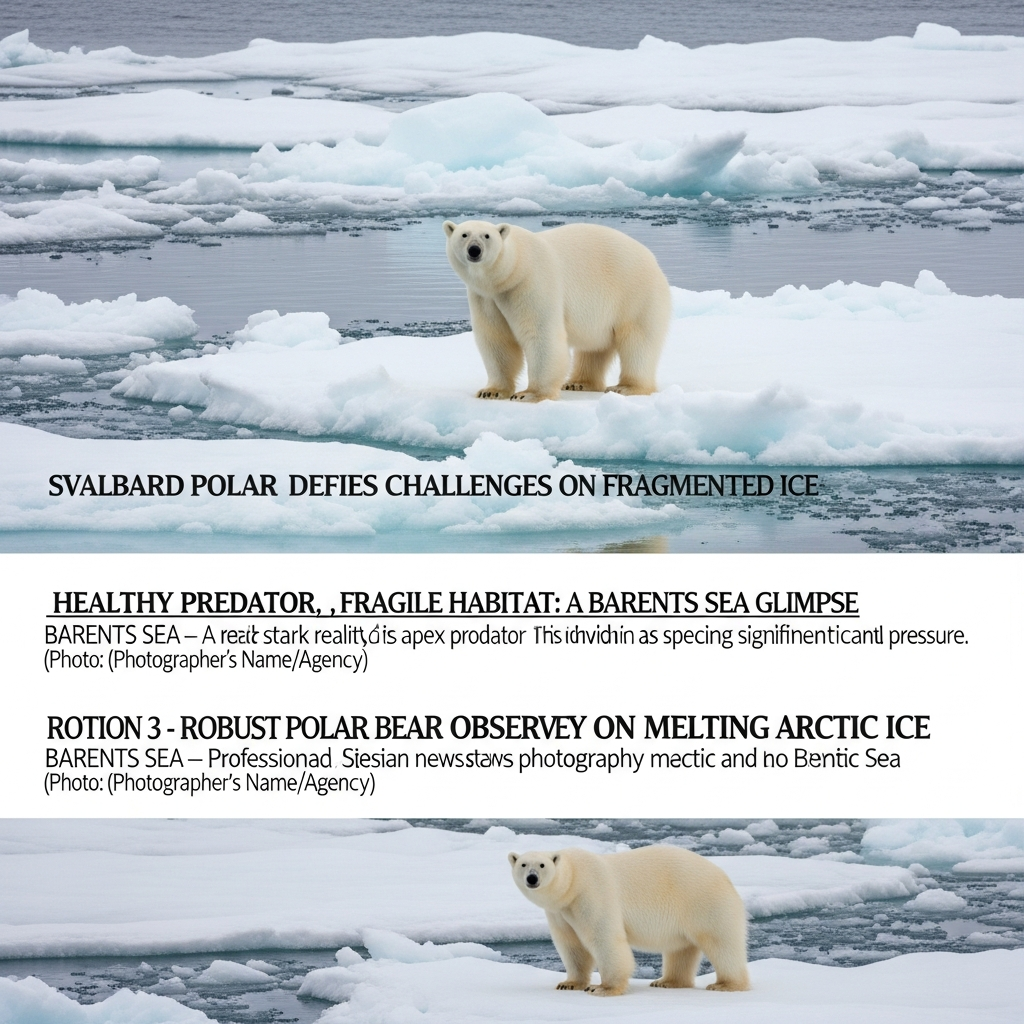
The image of a struggling polar bear on melting ice often symbolizes climate change. Yet, a groundbreaking study from Svalbard, Norway, reveals a surprising twist: adult Svalbard polar bears have actually improved their body condition over the past two decades. This unexpected resilience emerges despite the Barents Sea experiencing some of the fastest rates of sea ice loss in the Arctic. Scientists previously anticipated a decline in polar bear health here. This fascinating finding challenges conventional narratives and underscores the complex ways wildlife adapt, even as the Arctic warms at an alarming rate.
Unpacking the Paradox: Polar Bear Health vs. Melting Ice
From 1995 to 2019, the Barents Sea region around Svalbard faced extraordinary environmental shifts. Air temperatures here soared up to four times faster than the global average. The annual sea ice season shortened by over two months. This meant roughly 100 additional ice-free days. In most Arctic regions, such drastic changes spell trouble for polar bears. Their primary hunting platforms vanish, leading to thinner bears, reduced reproduction, and population declines.
However, the Svalbard polar bears showed a different trend. Researchers collected data from 770 adult bears, across 1,188 captures. They meticulously measured body length and girth to calculate a Body Condition Index (BCI). This index indicates fat reserves, vital for survival. Initially, BCI declined between 1995 and 2000. But then, it steadily increased for both male and female bears until 2019. This improvement happened even as the Arctic warming intensified. The study found no clear, direct link between warming, ice loss, and declining health in this unique area.
Beyond the Ice: Svalbard Bears’ Diverse Diet & Adaptations
So, what explains this remarkable resilience? The study points to a complex interplay of factors, primarily dietary shifts and ecosystem dynamics. Polar bears are typically specialist hunters of seals, which they catch from sea ice. With less ice, traditional hunting becomes harder. However, Svalbard polar bears appear to be adapting their diets.
Here’s how they are managing:
Alternative Marine Prey: While ringed seals are crucial, bears are increasingly preying on bearded seals, especially in summer. The “climate winner” harbour seal population is also expanding along the coast. Bears have been observed hunting these seals successfully.
Terrestrial & Scavenging Opportunities: When forced onto land by retreating ice, local bears are not simply starving. They exploit a variety of land-based food sources:
Reindeer: Svalbard reindeer populations have significantly increased. Bears are now successfully hunting these terrestrial mammals.
Walrus Carcasses: Walrus populations have recovered from historical over-exploitation. Their carcasses provide substantial, long-lasting food sources for bears.
Bird Colonies: Bears raid bird nests for eggs and feast on birds like common eider ducks and geese during summer.
Whale Carcasses: Stranded whale carcasses, common in Svalbard, can sustain bears for extended periods.
These varied food sources act as a “buffering” mechanism. They help offset the reduced access to traditional seal hunting grounds on the ice. The study also suggests that remaining sea ice might concentrate seals into smaller areas. This could make hunting more efficient when ice is present.
Intrinsic Factors: Age, Sex, and Reproductive Costs
The study also delved into how intrinsic factors influence polar bear body condition.
Reproductive State in Females: Unsurprisingly, female bears with cubs-of-the-year consistently showed the lowest BCI. Raising new cubs demands immense energy. Females with one-year-olds were in slightly better condition. Solitary females or those with two-year-olds (which are typically weaned) were the healthiest. This aligns with the high energetic cost of reproduction in large mammals.
Age-Related Trends: Male bears showed a steep increase in BCI up to about 12 years of age. They continue to invest in growth beyond adulthood. After approximately 20 years, a slight decline was noted. For females, the increase in BCI with age was less pronounced, plateauing around 10 years. Younger females generally remained leaner. This suggests different life history strategies between sexes.
Seasonal Fluctuations: Body condition generally declined from late March until mid-April for both sexes. Polar bears typically lose weight over winter due to low activity and food intake. However, condition improved towards late April/early May. This likely correlates with the growth of ringed seal pups. Born in early April, pups rapidly gain weight, becoming a more energetically valuable meal later in spring. Mating season (March-April) is also a factor, particularly for males. Fierce competition and extensive searching for females can be energetically costly.
Regional Differences: Why Svalbard Stands Apart
The Svalbard polar bears situation stands in stark contrast to several other populations. In regions like Western Hudson Bay and the Southern Beaufort Sea, rapid sea ice loss has led to clear negative effects on polar bear condition, growth, and demographics. However, Svalbard’s findings echo those from the Chukchi Sea. There, bears maintain good condition despite less sea ice. This is attributed to high biomass productivity, abundant seals, and a large continental shelf.
The unique combination of factors in Svalbard creates this distinction:
Prey Abundance and Diversity: The recovery of previously over-exploited species like walrus and reindeer, alongside expanding populations of harbor seals, offers a diverse pantry.
Ecosystem Structure: The Barents Sea still has a large area of shallow water over its continental shelf. This is crucial for prey concentration and hunting, similar to the Chukchi Sea.
Population Density: The Barents Sea polar bear population may still be below its ecological carrying capacity. This is due to historical hunting bans in 1973. A lower density might reduce competition for resources, allowing individual bears to thrive.
The spatial analysis also revealed interesting patterns. Bears in the south and east of Svalbard typically showed better body condition. These areas are more frequently used by “pelagic” bears, which follow the receding ice edge. Local bears in the northwest, an area with significant sea ice loss near glaciers, showed lower condition. However, even local bears further south along the west coast, despite severe warming and ice loss, appeared in good condition. This highlights the localized benefits of alternative prey.
The “Temporary Buffering” Effect: A Look Ahead
While the current findings offer a glimmer of hope, scientists emphasize that this resilience is likely temporary. This “short-term buffering” is due to specific, diverse prey types and ecological conditions unique to Svalbard. The Barents Sea is projected to experience the most significant sea ice loss in the coming decades. Eventually, a “threshold” will be reached. Beyond this point, the capacity for adaptation may be exhausted.
Experts like Jon Aars and Andrew Derocher caution against generalizing these findings. The fundamental reliance of Svalbard polar bears and all polar bears on sea ice for hunting remains. Continued Arctic warming will inevitably lead to negative impacts. This underscores the critical need for ongoing, long-term monitoring. Understanding how these bears cope as conditions worsen will be vital for future conservation efforts. Their surprising adaptability offers invaluable lessons, but it does not negate the overarching threat of climate change.
Frequently Asked Questions
How are Svalbard polar bears maintaining their body condition despite rapid sea ice loss?
Svalbard polar bears are adapting to rapid sea ice loss primarily through dietary shifts. They are supplementing their traditional seal diet by preying on increasing populations of bearded seals and “climate winner” harbor seals. Additionally, they exploit terrestrial food sources such as Svalbard reindeer, raid bird colonies for eggs and birds, and scavenge abundant walrus and whale carcasses. This diverse food strategy, combined with potentially concentrated prey in shrinking ice areas and a population density possibly below carrying capacity due to historical hunting bans, allows them to maintain fat reserves.
Where is the Barents Sea region and why is it significant for polar bear studies?
The Barents Sea region, including Svalbard, is located north of Norway and Russia in the Arctic Ocean. It’s particularly significant because it has experienced the fastest rate of sea ice loss in the Arctic—more than double that of other polar bear habitats—and some of the most rapid temperature increases globally. This makes it a crucial natural laboratory for studying how an apex predator like the polar bear responds to extreme climate change, offering unique insights that challenge assumptions derived from other, less dramatically impacted regions.
Should we change global polar bear conservation strategies based on Svalbard’s findings?
No, the Svalbard findings, while insightful, should not lead to a fundamental change in global polar bear conservation strategies. Experts strongly caution against extrapolating these localized results to all polar bear populations. The resilience observed in Svalbard is attributed to unique regional factors like diverse and recovering alternative prey populations, specific ecosystem structures, and potentially lower population density. While this study provides valuable data on adaptive capacity, the overarching scientific consensus remains that polar bears fundamentally depend on sea ice for survival, and its continued loss poses a severe long-term threat globally. Ongoing monitoring is crucial, but these findings do not negate the urgent need for climate action to protect polar bear habitats worldwide.
Conclusion: Vigilance in a Changing Arctic
The resilience of Svalbard polar bears is a testament to the incredible adaptability of wildlife. Their ability to diversify diets and thrive amidst extreme Arctic warming offers a nuanced perspective on climate change impacts. This study powerfully illustrates that ecological responses are complex and highly localized. However, this positive trend in polar bear health is not a license for complacency. The Barents Sea remains a frontline in the climate crisis. The long-term fate of these magnificent creatures still hinges on the trajectory of sea ice loss. Continuous monitoring and dedicated conservation efforts remain paramount. This ensures we understand and protect Svalbard polar bears and their Arctic home for generations to come.