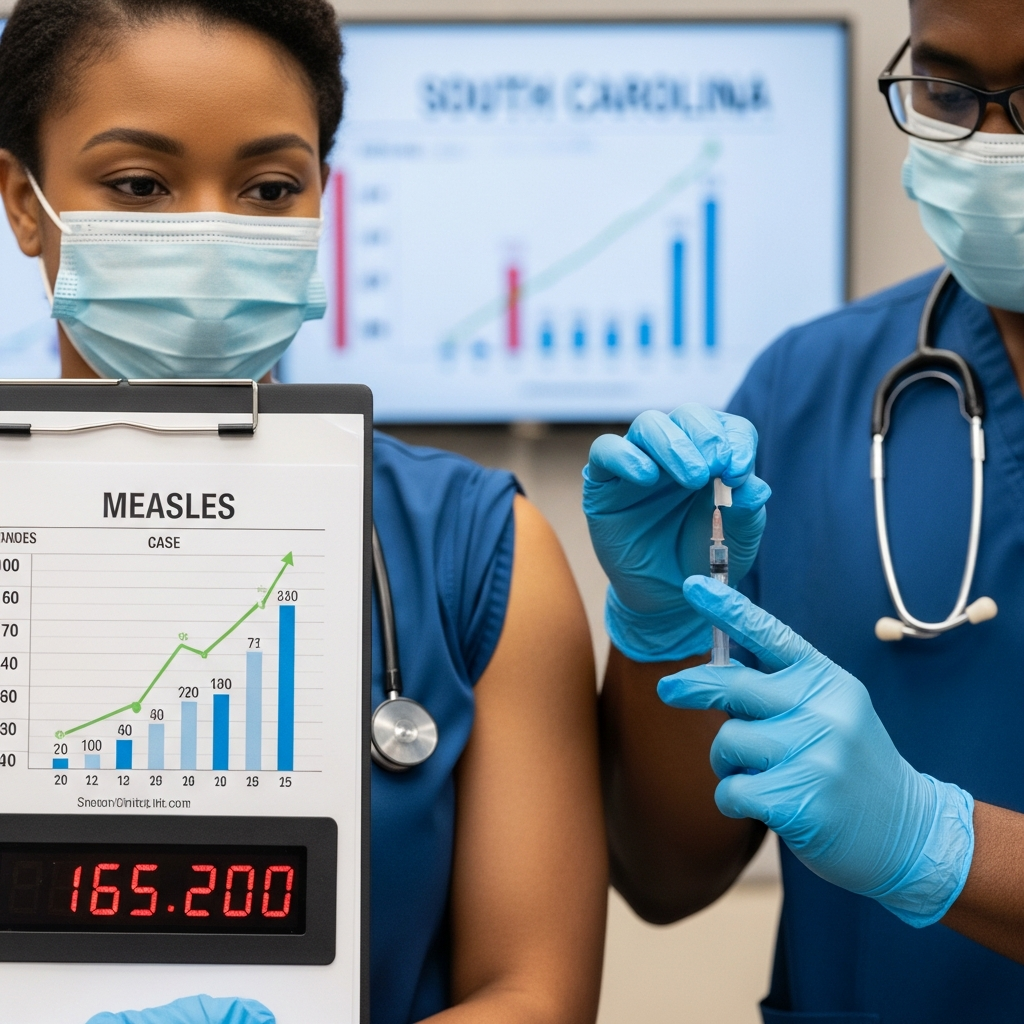
South Carolina faces an urgent public health crisis as its escalating measles outbreak has now surpassed the severe 2025 West Texas incident. With nearly 800 confirmed cases, this surge threatens the United States’ hard-won status as a measles-eliminated nation. Health officials are sounding the alarm, emphasizing the critical role of vaccination in stemming the tide of this highly contagious disease. This rapidly developing situation highlights the fragility of public health achievements when vaccine uptake declines, placing vulnerable communities and the nation’s health security in serious jeopardy.
Escalating Crisis: South Carolina’s Measles Outbreak Surges
The measles outbreak gripping South Carolina has reached unprecedented levels, with 789 confirmed cases as of January 27, having added 89 new cases in just four days. This alarming increase has propelled South Carolina past the 2025 West Texas outbreak, which recorded 762 cases and tragically led to two child fatalities. The South Carolina outbreak, which began in October 2025 and escalated significantly over the holiday period, is predominantly concentrated in the state’s northwest, particularly in Greenville and Spartanburg counties. Health officials confirm that the outbreak shows little sign of slowing, indicating active and widespread community circulation of the virus.
A concerning demographic breakdown reveals the impact of vaccination status on disease spread. Of the 789 confirmed cases in South Carolina, a staggering 695 individuals were unvaccinated. Only 14 were partially vaccinated with one MMR dose, while 20 were fully vaccinated. The vaccination status for another 60 cases remained unknown. Over half of the infected individuals, 493 cases, were between 5 and 17 years old. An additional 203 cases were in children under five, and 65 cases affected adults over 18. This data strongly implicates low vaccination rates as a primary driver of the extensive outbreak.
Origin and Spread: From Local Pockets to Interstate Concern
The South Carolina outbreak’s origin has been traced to Spartanburg County, initially spreading through private Christian academies where student populations largely lacked full vaccination. The contagious virus, exacerbated by holiday gatherings and subsequent travel, quickly moved beyond local school communities. This rapid spread has led to hundreds of children being quarantined, some multiple times, with 557 people currently under a 21-day quarantine and 20 in isolation. Experts warn that schools with low vaccination rates effectively act as “tinder boxes,” enabling diseases like measles to ignite and spread rapidly.
The concern extends beyond South Carolina’s borders. Cases directly linked to the state’s outbreak have already been documented in California, North Carolina, and Washington, with probable cases also emerging in Ohio. North Carolina alone has reported 14 cases, some with direct ties to the South Carolina outbreak. The interstate spread underscores the heightened risk, especially for vulnerable areas in western North Carolina that also grapple with low vaccination rates.
A Nation at Risk: US Measles Elimination Status in Jeopardy
The escalating outbreaks in South Carolina and elsewhere pose a severe threat to the United States’ measles elimination status, a designation proudly held since 2000. This critical status, which hinges on maintaining local transmission suppression for 12 consecutive months or more, is set for review by the Pan American Health Organization (PAHO) in April. The continuous circulation of measles from a single source could lead to its revocation, marking a significant public health setback.
Nationally, the Centers for Disease Control and Prevention (CDC) reported 416 confirmed measles cases across the U.S. as of January 22, 2026. This alarming figure represents nearly 20% of the entire 2025 case total, accumulated in just one month. The year 2025 itself was declared the nation’s worst for measles spread since 1991, with a total of 2,255 confirmed cases reported across 44 states. Among these, 49 distinct outbreaks—defined as three or more related cases—were identified, accounting for 89% of all cases. Tragically, three deaths were recorded in 2025, all in unvaccinated individuals, including two children in West Texas.
Demographic analysis of the 2025 cases revealed that 26% occurred in patients under five years old, while 44% were reported in those aged 5 to 19. A total of 243 patients required hospitalization, with 106 of them being children under five. Consistently, 93% of the country’s measles cases in 2025 involved individuals who were either unvaccinated or whose vaccination status was unknown, reinforcing the direct link between immunization rates and disease susceptibility.
Controversial Perspectives on Public Health Response
Amidst the growing crisis, statements from public health officials have sparked controversy. Dr. Ralph Abraham, the principal deputy director of the CDC, appeared to downplay the potential loss of measles elimination status, remarking, “It’s just the cost of doing business, with our borders being somewhat porous.” He further asserted, “We have these communities that choose to be unvaccinated. That’s their personal freedom,” which critics argue minimizes the collective public health consequences of individual vaccine hesitancy. This perspective offers a unique insight into some official stances on vaccine choice despite the clear public health risks.
Indeed, measles outbreaks are disproportionately affecting close-knit communities with the lowest vaccination rates. For instance, the South Carolina outbreak initially emerged among Ukrainian immigrant families in Spartanburg County, an area with an 8.2% nonmedical vaccine exemption rate. Similarly, the 2025 West Texas outbreak largely impacted a Mennonite community in Gaines County, where nonmedical exemptions soared to 19.5%. These examples highlight how personal choices, when widespread within a community, directly undermine herd immunity.
Understanding Measles: Symptoms, Complications, and Prevention
Measles is a highly contagious airborne virus that spreads with remarkable ease. It transmits through respiratory droplets released when an infected person coughs or sneezes. The virus can linger in the air for up to two hours and also spread through contact with contaminated surfaces, followed by touching the mouth, eyes, or nose. This extreme contagiousness makes high vaccination rates crucial for community protection.
Typical measles symptoms usually appear 7 to 14 days after exposure to the virus. Initial signs often include a high fever, persistent cough, runny nose, and watery, red eyes. A characteristic measles rash then develops three to five days after the onset of these first symptoms. While most individuals recover, measles is not a benign illness. Even in otherwise healthy children, it can cause severe illness and potentially lead to death.
Serious Complications and Lifesaving Protection
The complications from measles can be devastating and include ear infections, which can lead to hearing loss, pneumonia, croup, and severe diarrhea. More serious outcomes involve blindness and encephalitis, a dangerous swelling of the brain. For unvaccinated pregnant women, measles poses additional risks, potentially leading to premature birth or a low-birthweight baby. The CDC estimates that approximately 1 in 5 unvaccinated people who contract measles in the United States will require hospitalization.
Health experts consistently underscore that the best and most effective protection against measles is vaccination. The measles-mumps-rubella (MMR) vaccine, or the measles-mumps-rubella-varicella (MMRV) vaccine, is highly recommended. Two doses of the MMR vaccine provide a robust 97% protection against the virus. Children typically receive their first dose between 12 and 15 months of age, with a second dose administered between 4 and 6 years. Most adults born before 1957 are presumed to have acquired immunity due to widespread childhood exposure to the disease.
The Alarming Trend: Declining Vaccination Rates Fuel Outbreaks
The current resurgence of measles across the United States is directly linked to a disturbing nationwide trend: declining childhood vaccination rates. Since the pandemic, more parents have opted for religious or personal conscience waivers to exempt their children from required vaccinations. This trend critically undermines herd immunity, which requires a vaccination rate above 95% to effectively prevent outbreaks in a community. When vaccination rates fall below this threshold, communities become highly vulnerable to the rapid spread of diseases like measles.
This decline is evident in the nonmedical vaccine exemption rates observed in current outbreak epicenters. Spartanburg County, South Carolina, for example, has an 8.2% nonmedical exemption rate. The 2025 West Texas outbreak occurred in Gaines County, with a striking 19.5% exemption rate. Similarly, an ongoing outbreak along the Arizona-Utah border is linked to communities in Mohave County, Arizona (15.9% exemption rate), and Washington County, Utah (19.6% exemption rate). These figures clearly illustrate how concentrated pockets of unvaccinated individuals create fertile ground for widespread transmission.
Beyond South Carolina: Other Active Outbreaks
While South Carolina remains a primary concern, it is not the only state grappling with significant measles activity. Health officials are also actively responding to a large, ongoing outbreak affecting the Utah-Arizona border region, particularly in the towns of Hildale, Utah, and Colorado City, Arizona, collectively known as “Short Creek.” Arizona health officials have documented 222 cases in Mohave County, with recent isolated detections in other counties. Utah officials have confirmed 216 cases, with 55 of those emerging in just three weeks. Experts in both states suspect these numbers may be undercounts.
In addition to South Carolina, Utah, and Arizona, other states have reported confirmed measles cases in 2026. These include California, Florida, Georgia, Idaho, Kentucky, Minnesota, North Carolina, Ohio, Oregon, Virginia, and Washington. This widespread presence underscores the national scope of the measles resurgence and the pervasive threat to communities with insufficient vaccination coverage.
Frequently Asked Questions
Why is the South Carolina measles outbreak a major public health concern?
The South Carolina measles outbreak is alarming because of its rapid escalation and significant scale, with 789 confirmed cases, making it the largest in the U.S. in nearly three decades. It has surpassed the severe 2025 West Texas outbreak and shows no signs of slowing down, with 89 new cases confirmed in just four days. The outbreak’s concentration in areas with low vaccination rates, coupled with interstate spread, threatens the U.S.’s measles elimination status and highlights the severe consequences of declining community immunity.
What is the best way to protect yourself and your family from measles?
The most effective protection against measles is the measles-mumps-rubella (MMR) vaccine. Health experts recommend two doses of the MMR vaccine, which provides 97% protection against the virus. Children typically receive their first dose between 12 and 15 months of age, with a second dose given between 4 and 6 years. For adults, those born before 1957 are generally presumed to be immune. Ensuring up-to-date vaccination is crucial to prevent infection and protect vulnerable individuals in the community.
Which regions in the U.S. are currently experiencing significant measles outbreaks?
Beyond South Carolina, which is concentrated in Spartanburg and Greenville counties, a major ongoing measles outbreak is affecting the Utah-Arizona border region, specifically the towns of Hildale, Utah, and Colorado City, Arizona (“Short Creek”). These areas, like South Carolina, are characterized by communities with low vaccination rates. Other states that have reported confirmed measles cases in 2026 include California, Florida, Georgia, Idaho, Kentucky, Minnesota, North Carolina, Ohio, Oregon, Virginia, and Washington, indicating a widespread national concern.
Conclusion
The escalating measles outbreak in South Carolina serves as a stark reminder of the continuous vigilance required to maintain public health. With cases rapidly approaching the 800 mark, this incident has not only eclipsed the recent West Texas outbreak but also placed the entire nation’s measles elimination status in immediate jeopardy. The overwhelming majority of those affected are unvaccinated, underscoring the undeniable link between lagging vaccine uptake and the resurgence of this highly contagious, potentially deadly disease. As communities across the U.S. grapple with declining vaccination rates and the rise of nonmedical exemptions, the call for renewed commitment to public health measures and widespread immunization becomes more urgent than ever. Protecting our communities from measles requires collective action and a re-emphasis on the proven power of vaccines.