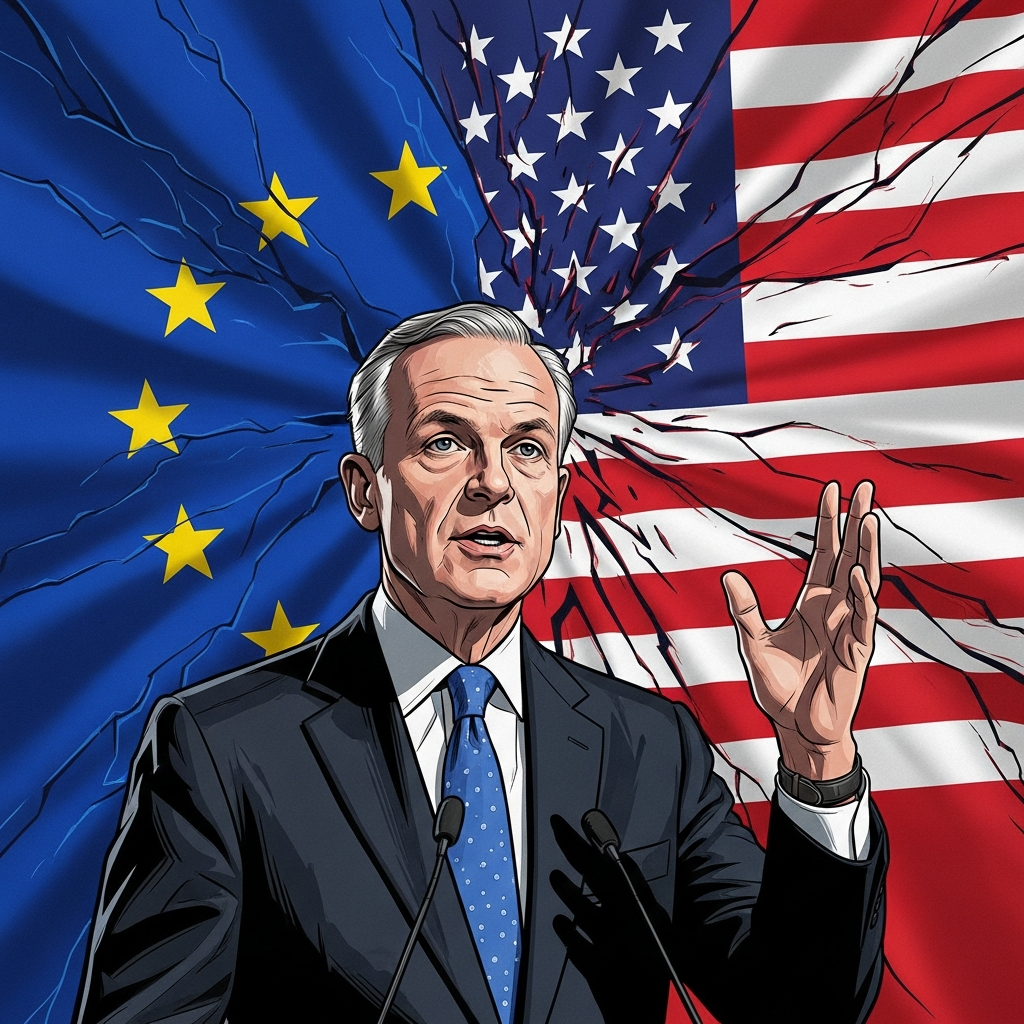
The early days of 2026 marked an undeniable turning point in Europe US relations, triggering a profound sense of disorientation across the continent. What transpired in a single week reshaped decades of established international norms and trust, signaling a “rupture, not a transition,” as aptly described by Canadian Prime Minister Mark Carney. This period wasn’t just a diplomatic squabble; it was a fundamental reordering of global alliances, forcing Europe to confront a new, more volatile reality. The bedrock of transatlantic partnership, once seemingly unbreakable, has been profoundly fractured, demanding an immediate re-evaluation of Europe’s strategic future and security framework.
A Week That Shattered Transatlantic Trust
The catalyst for this unprecedented upheaval was a series of provocative actions from former President Donald Trump, just days into January 2026. His audacious threats to acquire Greenland, a sovereign territory of NATO ally Denmark, through “the hard way” if necessary, sent shockwaves across Europe. This direct challenge to a close partner, accompanied by promises of punitive tariffs, was deemed “fundamentally unacceptable” by French President Emmanuel Macron at the World Economic Forum in Davos. This wasn’t merely unconventional rhetoric; it was a taboo-shattering display that left Europe reeling.
As the week unfolded, European leaders expressed growing alarm. Polish Prime Minister Donald Tusk spoke of “appeasement” – a term laden with painful historical resonance – declaring that Europe “cannot afford to be weak” against either adversaries or allies. A senior EU diplomat noted the “very unorthodox rhetoric” emanating from the US administration. European Council President Antonio Costa emphasized the need for “cordial and respectful” relations, a stark contrast to the aggressive posture of the Trump White House. The consensus was clear: the United States, under Trump, was no longer the unequivocally trusted friend and ally it had been for generations. This stark realization, though perhaps long-foreshadowed, now cemented itself as an undeniable truth.
The Erosion of NATO’s Unquestioned Permanence
For over 70 years, NATO has served as the bedrock of European security, quietly shaping political life and allowing the continent to demilitarize relationships, foster economic recovery, and expand the EU. It provided a sense of “permanence,” transforming American power into a standing guarantee against external threats and even “from itself,” enabling armies to shrink and civil society to flourish. However, Trump’s consistent contempt for NATO’s internal logic, culminating in the Greenland threats, introduced a palpable “vertigo” into European politics.
Experts like Matthew Kroenig of the Atlantic Council suggest Trump uses escalation as a negotiation tactic, but the Irish Examiner highlighted that even if specific disputes are resolved, the act of raising “the unthinkable”—questioning core alliances and threatening allies—erodes the crucial sense of permanence that underpins these partnerships. Former EU Council chief Charles Michel starkly declared the transatlantic relationship “as we’ve known it for decades is dead.” The implications of this are profound, with some EU diplomats questioning whether the US would truly defend countries like Estonia if it was simultaneously pursuing territorial ambitions against another ally. This signals a move from a psychology of “permanence” to one of “contingency.”
Economic Realities Fueling Europe’s Strategic Shift
The diplomatic fallout also had significant economic undercurrents and policy shifts. China, in 2025, posted a record trade surplus of $1.2 trillion, with exports to the European Union increasing by 8.4%. This surge occurred even as China’s exports to the US fell by 20%, illustrating a global economic realignment. The Deloitte Insights report from January 2026 warned that China’s persistent surplus and “promotional pricing” in markets like the EU were creating disinflationary pressure and prompting the EU to consider import restrictions.
Crucially, Germany, having experienced economic contractions in prior years, saw its economy grow modestly in 2025. This rebound was directly attributed to an increase in government borrowing for infrastructure and defense spending, initiated in early 2025 due to “concerns over US support for NATO and Ukraine,” according to the Deloitte analysis. This demonstrates a tangible shift in European fiscal priorities driven by geopolitical uncertainty. The US dollar, meanwhile, experienced one of its worst years in 2025, depreciating sharply against the Euro, partly due to weakened US trade and a diminishing US role in the global economy. These economic indicators underscore the broader forces compelling Europe towards greater strategic autonomy.
Trump’s “America First” Doctrine: Europe as an Adversary
The Council on Foreign Relations’ analysis of Trump’s December 2025 National Security Strategy (NSS) offers critical insight into the administration’s view of Europe. Characterized as more “polemic than policy,” the NSS marked a radical departure from previous strategies. It notably downplayed the threat from Russia and China (repositioning China as an economic competitor) while elevating the Western Hemisphere as the highest priority. The document’s strongest criticism was reserved not for traditional adversaries, but for US “foreign policy elites” and, significantly, European allies.
Liana Fix of the CFR noted the NSS adopted a “civilizational” approach to Europe, accusing it of neglecting “Western” values, suffering “loss of national identities,” and experiencing “economic stagnation, military weakness, and ‘civilizational erasure’.” The strategy even accused Europe of censorship and explicitly aimed to “cultivate resistance… within European nations,” endorsing far-right “patriotic” parties. This signals an end to the transatlantic alliance based on shared liberal values, reorienting towards an “alliance of illiberals.” Trump’s consistent worldview, detailed by the ECFR, frames Europe as a political opposition, “ripping off” America, and even a “foe,” worse than China, due to commercial imbalances and its “liberal” bureaucratic structure. His methods – elimination, transformation, and subjugation – are projected globally, with Europe being a primary target.
Forging a New Path: European Strategic Autonomy
Faced with Trump’s assertive “America First” approach, Europe’s choice was stark: defiance or subservience. Poland’s Tusk warned that “appeasement means no results, only humiliation.” Discussions among EU diplomats confirmed a growing consensus around the urgent need for independence from the whims of the White House, particularly in defense matters. This included a departure from past “Trumpwhispering” tactics in 2025. Macron’s unambiguous stance, “We do prefer respect to bullies,” encapsulated the growing resolve.
Last year saw a strong convergence around coordinated funding for European defense, emphasizing “buying European” to boost industrial progress. This trajectory is expected to continue into 2026, strengthening Europe’s industrial base and military capacity. While the concept of an official EU army or security council was broached by an EU commissioner – a sign of long-held taboos being challenged – broad consensus for such a level of integration remains nascent. The Irish Examiner emphasized that the EU, while a “gravitational pull,” is not NATO; it lacks a shared strategic tradition or a credible nuclear umbrella, suggesting a truly post-NATO Europe might fragment into overlapping security “ecologies.”
Navigating Lingering Threats and Complex Realities
Despite the focus on transatlantic relations, Europe’s conventional threats have not dissipated. Russia launched one of its largest bombardments of Kyiv in January 2026, and Finnish military intelligence warned of Russian threats to Baltic Sea underwater infrastructure. Hostile actors in the Middle East and China also continue to pose risks.
The complex nature of Europe US relations means not all European responses were openly defiant. American military and economic power remains significant, and Europe is not yet ready to manage a sustained conflict with Russia alone. Germany’s Chancellor Friedrich Merz expressed “gratitude” for Trump stepping back from potential confrontation over Greenland, highlighting a continued caution. Baltic countries, typically outspoken, remained notably quiet, with Lithuania’s former defense minister Dovilė Šakalienė stressing the need to focus on pragmatic military and technical cooperation, rather than emotion. Lithuania’s President Gitanas Nauseda reiterated, “The US is still our closest friend,” underlining the deep-seated ties and the challenges of a complete break.
The ECFR publication advocates for Europe to adopt a “confrontational strategy” against Trump’s plan. This involves: reinventing multilateralism with diverse global partners, fighting back against attempts to transform European democracies from within, and diversifying away from US reliance in critical areas. Without such a robust response, Europe risks “marginalisation but irreversible transformation.”
Frequently Asked Questions
What events triggered the significant shift in Europe-US relations in early 2026?
The decisive shift in Europe US relations was primarily triggered by former President Donald Trump’s actions in January 2026. This included his aggressive threats to acquire Greenland, a sovereign territory of NATO ally Denmark, even through “the hard way,” coupled with promises of punitive tariffs against European allies. These actions, particularly the challenge to a NATO member’s sovereignty, were widely seen as a direct breach of diplomatic norms and a severe erosion of transatlantic trust, compelling European leaders to re-evaluate their alliances and security strategies.
How has NATO’s foundational role been challenged by recent US foreign policy shifts?
NATO, historically viewed as an unquestioned bedrock of European security, has faced significant challenges due to recent US foreign policy shifts, particularly under Trump. His public contempt for the alliance’s internal logic and his “America First” approach, which frames Europe as an economic competitor rather than an ally, undermined Article 5’s collective defense guarantee. This introduced a “post-NATO psychology,” as European leaders began to perceive the US commitment as “contingent” rather than “permanent,” leading to an “emotional rupture” and prompting discussions about European strategic autonomy outside the traditional NATO framework.
What strategies are European nations considering to enhance their strategic autonomy?
To enhance strategic autonomy, European nations are consolidating around several key strategies. These include significantly increasing coordinated funding for European defense, with a strong emphasis on “buying European” to bolster the continent’s industrial base and military capacity. There are also discussions about a more integrated European defense, potentially even exploring concepts like an official EU army or security council, though full integration remains a long-term goal. Furthermore, the ECFR suggests reinventing multilateralism with diverse global partners, actively resisting foreign interference in European democracies, and diversifying away from critical reliance on American suppliers and markets.
The events of early 2026 represent a profound and potentially irreversible shift in the Europe US relations. The old paradigms of unquestioning trust and shared values have been severely tested, giving way to a new reality of strategic uncertainty and increased self-reliance for Europe. As the continent navigates persistent threats from Russia and redefines its place in a multipolar world, the ongoing evolution of its relationship with the United States will undoubtedly shape the global geopolitical landscape for years to come. Europe’s path forward demands a delicate balance of maintaining existing ties while robustly forging an independent and resilient future.