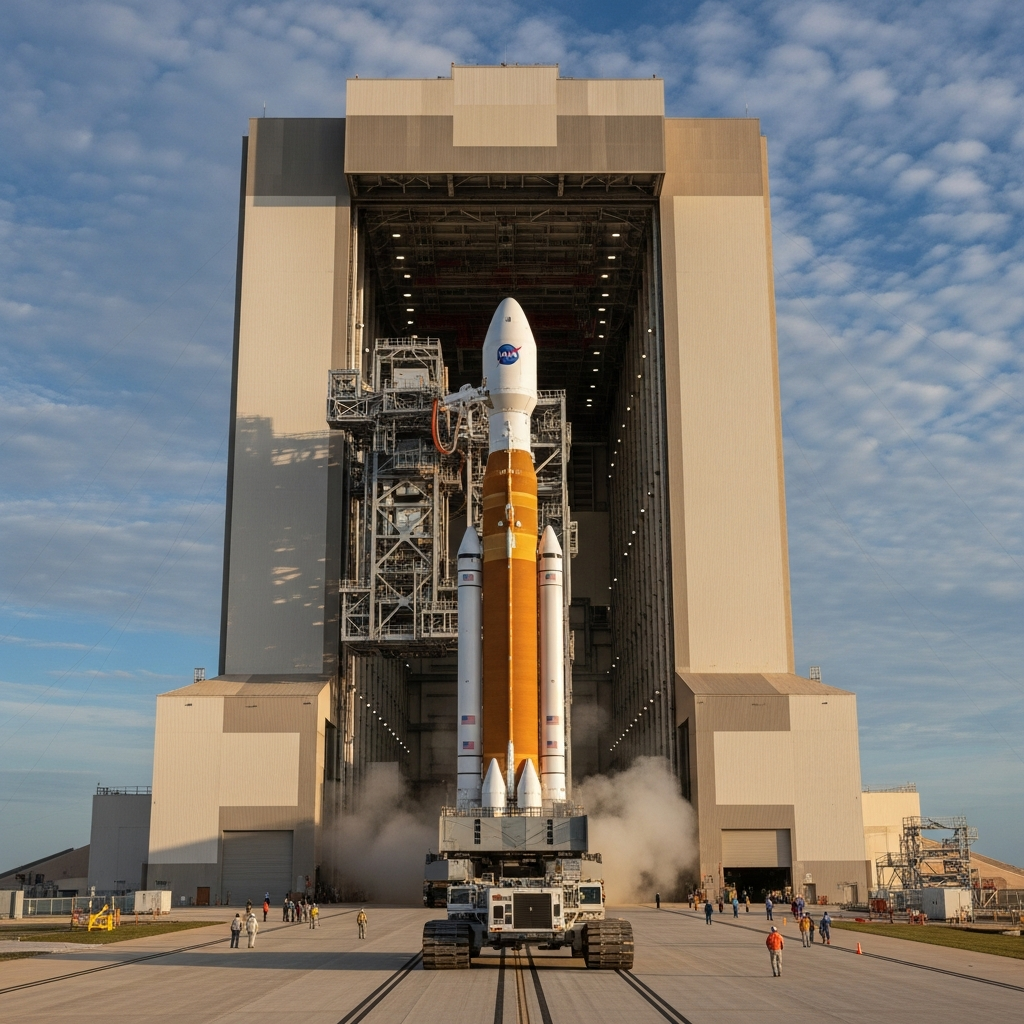
Humanity is poised for a monumental leap back to the Moon as NASA prepares for its Artemis 2 moon mission. On January 17, 2026, the massive Space Launch System (SLS) rocket and Orion spacecraft, fully stacked for the mission, will begin their journey from the Vehicle Assembly Building (VAB) to Launch Pad 39B at Florida’s Kennedy Space Center. This crucial rollout marks a significant step towards the first crewed lunar mission in over 50 years, with a potential launch window opening as early as February 6. The world watches as NASA advances its ambitious program to establish a sustained human presence on the Moon and pave the way for future Mars missions.
The Historic Rollout: A Critical Step Towards the Moon
The journey of the Artemis 2 stack to Launch Pad 39B is more than just a logistical move; it’s a symbolic stride forward in space exploration. This intricate operation, carried out by NASA’s specialized Crawler-Transporter 2 vehicle, highlights the immense scale and precision required for deep space endeavors. The rollout will enable a series of vital pre-launch checks and rehearsals, ensuring every component is ready for the rigors of lunar space.
The Journey to Pad 39B
The towering 322-foot (98-meter) SLS rocket, one of the largest and most powerful active rockets globally, will embark on a slow, deliberate 4-mile (6.4-kilometer) trek. This monumental journey, from the confines of the VAB to the exposed launch pad, is anticipated to take up to 12 hours. Once positioned at Pad 39B, technicians will immediately connect the ground support equipment, including electrical lines, environmental control system ducts, and crucial cryogenic propellant feeds. This initial power-up at the pad is essential to verify the proper functioning of all integrated systems before any further tests proceed.
Crawler-Transporter 2: A Feat of Engineering
The Crawler-Transporter 2, a colossal vehicle purpose-built for moving rockets of this magnitude, is a spectacle in itself. Its meticulous operation ensures the safe transport of the delicate SLS-Orion stack, traversing the specialized crawlerway at a painstakingly slow pace. This journey allows for a critical transition from assembly to the launch environment, where the integrated spacecraft will undergo the ultimate series of tests designed to simulate launch conditions. Lori Glaze, acting associate administrator for NASA’s Exploration Systems Development Mission Directorate, underscored the mission’s priority, stating that “crew safety will remain our top priority at every turn as we near humanity’s return to the moon.”
Artemis 2: Humanity’s Return to Lunar Space
Artemis 2 is not a lunar landing mission, but a vital 10-day circumlunar journey. This uncrewed mission’s predecessor, Artemis 1, successfully sent an Orion capsule around the Moon in November 2022, proving the hardware’s capabilities. Now, Artemis 2 will rigorously test the systems and hardware with a human crew, extending further into deep space than any human has traveled in over 50 years. It’s a critical stepping stone, providing invaluable data and experience for subsequent lunar surface expeditions.
Meet the Trailblazing Crew
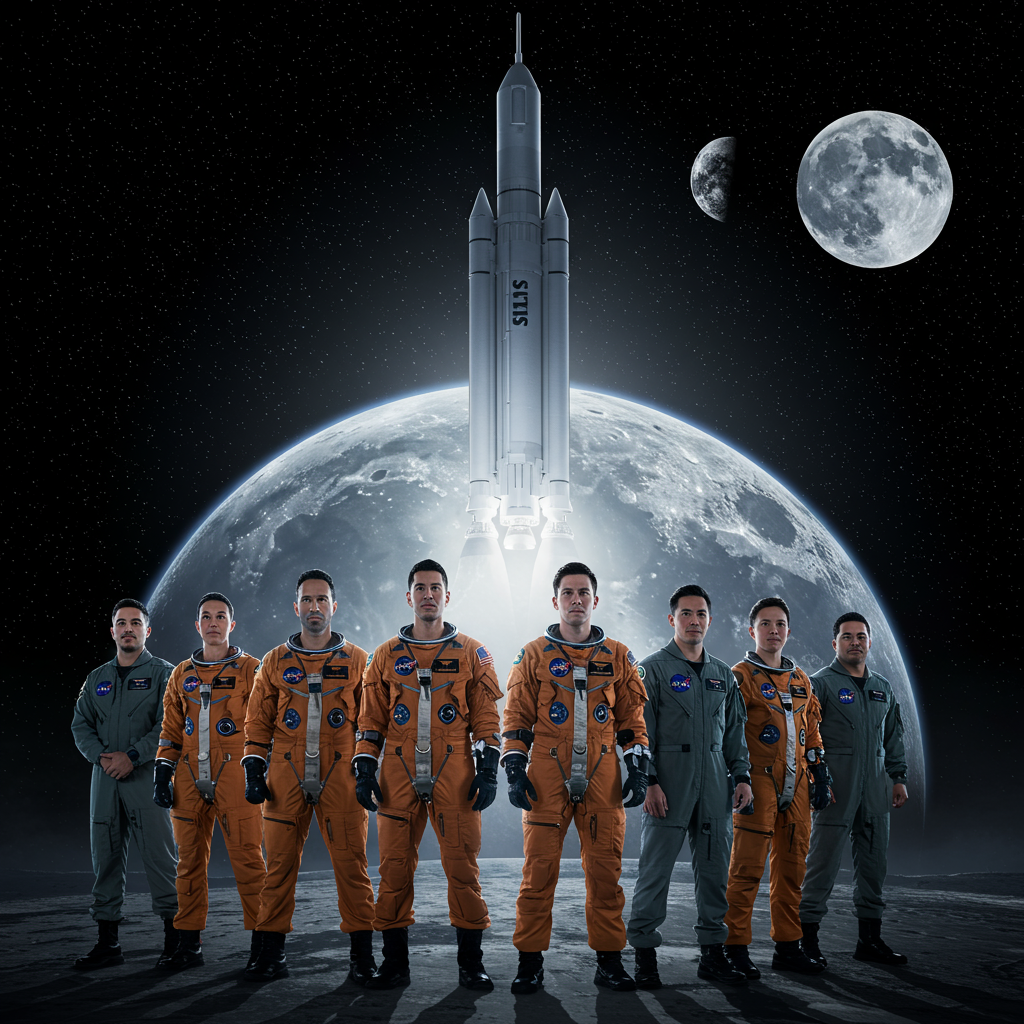
A diverse and highly skilled crew of four astronauts will embark on this historic voyage:
Reid Wiseman (NASA): Mission Commander
Victor Glover (NASA): Pilot (first African American assigned to a NASA lunar mission)
Christina Koch (NASA): Mission Specialist (first woman to fly close to the Moon)
Jeremy Hansen (Canadian Space Agency): Mission Specialist (first Canadian to fly close to the Moon)
This crew represents a new era of inclusivity in space exploration, embodying the global collaboration and diverse talent driving humanity’s renewed lunar ambitions. Their final walkdown at the pad, a tradition before launch, will be a moment of reflection and readiness before their unprecedented journey.
Mission Profile: What Artemis 2 Will Do
The primary objective of Artemis 2 is to test the Orion spacecraft’s life support and navigation systems, as well as the crew’s ability to operate in the radiation-heavy environment beyond Earth’s protective magnetic field. The mission will send the Orion capsule approximately 4,700 miles beyond the far side of the Moon before it slingshots back to Earth. This flyby will confirm the functionality of all systems required for sustained human deep space travel, including communication, navigation, and environmental controls. The data gathered will be crucial for the success of Artemis 3, which aims to land astronauts on the lunar South Pole.
Beyond Artemis 2: The Larger Vision
The Artemis Program embodies a much grander vision than just returning humans to the Moon. Its long-term goals include establishing a sustained human presence on the lunar surface, potentially at the Moon’s South Pole where abundant water ice could be harvested. This lunar outpost would serve as a vital staging ground, extracting resources for drinking, breathing, and even producing rocket fuel for future crewed missions to Mars. The impending launch of Artemis 2 also unfolds against the backdrop of a renewed global space race, with nations like China advancing their own lunar exploration efforts, highlighting the strategic importance of NASA’s endeavors. Former President Donald Trump has also articulated a political goal of achieving a lunar landing before the end of his potential second term in 2028, adding another layer to the program’s urgency.
Rigorous Pre-Launch Testing: Ensuring Safety
Before the Artemis 2 crew can lift off, the SLS and Orion stack must undergo a series of exhaustive tests and checkouts. These meticulous procedures are designed to identify and resolve any potential issues, prioritizing astronaut safety above all else. The lessons learned from previous missions, especially Artemis 1, have been thoroughly integrated into the current testing protocols.
The Wet Dress Rehearsal: A Crucial Test
A critical pre-launch test is the “wet dress rehearsal,” slated for late January. During this complex exercise, teams will demonstrate their ability to load more than 700,000 gallons (2.65 million liters) of super-chilled cryogenic propellants into the SLS rocket. They will also conduct a full launch countdown, pausing and resuming during the critical terminal count phase (final 10 minutes) to practice anomaly management. Finally, the teams will rehearse safely offloading the propellants from the rocket, all without astronauts onboard. The closeout crew will also practice procedures for securing astronauts and closing the Orion hatches.
Lessons Learned from Artemis 1
The importance of these rehearsals cannot be overstated, as evidenced by the Artemis 1 mission. Its wet dress rehearsals revealed multiple liquid hydrogen leaks, necessitating several rollbacks to the VAB for repairs. These issues significantly delayed Artemis 1’s launch from spring to November 2022. However, the diligent work led to successful fixes, culminating in a triumphant uncrewed mission that proved the Orion spacecraft‘s capabilities. For Artemis 2, enhanced procedures are in place to prevent gaseous nitrogen accumulation, a factor that caused issues during Artemis 1’s closeout crew practice. NASA maintains its commitment to safety, affirming that additional wet dress rehearsals or even a rollback to the VAB may occur if needed.
Navigating the Launch Window: Dates and Constraints
Following a successful wet dress rehearsal, NASA will hold a flight readiness review. This comprehensive assessment of all systems, flight hardware, infrastructure, and the launch, flight, and recovery teams will precede the announcement of an official target launch date. While the broad window for Artemis 2 opens on February 6 and extends through April 10, several factors tightly constrain the specific launch opportunities.
Key Launch Periods
The two-month launch window holds only 15 potential launch dates, clustered into specific periods due to orbital mechanics and performance requirements:
Launch Period Jan. 31 – Feb. 14: Opportunities on February 6, 7, 8, 10, and 11.
Launch Period Feb. 28 – March 13: Opportunities on March 6, 7, 8, 9, and 11.
Launch Period March 27 – April 10: Opportunities on April 1, 3, 4, 5, and 6.
Factors Affecting Launch Opportunities
Beyond the precise orbital mechanics that dictate when the SLS can deliver Orion into its trajectory, other practical limitations exist. These include the schedule of other users on the Eastern Range, the need for commodity replenishment (like propellants), and prevailing weather conditions. NASA officials note that typically, up to four launch attempts may be possible within an approximate week-long opportunity within a launch period. The agency prioritizes readiness and performance, acknowledging that the actual launch date will be determined by the successful completion of all preparatory steps.
The Role of Marshall Space Flight Center
Huntsville’s Marshall Space Flight Center plays an indispensable role in the progress of the Artemis 2 mission. Roger Baird, associate director at Marshall, emphasized the center’s deep involvement in critical tests and reviews. Marshall leads the development, integration, and operation of the Space Launch System (SLS)*, ensuring this powerful system is ready for crewed missions beyond Earth orbit.
Marshall teams were instrumental in the assembly of the launch vehicle, named “Integrity” by the crew, including the precise stacking of solid rocket boosters. Their work encompassed powering up the vehicle, testing its numerous systems, and uploading flight software for the onboard computers. Beyond hardware, Marshall teams have conducted extensive full mission simulations covering pre-launch, launch, and ascent scenarios, practicing the management of challenging anomalies to ensure peak team readiness. Looking ahead, Marshall’s involvement extends to Artemis 3 and subsequent missions, where they will manage the industry-led human landing systems designed to transport crews to and from the lunar surface, advancing the groundwork for future human missions to Mars.
Frequently Asked Questions
What is the primary objective of the Artemis 2 mission?
The main goal of the Artemis 2 mission is to conduct the first crewed flight test of the Orion spacecraft and Space Launch System (SLS) rocket around the Moon. This 10-day journey, which will not land on the lunar surface, aims to rigorously test Orion’s life support systems, navigation capabilities, and the crew’s ability to operate in deep space. It’s a critical precursor to Artemis 3, which intends to land astronauts on the Moon’s South Pole, providing invaluable data for future human exploration beyond Earth orbit.
Where will the Artemis 2 rocket be prepared for launch?
The Artemis 2 rocket, a fully integrated Space Launch System (SLS) and Orion spacecraft, will be prepared for launch at NASA’s Kennedy Space Center in Florida. Specifically, it will be rolled out from the Vehicle Assembly Building (VAB) to Launch Pad 39B. This 4-mile (6.4-kilometer) journey on the specialized Crawler-Transporter 2 vehicle is targeted for January 17, 2026. Once at Pad 39B, it will undergo final integration, crucial testing, and launch rehearsals, including a wet dress rehearsal.
Why are the wet dress rehearsals so critical for Artemis 2?
Wet dress rehearsals are crucial for Artemis 2 because they demonstrate the entire fueling and launch countdown process without an actual launch. During this test, over 700,000 gallons of cryogenic propellants are loaded into the SLS rocket, a full launch countdown is executed, and the safe offloading of propellants is practiced. These rehearsals are vital for identifying and resolving any technical issues, such as the liquid hydrogen leaks experienced during Artemis 1’s rehearsals, ensuring the safety and readiness of the rocket and spacecraft for the crewed mission.
The Dawn of a New Lunar Era
The rollout of the Artemis 2 moon mission rocket on January 17, 2026, marks an exciting chapter in human space exploration. It’s a testament to decades of engineering, scientific dedication, and international collaboration. This mission is far more than a revisit to our celestial neighbor; it’s a foundational step towards building a sustainable presence on the Moon and, ultimately, pushing humanity’s reach to Mars. As the SLS and Orion stack prepares for its historic journey, the world anticipates the dawn of a new era, inspiring generations to come with the promise of deep space exploration.