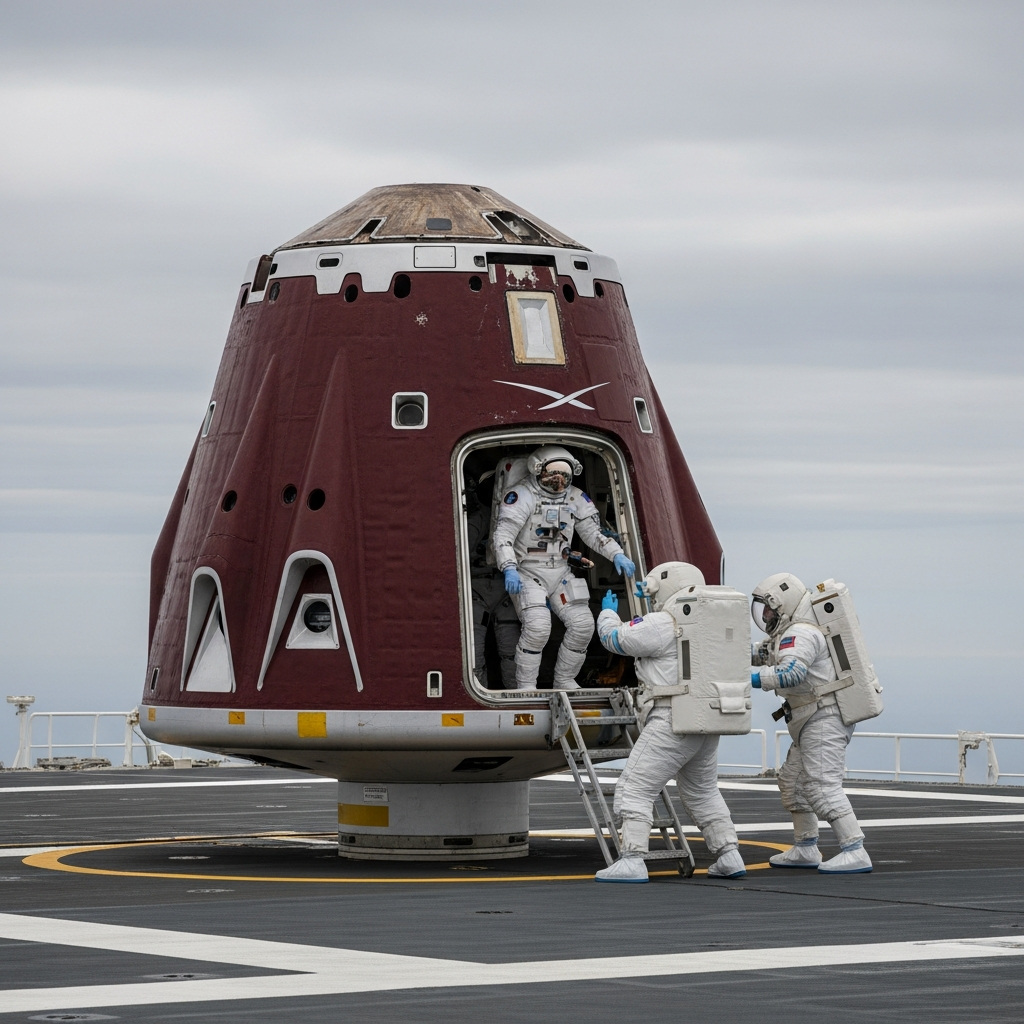
The International Space Station (ISS) is witnessing a historic moment as NASA and SpaceX orchestrate the first-ever controlled ISS medical evacuation of a crew. Four astronauts from the Crew-11 mission are now on an expedited journey back to Earth due to a serious medical concern with one of the team members. This unprecedented event underscores NASA’s paramount commitment to astronaut health and safety, even as it navigates complex operational challenges in orbit and on the ground.
The decision for this early Crew-11 return was made on January 8, 2026, after a medical issue arose with an unnamed astronaut on January 7. While the affected individual is reported to be in stable condition, the unique environment of the orbital laboratory necessitates ground-based medical evaluation and treatment that cannot be fully provided in space. This article provides the latest updates on the unfolding events, from the heartfelt change of command ceremony to the intricate details of the SpaceX Dragon’s journey home.
Unprecedented Circumstances: Why Crew-11 is Returning Early
For the first time in its 25-year operational history, the International Space Station is the site of a planned medical evacuation. The four-person Crew-11, comprising NASA Commander Zena Cardman, NASA Pilot Mike Fincke, Japan’s Kimiya Yui, and Russia’s Oleg Platonov, launched to the ISS in August 2025. Their mission, originally scheduled to last approximately another month, was cut short to ensure the best possible care for the unwell astronaut.
Dr. James Polk, NASA’s chief medical officer, has clarified that the medical issue is not an injury but rather a condition linked to the prolonged exposure to microgravity. While specifics are being withheld out of privacy, the situation warrants a comprehensive medical “workup” on Earth. This is not an emergent evacuation in the sense of an immediate life-threatening crisis, which might require a return within hours. Instead, it’s a carefully planned, multi-day operation, highlighting the robust, albeit limited, medical capabilities aboard the ISS. Former Canadian Space Agency astronaut Chris Hadfield praised NASA’s decision, emphasizing that crew health and safety always take precedence.
The Critical Timeline: From Orbit to Ocean Splashdown
The journey home for the Crew-11 astronauts is a meticulously planned sequence of events, managed jointly by NASA and SpaceX. The current timeline projects a swift return to Earth.
Wednesday, January 14, 2026:
3:00 p.m. EST: Hatch closure coverage begins.
3:30 p.m. EST: SpaceX Dragon and ISS hatches officially close.
4:45 p.m. EST: Undocking coverage starts.
5:00 p.m. EST: The SpaceX Dragon Endeavour capsule undocks from the ISS and begins its initial departure maneuvers.
Thursday, January 15, 2026:
2:15 a.m. EST: Landing coverage commences.
2:50 a.m. EST: Dragon performs its crucial deorbit burn.
3:40 a.m. EST: Splashdown in the Pacific Ocean, off the Southern California coast.
5:45 a.m. EST: Post-landing press conference held.
The entire return journey, from undocking to splashdown, is anticipated to take approximately 11 hours. NASA Administrator Jared Isaacman confirmed that, aside from the early departure, the ISS medical evacuation procedures will follow SpaceX’s standard undocking and reentry protocols.
Preparations in Orbit: Handover and Packing
Even as the return date loomed, life aboard the ISS continued, albeit with an accelerated pace of preparations. A significant event leading up to the undocking was the change of command ceremony for Expedition 74. On January 12, Crew-11 pilot Mike Fincke, who had been commanding the station, officially relinquished control to Russian cosmonaut Sergey Kud-Sverchkov. This heartfelt ceremony included Fincke symbolically handing over a golden key to the station, concluding with a group hug among the seven astronauts. Fincke expressed his confidence in the incoming team, remarking, “We’re leaving you all with a lot of work, but also with a lot of knowledge knowing that you guys are really going to do super well.”
In the days leading up to their departure, the Crew-11 astronauts were busy with essential tasks:
Suit Checks: They conducted fit and operability checks of their SpaceX Dragon pressure suits, vital for reentry. These suits ensure audio and video communication systems are functioning correctly, accounting for physiological changes in microgravity.
Packing: Personal items and other gear were meticulously packed into the Dragon capsule, preparing for the tight confines of the return journey.
- Procedure Review: Astronauts retrieved computer tablets to review the detailed steps for departing the station and reentering Earth’s atmosphere.
- www.space.com
- www.scientificamerican.com
- www.space.com
- www.space.com
- www.newscientist.com
Two planned spacewalks by Fincke and Cardman, one initially scheduled for January 8 and another for the following week, were canceled due to the medical concern, highlighting the direct operational impact of the situation. Japanese astronaut Kimiya Yui, reflecting on his time in orbit, shared a stunning video of auroras and photos of the Japan-built Kibo module, expressing a poignant farewell to his orbital home.
Splashdown Logistics: Weather and Recovery
The final phase of the ISS medical evacuation involves a precise splashdown in the Pacific Ocean. SpaceX has been exclusively utilizing Pacific splashdown sites since 2025 to mitigate the risk of debris falling over populated areas. Multiple potential landing zones off the Southern California coast, including San Diego, Oceanside, and Los Angeles, are available.
NASA and SpaceX are diligently monitoring weather and sea conditions, which are critical factors for both the undocking and recovery operations. While current forecasts are favorable for the January 15 return, a final decision on the specific landing zone will be made closer to the undocking. The targeted splashdown time, 3:40 a.m. EST (12:40 a.m. local time), means recovery efforts will occur in darkness. SpaceX’s recovery crews are typically able to collect the Dragon capsule and extract its crew within an hour of splashdown, provided conditions are optimal.
Impact on ISS Operations and Future Missions
The early Crew-11 return will significantly alter the staffing of the International Space Station, at least temporarily. The departure of these four astronauts will leave a “skeleton crew” of just three individuals: Russian cosmonauts Sergey Kud-Sverchkov and Sergei Mikaev, and NASA astronaut Chris Williams. This reduced team will be responsible for maintaining the orbital laboratory until the next crew can arrive.
NASA and SpaceX are actively working to accelerate the launch of the Crew-12 mission, which was initially scheduled for February. While efforts are underway to replenish the station’s crew, the ISS could operate with a reduced complement for a month or more. Former NASA astronaut Ed Lu empathized with the affected astronaut, recognizing the inherent pressure to complete missions but affirming trust in NASA’s judgment regarding crew safety.
Importantly, NASA Administrator Jared Isaacman has confirmed that this ISS medical evacuation and the accelerated Crew-12 launch will not impact the agency’s ambitious Artemis 2 moon mission. The mission, which plans to launch four astronauts around the Moon, remains on track for early February. Isaacman stated these are “totally separate campaigns,” ensuring no deconfliction issues will arise.
Frequently Asked Questions
What led to the first-ever controlled ISS medical evacuation?
The first-ever controlled ISS medical evacuation was initiated due to an undisclosed medical concern affecting one of the four Crew-11 astronauts. While NASA has not revealed the specific ailment or the astronaut’s identity due to privacy, Dr. James Polk, NASA’s chief medical officer, confirmed it’s not an injury but a condition related to prolonged exposure to microgravity. Though the astronaut is stable, the decision was made to return the crew early to Earth to provide access to comprehensive diagnostic and treatment capabilities unavailable on the space station.
Where will the Crew-11 astronauts splash down upon their return?
The Crew-11 astronauts, aboard their SpaceX Dragon Endeavour capsule, are targeted to splash down in the Pacific Ocean off the Southern California coast. SpaceX exclusively uses Pacific splashdown sites to avoid populated areas. Multiple potential landing zones are available, including areas near San Diego, Oceanside, and Los Angeles. The exact location will be finalized closer to undocking, depending on real-time weather and sea conditions, with recovery operations occurring in darkness on January 15.
What are the next steps for ISS operations after Crew-11’s departure?
Following Crew-11’s departure, the ISS will operate with a “skeleton crew” of three astronauts: NASA’s Chris Williams and Russian cosmonauts Sergey Kud-Sverchkov and Sergei Mikaev. This reduced team will manage the station’s ongoing operations. NASA and SpaceX are working to accelerate the launch of the replacement Crew-12 mission, originally slated for February, to restore full staffing. Despite the adjustments, NASA has confirmed that this situation will not impact the Artemis 2 moon mission, which remains on schedule.
Conclusion
The ISS medical evacuation of Crew-11 represents a significant and unprecedented chapter in human spaceflight. It highlights the inherent risks of long-duration missions and NASA’s unwavering dedication to astronaut well-being. From the bittersweet change of command to the meticulous planning for reentry and splashdown, every step of this complex operation prioritizes the safety of those who venture beyond Earth. As the Dragon Endeavour makes its descent, the world watches, reminded of both the fragility of life in space and the remarkable resilience and ingenuity of those who explore it. The successful return of Crew-11 will pave the way for valuable insights into astronaut health, further solidifying the protocols for future missions to the Moon, Mars, and beyond.