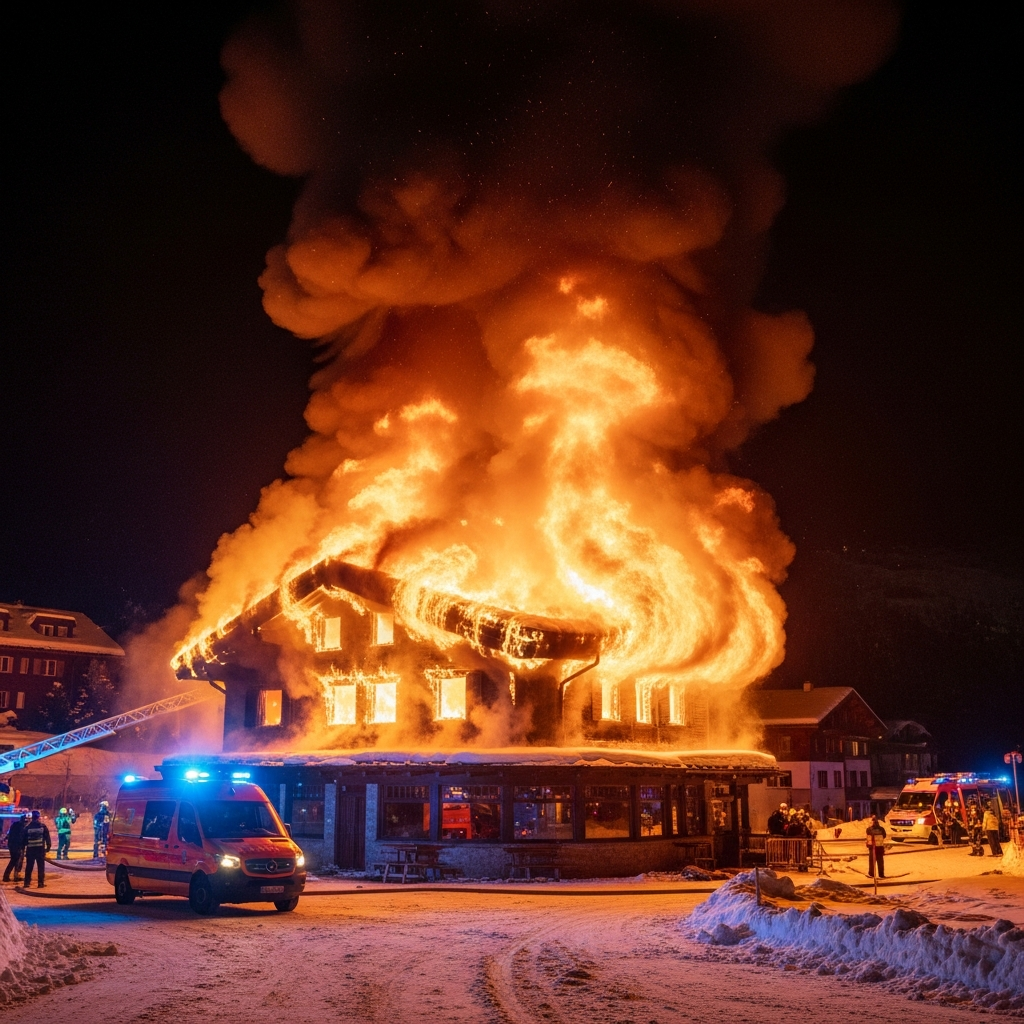
A devastating fire engulfed Le Constellation bar in the upscale Swiss ski resort of Crans-Montana on New Year’s Day, transforming festive celebrations into a catastrophic tragedy. The inferno, which erupted around 1:30 AM local time, claimed approximately 40 lives and left 115 individuals injured, many with severe burns. This horrific incident plunged the Valais canton into a state of emergency and sent shockwaves across Switzerland and beyond.
Crans-Montana’s Night of Terror: The Le Constellation Tragedy
The popular Le Constellation bar, known for attracting a vibrant, young crowd primarily between 15 and 25 years old, was packed with revelers ringing in the new year. What began as a night of joyous celebration quickly descended into a scene of unimaginable horror. The rapid spread of flames trapped many inside, creating chaos and panic as thick black smoke filled the basement-level venue. This Crans-Montana bar fire is now etched into Switzerland’s history as one of its worst modern tragedies.
Eyewitnesses recounted terrifying scenes as the fire took hold. Daniella, a survivor from Milan, described people “running in all directions, screaming and crying” in the immediate aftermath. An 18-year-old, who bravely entered the burning building searching for his brother, reported seeing “people burning… from head to foot, no clothes anymore.” Another survivor, Axel Clavier, spoke of being trapped and desperately breaking a window to escape the overwhelming heat and smoke. He noted that “half of my clothes were gone, it was crazy.”
The Sudden Ignition and Rapid Inferno
Multiple witness accounts point to a chilling hypothesis regarding the fire’s origin. Several revelers, including Axel Clavier and two French women named Emma and Albane, reported seeing waitresses carrying champagne bottles adorned with flares or birthday candles. These decorative elements were allegedly held dangerously close to the ceiling. Emma and Albane specifically recalled that “the entire ceiling was ablaze” within seconds, with flames rising “very quickly” after an apparent ignition. This rapid spread forced desperate escape attempts, as survivors struggled to break windows and glass doors with furniture to flee.
Understanding the “Flashover” Phenomenon
Richard Hagger, President of the UK Association of Fire Investigators, offered critical insight into the fire’s deadliness, explaining the concept of a “flashover.” He described this as an extremely rapid fire development where initial flames and thermal radiation mushroom out across the ceiling. This heat then radiates downwards onto other flammable materials within the room, such as furniture, causing them to thermally decompose and produce highly combustible gases. When these gases ignite, the entire room becomes engulfed in flames “within a matter of seconds,” a phenomenon eerily consistent with eyewitness descriptions of the Le Constellation fire’s speed.
The Massive Emergency Response and Overwhelmed Hospitals
The scale of the disaster triggered an unprecedented emergency response. Authorities deployed 13 helicopters, 42 ambulances, and approximately 150 emergency responders from the Valais region. A no-fly zone was immediately imposed over Crans-Montana as rescue and recovery efforts began. Triage centers were quickly set up in nearby buildings, including a local bar and a UBS bank branch, before victims were airlifted to hospitals.
The sheer number of casualties, particularly those with severe third-degree burns and internal burns from smoke inhalation, quickly overwhelmed Switzerland’s medical infrastructure. Hospitals in Sion, Lausanne, Zurich, Geneva, and Bern rapidly reached capacity. To manage the influx of critical burn victims, a European network facilitated the transfer of several patients to specialized units in Milan, Germany, and France. This international coordination underscored the gravity of the injuries and the intensive care required for recovery.
The Agonizing Task of Victim Identification
One of the most profound challenges facing authorities was the identification of the victims. Due to the severe burns sustained, Canton Valais President Mathias Reynard and Swiss President Guy Parmelin warned that this process would be lengthy and arduous, potentially taking days or even weeks. Families of the missing faced an “agonising wait” for news, many turning to social media in desperate searches for their loved ones. Care teams provided psychological support to those affected by the tragic Crans-Montana bar fire.
The victims represented multiple nationalities, reflecting Crans-Montana’s international appeal. The French foreign ministry reported eight French citizens missing, with three survivors transferred to French hospitals. Italy’s Foreign Minister stated 16 Italians were missing and about 15 were injured, including a 16-year-old from Bologna and two teenagers from Milan. Nineteen-year-old Tahirys Dos Santos, a youth player for French football club FC Metz, was among those severely burned and airlifted to a German hospital.
Investigation, Mourning, and Lessons Learned
Valais canton Prosecutor General Béatrice Pilloud led the ongoing investigation, prioritizing victim identification and the return of bodies to families. While authorities quickly ruled out an attack, they refused to comment on witness speculation regarding candles or flares, stating that “several hypotheses” existed. A key area of inquiry focused on the bar’s capacity, as witnesses estimated closer to 200 people inside, despite the venue’s stated capacity of 300 indoors. Investigators also examined recovered cell phones and adherence to emergency protocols.
The Crans-Montana community, though an international resort, exhibited a “close-knit” response. A memorial of flowers, candles, and messages was established at the scene, and mourners gathered for a vigil. Swiss President Guy Parmelin described the incident as “one of the worst tragedies our country has ever experienced,” postponing his New Year’s address and ordering flags flown at half-mast for five days. International condolences poured in from leaders like King Charles III, European Commission President Ursula von der Leyen, and French President Emmanuel Macron.
Parallels and the Call for Nightclub Safety
The Le Constellation fire draws sobering parallels to other deadly public venue fires worldwide, underscoring critical safety concerns. Previous catastrophes, such as the Pulse club fire in North Macedonia, the Santika club fire in Thailand, and the historic Cocoanut Grove fire in the US, often involved overcrowding, inadequate exits, lack of sprinklers, or pyrotechnic devices. These recurring tragedies highlight the urgent need for stringent safety standards and enforcement in entertainment venues to prevent future loss of life.
Frequently Asked Questions
What caused the devastating New Year’s Eve fire at Le Constellation bar in Crans-Montana?
While the official investigation is ongoing, multiple eyewitnesses reported seeing waitresses carrying champagne bottles adorned with flares or lit candles dangerously close to the bar’s ceiling just before the fire erupted. This initial ignition is believed to have quickly triggered a “flashover” phenomenon, where the entire room rapidly became engulfed in flames due to the sudden ignition of combustible gases. Authorities have ruled out an attack but are examining various hypotheses, including the bar’s capacity.
How did emergency services and hospitals manage the Crans-Montana ski resort fire crisis?
The emergency response was massive, involving 13 helicopters, 42 ambulances, and 150 first responders from the Valais region. Hospitals across Switzerland, particularly in Sion and Lausanne, were quickly overwhelmed by the sheer number of severe burn victims. A European medical network facilitated the transfer of critically injured patients to specialized burn units in Milan, Germany, and France, ensuring they received the intensive care required for their long recoveries. Psychological support teams were also deployed to assist affected families.
What were the challenges in identifying victims of the Crans-Montana tragedy, and what lessons can be drawn?
Identifying the victims of the Crans-Montana bar fire proved to be an agonizing and lengthy process, expected to take days or even weeks, due to the severity of the burns sustained. Many victims were young, and from various nationalities, complicating identification. This tragedy, much like other devastating nightclub fires globally, underscores the critical importance of rigorous fire safety protocols, adequate emergency exits, and strict adherence to venue capacity limits. Investigations into the bar’s capacity and safety measures are crucial to prevent similar incidents.
Conclusion
The New Year’s Eve Crans-Montana bar fire at Le Constellation remains a deeply scarring event for Switzerland and the international community. The tragic loss of life and the severe injuries sustained by so many young individuals underscore the fragility of safety in celebratory environments. As investigations continue to determine the exact cause and any contributing factors, the memory of this devastating incident serves as a powerful reminder of the imperative for vigilant fire safety measures and emergency preparedness in public venues worldwide. The lengthy process of healing, both physical and emotional, will undoubtedly continue for the victims, their families, and the affected community for years to come.