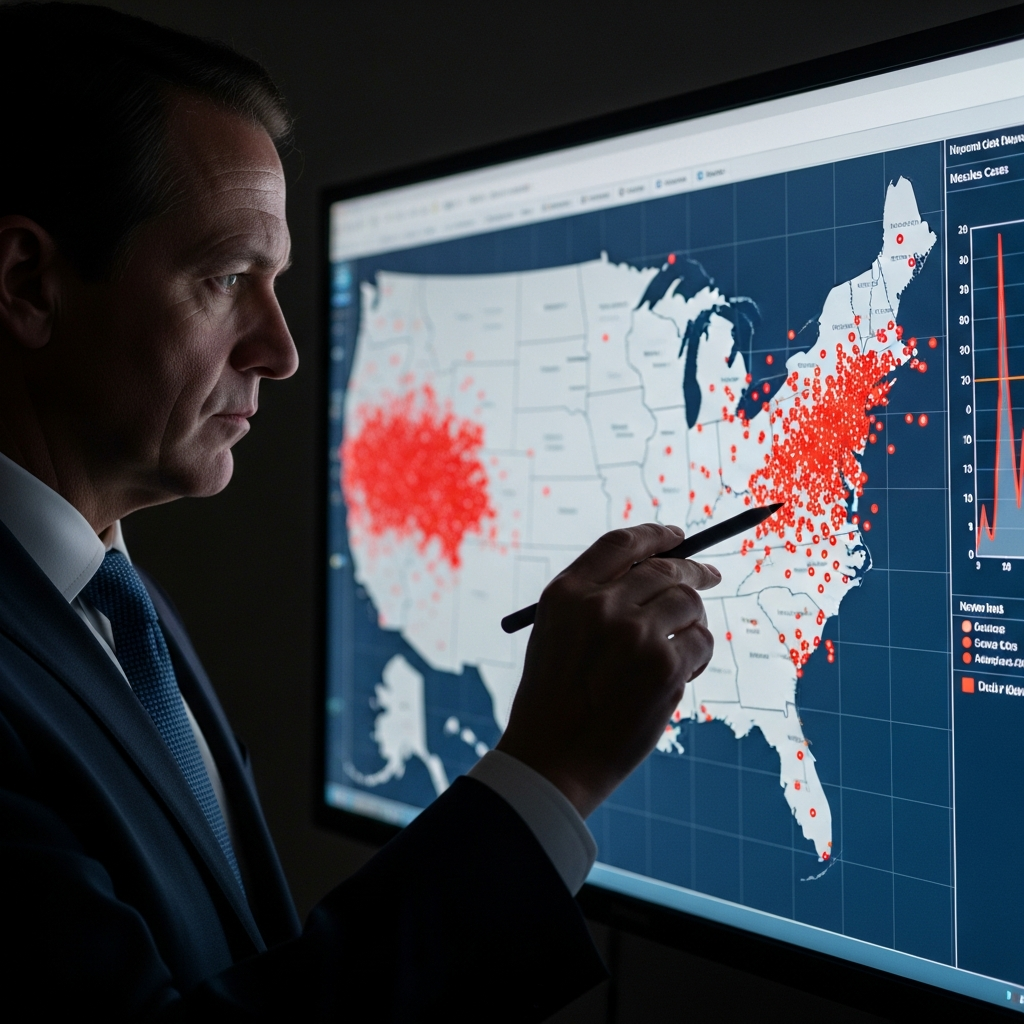
The United States is grappling with a profound public health emergency as measles cases have surged to their highest levels in over three decades. With more than 2,000 infections reported nationwide in 2025, the nation faces the imminent risk of losing its hard-won measles “elimination status,” a designation held since 2000. This alarming increase isn’t just a national concern; it reflects a dangerous global resurgence of a highly contagious, vaccine-preventable disease. Understanding the drivers behind this crisis—from declining vaccination rates to the spread of misinformation—is crucial for protecting public health and preventing further spread.
A Staggering Rise: Measles Hits a 30-Year Peak
As of December 23, 2025, the Centers for Disease Control and Prevention (CDC) confirmed 2,012 measles cases across 44 U.S. jurisdictions. This staggering figure marks a significant escalation from previous reports, which noted 1,277 cases by early July and 1,288 by late July of the same year. To put this into perspective, only 285 confirmed measles cases were reported in all of 2024. This dramatic increase signals a severe setback in disease control, echoing a concerning trend last seen in the early 1990s.
The direct consequence of this sustained transmission is clear: the U.S. stands poised to lose its measles elimination status by the end of January 2026. This status, achieved when the disease no longer spreads continuously for a year, is a testament to successful vaccination programs. Its potential loss would underscore a critical failing in current public health defenses and could have far-reaching implications for global health security.
Why This Resurgence Matters: Health, Economy, and Trust
The current measles outbreak carries significant weight beyond mere statistics. It represents a triple threat:
Severe Health Consequences: Measles is not a benign childhood illness. It can lead to serious complications such as pneumonia, brain swelling, and even death, particularly in infants and young children with underdeveloped immune systems. Tragically, 2025 has already seen the first measles deaths in a decade, including two children in Texas and an adult in New Mexico, all unvaccinated. Around 1 to 3 out of every 1,000 children who contract measles die from respiratory and neurological complications.
Economic Burden: Responding to measles outbreaks is incredibly costly. Each confirmed case can incur an estimated $30,000 to $50,000 in public health response expenses, including contact tracing, isolation measures, and treatment. These costs quickly accumulate, placing immense strain on state health departments, many of which have faced significant funding limitations in recent years.
Erosion of Public Trust: The resurgence of a previously eliminated disease can shake public confidence in healthcare systems and vaccine effectiveness. This erosion of trust makes future public health campaigns even more challenging.
The Root Cause: Declining Vaccination Rates and Misinformation
The primary driver behind this alarming rise in measles cases is a worrying decline in vaccination rates, both domestically and globally. The Centers for Disease Control and Prevention (CDC) reported a concerning drop in kindergarten vaccination rates during the 2024-25 school year. Nationally, less than 93% of U.S. kindergarteners received the recommended two doses of the Measles, Mumps, and Rubella (MMR) vaccine, falling short of the 95% threshold required for robust herd immunity.
Specific communities with even lower immunization rates have become epicenters for large outbreaks. For instance, a significant outbreak in West Texas, particularly within a Mennonite community in Gaines County, accounted for over 700 cases alone. In this county, only 82% of kindergarteners received the MMR vaccine. Such pockets of vulnerability allow the highly contagious virus to spread rapidly, threatening the entire population.
The Role of Misinformation in Fueling the Crisis
The spread of health misinformation has significantly hampered efforts to control the current outbreak. Public figures, including Health and Human Services Secretary Robert F. Kennedy Jr., have complicated the messaging by framing vaccination as a “personal choice” and promoting unproven treatments. While Secretary Kennedy later endorsed the MMR vaccine as “the most effective way to prevent the spread of measles,” his earlier statements and emphasis on unproven alternatives like high-dose vitamin A—which the CDC clarifies is not a treatment for measles—created confusion. Healthcare providers on the front lines describe misinformation as their “biggest nemesis,” directly leading patients to opt out of proven vaccinations.
Global Context: Measles Anywhere is a Threat Everywhere
The U.S. measles crisis is not an isolated event. It is intricately linked to a global resurgence of the disease. The CDC highlights that measles, a highly contagious human disease, easily crosses international borders. An estimated 10.3 million people were infected globally in 2023, with outbreaks currently occurring in every region of the world.
Unvaccinated individuals traveling abroad can contract measles and readily spread it upon returning home, igniting local outbreaks. This “importation” of cases into at-risk U.S. populations with low immunization rates is a consistent pattern. The 2019 outbreak, which saw almost 1,300 cases and nearly caused the U.S. to lose its elimination status, largely stemmed from such international introductions.
Provisional data as of December 2025 underscores the severity of global outbreaks, with the top 10 countries experiencing the most significant numbers:
Yemen: 13,417 cases
Mongolia: 12,172 cases
Pakistan: 10,158 cases
Nigeria: 8,820 cases
India: 7,806 cases
Angola: 6,690 cases
Indonesia: 6,033 cases
Russian Federation: 4,184 cases
Mexico: 3,717 cases
- Afghanistan: 3,429 cases
- www.cdc.gov
- www.nbcnews.com
- www.bbc.com
- www.cidrap.umn.edu
- www.aha.org
This international landscape directly impacts the U.S., demonstrating that global health security depends on robust vaccination efforts everywhere.
The MMR Vaccine: Your Best Defense Against Measles
The Measles, Mumps, and Rubella (MMR) vaccine remains the most effective and safest defense against this dangerous virus. Two doses of the MMR vaccine are 97% effective against measles and provide lifelong protection. The vaccine also offers immunity against mumps and rubella, two other serious diseases.
Public health officials consistently recommend vaccination as the critical preventive measure. In response to the current outbreak, Texas officials have recommended an early dose for babies aged 6 to 11 months, followed by the standard two-dose schedule for unvaccinated children over 12 months. This proactive approach aims to build immunity in the most vulnerable populations. While some local outbreaks, such as the major one in West Texas, have successfully concluded due to targeted public health interventions, the overall national challenge persists.
Public Health Response and Ongoing Challenges
The CDC has ramped up its support for healthcare providers, expanding resources in its “Be Ready for Measles Toolkit” with decision tools to manage cases and prevent further spread. The Department of Health and Human Services (HHS) also continues to support community efforts by providing technical assistance and vaccines.
However, challenges remain. The need for sustained funding for state health departments is critical, as previous cuts in COVID grant money have hindered their capacity for rapid outbreak response. Furthermore, effectively countering pervasive misinformation requires a concerted effort from public health agencies, healthcare professionals, and trusted community leaders to provide accurate, consistent information about vaccine safety and efficacy.
Frequently Asked Questions
Why are measles cases surging in the U.S. now, and what does ‘elimination status’ mean?
Measles cases are surging in the U.S. primarily due to declining vaccination rates, both domestically and linked to increasing global outbreaks. The national kindergarten vaccination rate for the MMR vaccine has fallen below the 95% threshold needed for robust herd immunity, creating vulnerable communities where the virus can spread easily. “Elimination status,” a designation the U.S. earned in 2000, means that measles is no longer continuously transmitted within the country for a period of at least 12 months. The current surge, with over 2,000 cases in 2025, threatens this status, indicating the disease is once again actively circulating.
Where can I find reliable information about the MMR vaccine and local vaccination clinics?
For reliable information about the MMR vaccine, its safety, and efficacy, the Centers for Disease Control and Prevention (CDC) website (cdc.gov) is the authoritative source. Your local public health department also offers accurate guidance. To locate vaccination clinics, you can contact your primary care physician, local health department, or visit the websites of major pharmacies which often provide immunization services. Many state health department websites also offer tools or directories for finding nearby clinics.
What are the immediate steps families and communities can take to protect against measles?
The most immediate and effective step families and communities can take is ensuring everyone eligible receives two doses of the Measles, Mumps, and Rubella (MMR) vaccine. The vaccine is 97% effective and provides lifelong protection. For infants aged 6-11 months in outbreak areas, an early dose may be recommended by local health officials. Additionally, staying informed through credible sources like the CDC and state health departments, and actively countering health misinformation, are crucial. If you suspect exposure or develop symptoms, contact your healthcare provider immediately to prevent further spread.
Moving Forward: A Call to Action for Public Health
The alarming rise in U.S. measles cases is a stark reminder of the fragility of public health achievements when vaccination rates decline. The potential loss of measles elimination status is not merely a symbolic defeat; it represents a tangible threat to the health and safety of communities nationwide. Reversing this trend demands a concerted effort: bolstering vaccination rates through education and accessible services, actively combating misinformation, and ensuring robust funding for public health infrastructure. It is a collective responsibility to protect the gains made against vaccine-preventable diseases and secure a healthier future for all.