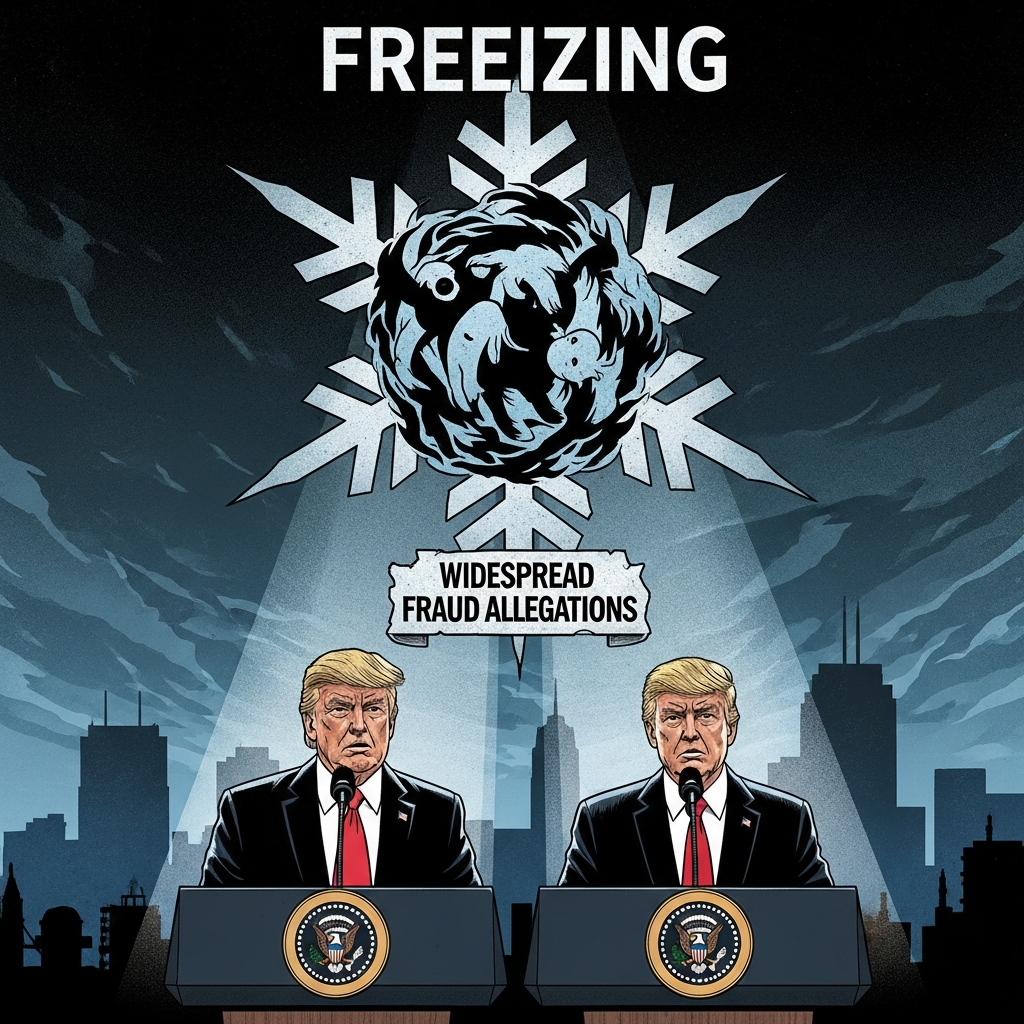
The Trump administration has delivered a significant blow to Minnesota, announcing an immediate freeze on critical federal child care funds. This controversial move, driven by allegations of widespread fraud in government programs, has ignited a fierce political debate and sparked concerns about the future of child care services in the state. Deputy Secretary of Health and Human Services Jim O’Neill declared the action was a direct response to “blatant fraud that appears to be rampant,” setting the stage for a tense standoff between federal and state officials.
The decision affects $185 million in annual federal funding to Minnesota, money crucial for supporting an estimated 19,000 American children, including infants and toddlers. This dramatic intervention underscores a broader federal push to curb alleged misuse of taxpayer dollars, but critics argue it’s a politically charged maneuver with potentially devastating consequences for vulnerable families.
Federal Clampdown: Why Minnesota’s Funds Were Frozen
The sudden federal funding freeze stems from escalating concerns over fraud within Minnesota’s state-run, federally funded programs. Deputy Secretary O’Neill, also serving as acting director for the Centers for Disease Control and Prevention, made the announcement on social media, emphasizing a zero-tolerance stance. He stated, “We have turned off the money spigot and we are finding the fraud,” signaling a determined effort to root out corruption.
A pivotal catalyst for this action appears to be a viral video posted by a right-wing influencer. The video, widely shared on social platforms, claimed to expose up to $100 million in fraud allegedly committed by day care centers predominantly operated by Somali residents in Minneapolis. This social media outcry fueled the administration’s demand for an immediate and comprehensive audit. O’Neill specifically requested that Minnesota Governor Tim Walz submit an audit of these centers, complete with attendance records, licenses, complaints, investigations, and inspection reports.
The federal action wasn’t entirely out of the blue. It closely followed a U.S. Homeland Security fraud investigation in Minneapolis, where officials questioned workers at unidentified businesses just days before the funding freeze announcement. This indicates a coordinated federal effort targeting the state’s alleged vulnerabilities.
A Pattern of Fraud: Minnesota’s Ongoing Struggle
The funding freeze arrives amidst a backdrop of extensive and long-running fraud investigations in Minnesota. The state has been grappling with several high-profile cases involving the alleged theft of federal funds.
Most notably, the “Feeding Our Future” scandal made national headlines. This massive pandemic food fraud scheme revolved around a nonprofit organization that prosecutors identified as being at the heart of the country’s largest COVID-19-related fraud scam. Fifty-seven defendants in Minnesota have already been convicted for exploiting a program designed to feed children during the pandemic, with stolen funds estimated at $300 million.
Beyond this specific case, a federal prosecutor made a shocking allegation earlier this month: potentially “half or more” of the approximately $18 billion in federal funds allocated to 14 programs in Minnesota since 2018 may have been stolen. These programs include child nutrition, housing services, and even autism support initiatives. According to the U.S. Attorney’s Office for Minnesota, a significant majority of the defendants implicated in these widespread schemes are Somali Americans. This demographic detail has introduced a contentious political dimension to the fraud allegations.
Governor Walz Fights Back: Accusations of Politicization
Minnesota Governor Tim Walz, who is the 2024 Democratic vice presidential nominee, did not hesitate to push back against the federal decision. Taking to social media, Walz acknowledged the seriousness of fraud but accused the Trump administration of “politicizing the issue to defund programs that help Minnesotans.” He characterized the move as part of “Trump’s long game,” suggesting a strategic effort beyond merely combating fraud.
Walz emphasized that his administration has spent years actively cracking down on fraudsters and taking aggressive actions to prevent further financial malfeasance. He asserted that an audit, which is due by late January, would provide a clearer and more accurate picture of the fraud’s actual extent. While welcoming federal support in investigating and prosecuting crime, Walz labeled the withholding of funds a “PR stunt” that unfairly targets immigrants and does not offer a genuine solution to the underlying problem. His administration has consistently defended its response to the fraud cases.
Broader Federal Scrutiny and New Safeguards
The federal government’s response extends beyond Minnesota. Deputy Secretary O’Neill also announced significant nationwide changes to how payments are disbursed through the Administration for Children and Families (ACF), an agency within the U.S. Health and Human Services Department. Moving forward, all ACF payments across the U.S. will now require “justification and a receipt or photo evidence” before funds are sent. This marks a substantial shift toward a “defend the spend” system, aimed at bolstering accountability and preventing fraud proactively.
Furthermore, officials have launched a dedicated fraud-reporting hotline and email address, providing new channels for individuals to report suspicious activities. Assistant Secretary Alex Adams highlighted the critical importance of these funds, stating in a video, “Any dollar stolen by fraudsters is stolen from those children.” He also revealed that discussions with the director of Minnesota’s child care services office indicated a lack of confidence in determining whether the alleged fraud was isolated or stretched statewide, underscoring the perceived need for federal intervention.
The Political Undercurrents and Community Impact
The federal funding freeze has ignited a fierce political firestorm, particularly concerning its implications for Minnesota’s Somali American community, which is the largest in the U.S. Donald Trump has consistently capitalized on the fraud cases, using them to criticize Governor Walz’s administration and, more broadly, to target the Somali diaspora in the state. This has been a recurring theme in his rhetoric, at times leading to calls for a ban on refugees from Somalia.
The accusations and the subsequent funding freeze have deeply impacted the community. Democratic U.S. Rep. Ilhan Omar, a prominent Somali American from Minnesota, has publicly urged the public not to blame an entire community for the actions of a few individuals. Her plea underscores the sensitivity and potential for collective stigmatization when fraud allegations are tied to specific ethnic groups.
The situation presents a complex challenge: how to effectively combat fraud and ensure responsible use of taxpayer money without inadvertently penalizing innocent families or fueling discriminatory narratives. The freezing of funds, while intended to halt illicit activities, could simultaneously disrupt vital child care services for thousands of children who rely on these programs. The delicate balance between aggressive enforcement and empathetic policy implementation remains a central tension in this unfolding story.
Frequently Asked Questions
What prompted the Trump administration to freeze child care funds for Minnesota?
The Trump administration froze Minnesota’s child care funds due to allegations of widespread fraud in government programs, particularly within child care centers. Deputy Secretary Jim O’Neill cited “blatant fraud” after a right-wing influencer’s video claimed up to $100 million in fraud by Somali-operated day care centers in Minneapolis. This decision followed a U.S. Homeland Security investigation in the city.
How much federal funding is affected by this freeze, and what is its purpose?
The freeze impacts $185 million in federal child care funds that the Administration for Children and Families (ACF) annually provides to Minnesota. This money is designated to help approximately 19,000 American children, including toddlers and infants, access essential child care services. Assistant Secretary Alex Adams emphasized that any funds stolen by fraudsters directly deprive these children.
What nationwide changes is the federal government implementing to prevent future fraud?
Beyond the Minnesota fund freeze, the Administration for Children and Families (ACF) is introducing new nationwide requirements. All future ACF payments across the U.S. will now demand “justification and a receipt or photo evidence” before funds are disbursed, creating a “defend the spend” system. Additionally, the department has launched a new fraud-reporting hotline and email address to encourage reporting of suspicious activities.
Conclusion
The federal decision to freeze Minnesota’s child care funds represents a dramatic escalation in the battle against government program fraud. While the Trump administration asserts its commitment to protecting taxpayer dollars and children from exploitation, Governor Walz decries the move as a politically motivated attack on vital programs. With an audit pending in late January, the full scope of the alleged fraud and the true impact of this federal action remain to be seen. The ongoing investigations, coupled with new nationwide financial safeguards, highlight a critical need for robust oversight without compromising essential services for vulnerable populations. This situation underscores the complex interplay between federal policy, state governance, and the well-being of thousands of families.