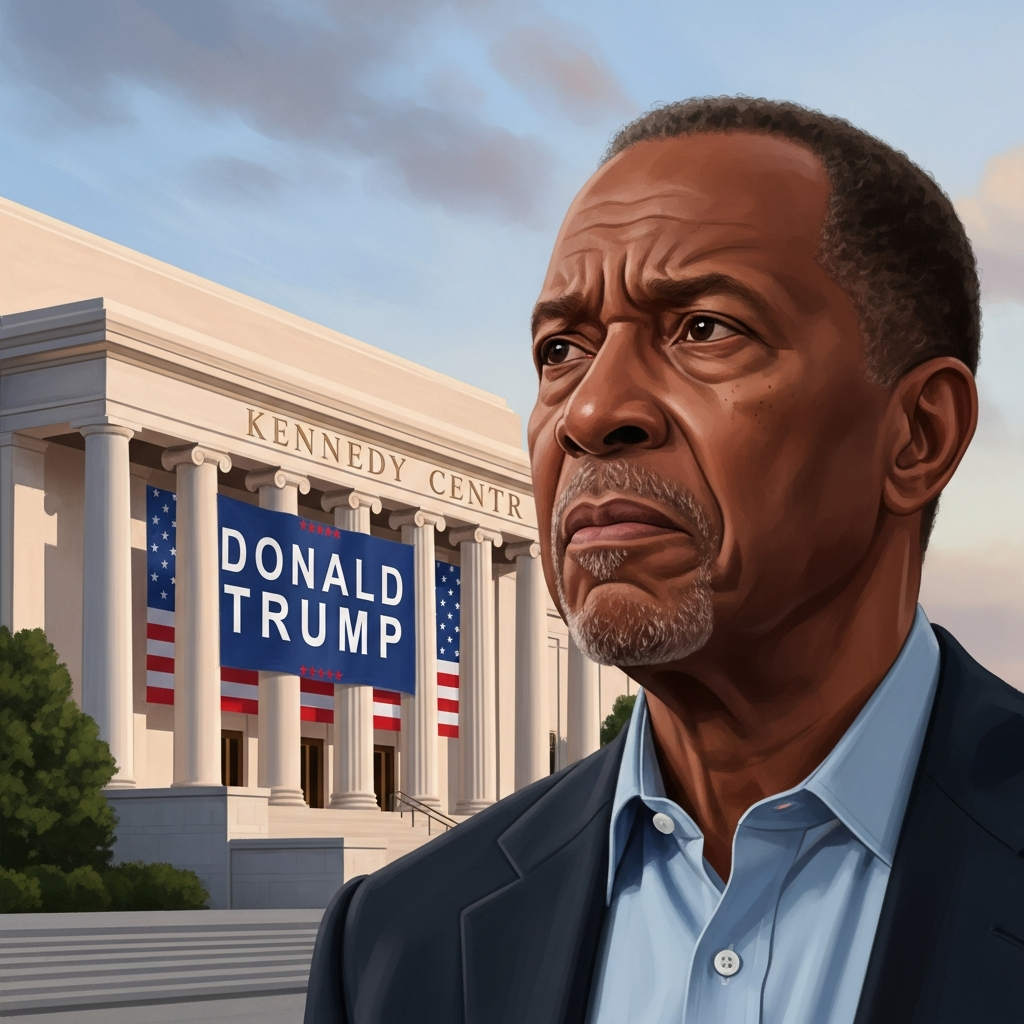
A cherished Christmas Eve jazz concert, a two-decade-long holiday tradition at Washington D.C.’s esteemed Kennedy Center, has been abruptly canceled. This dramatic decision by long-time host and musician Chuck Redd stems from the controversial addition of President Donald Trump’s name to the iconic performing arts institution. The abrupt rebranding has sparked widespread outrage, igniting a fierce debate over the center’s legal status as a memorial and the principle of artistic freedom within federal cultural institutions.
Christmas Eve Tradition Halted by Artistic Protest
Musician Chuck Redd, a renowned drummer and vibraphone player, officially called off his planned Christmas Eve “Jazz Jam” concert. Redd, who has hosted the holiday series since 2006, succeeding jazz bassist William “Keter” Betts, confirmed his decision to The Associated Press. He stated unequivocally that the name change, first seen on the Kennedy Center website and then hours later prominently displayed on the building’s facade, prompted his protest. The Kennedy Center’s website now lists the highly anticipated concert as officially canceled, with no plans for rescheduling. This move by Redd is a significant personal statement, given his long history of performing at the center since the start of his career.
The Controversial Rebranding: Trump’s Name Added
The facility’s facade now reads “The Donald J. Trump and The John F. Kennedy Memorial Center for the Performing Arts.” This change, implemented last Friday, December 19, 2025, follows months of President Trump hinting at his openness to such an alteration. According to the White House, the decision received approval from a board handpicked by the president. This action signals a broader push by the administration to reshape federal cultural institutions, often framed as a mission to counter “woke” culture.
The rebranding effort has drawn immediate and significant criticism from various sectors. Many view it as a direct affront to the legacy of John F. Kennedy and a violation of the center’s original purpose. Demonstrators have gathered in Washington D.C., protesting the decision and the prominent display of Trump’s name.
Legal Battle Looms Over JFK Memorial Status
The legality of adding President Trump’s name to the Kennedy Center is strongly contested by scholars, historians, and legal experts. The center was established by Congress in 1964, a year after President Kennedy’s assassination, specifically as a living memorial to him. Crucially, the foundational law explicitly prohibits the board of trustees from designating the center as a memorial to anyone else or from affixing another individual’s name to its exterior. Former House historian Ray Smock, among others, firmly asserts that any such alterations would necessitate congressional approval.
President Kennedy’s niece, Kerry Kennedy, has publicly vowed to work towards removing Trump’s name from the building once he leaves office. Joe Kennedy III, JFK’s grandnephew and a former House member, took to social media to denounce the change, drawing parallels to an attempt to rename the Lincoln Memorial. Senator Chris Van Hollen, a Maryland Democrat, has pledged to seek an “amendment on the interior appropriations bill” to reverse the change when Congress reconvenes, underscoring the political and legislative challenges ahead. These statements highlight a growing consensus among opponents that the board lacks the authority for such a unilateral decision, setting the stage for potential legislative and judicial action.
Trump’s Expanding Influence on Federal Arts Institutions
This name change is not an isolated event but rather part of a discernible pattern of President Trump’s increasing involvement with the Kennedy Center during his second term. Initially, he largely ignored the institution, which honors an iconic Democrat. However, he has since become deeply involved, reportedly forcing out previous leadership and significantly overhauling the board to install his appointees. Notably, he arranged for himself to head the board, and appointed staunch ally Ric Grenell as interim executive director.
Breaking long-standing tradition, Trump personally hosted this year’s Kennedy Center Honors, a role typically assumed by the president as a spectator. These actions are widely perceived as part of a larger strategy to exert political influence over federal cultural institutions and reshape them in his image. White House press secretary Karoline Leavitt defended the decision on social media, claiming the addition would lead to “new levels of success and grandeur” for the center, enhancing its reconstruction, financial standing, and reputation. Critics, however, argue that these actions compromise traditional U.S. institutions and artistic integrity.
A Wave of Artistic Withdrawals and Boycotts
The controversy surrounding the Kennedy Center Trump name has led to a significant wave of artistic withdrawals and boycotts. Chuck Redd’s cancellation of the Christmas Eve concert is just one instance in a growing list of artists refusing to perform at the rebranded venue. Numerous prominent performers have called off engagements since Trump’s increased involvement with the center.
Among those who have pulled out are actress and writer Issa Rae, rock musician Peter Wolf, and “Hamilton” creator Lin-Manuel Miranda, who canceled a planned production of his acclaimed musical. These collective actions signify a robust artistic protest against what many see as political interference and a disregard for the center’s original commemorative intent. The arts community’s strong reaction underscores the deep tension between the administration’s policies and the values of artistic freedom and institutional integrity. The Kennedy Center now faces a crossroads, increasingly pulled into partisan politics, which could redefine its role and relationship with the performing arts world.
Frequently Asked Questions
Why was the Christmas Eve jazz concert at the Kennedy Center canceled?
The long-standing Christmas Eve jazz concert was canceled by its host, musician Chuck Redd, in protest of the Kennedy Center’s controversial rebranding. Redd made the decision after President Donald Trump’s name was officially added to the facility’s facade and website on December 19, 2025. As a sign of artistic defiance against what he viewed as an inappropriate political intervention, Redd chose to halt the beloved holiday tradition.
What are the legal arguments against renaming the Kennedy Center?
Legal scholars and historians strongly argue that adding President Trump’s name violates federal law. The Kennedy Center was established by Congress in 1964 as a living memorial to John F. Kennedy, and the law explicitly prohibits its board of trustees from creating memorials for others or adding other names to its exterior. Experts, including former House historian Ray Smock, assert that any such name change would require congressional approval, which was not obtained, making the board’s decision legally questionable.
How has the controversial renaming of the Kennedy Center impacted the arts community?
The controversial renaming has sparked widespread condemnation and significant impact within the arts community. Beyond Chuck Redd’s concert cancellation, numerous other prominent artists, including Issa Rae, Peter Wolf, and Lin-Manuel Miranda, have canceled planned performances and productions. This collective artistic boycott highlights a deep concern over political influence on cultural institutions and a strong commitment to artistic freedom, creating substantial tension between the administration and the performing arts sector.
Conclusion
The cancellation of the traditional Christmas Eve jazz concert at the Kennedy Center highlights a profound cultural and political conflict. The controversial addition of President Trump’s name to the John F. Kennedy Memorial Center has ignited a fierce debate, drawing lines between legal precedent, artistic integrity, and political influence. As legal challenges and congressional actions are anticipated, the future of this revered institution remains uncertain. The widespread artistic protests underscore the deep concerns within the arts community, signaling a sustained period of tension and scrutiny for the newly rebranded center.