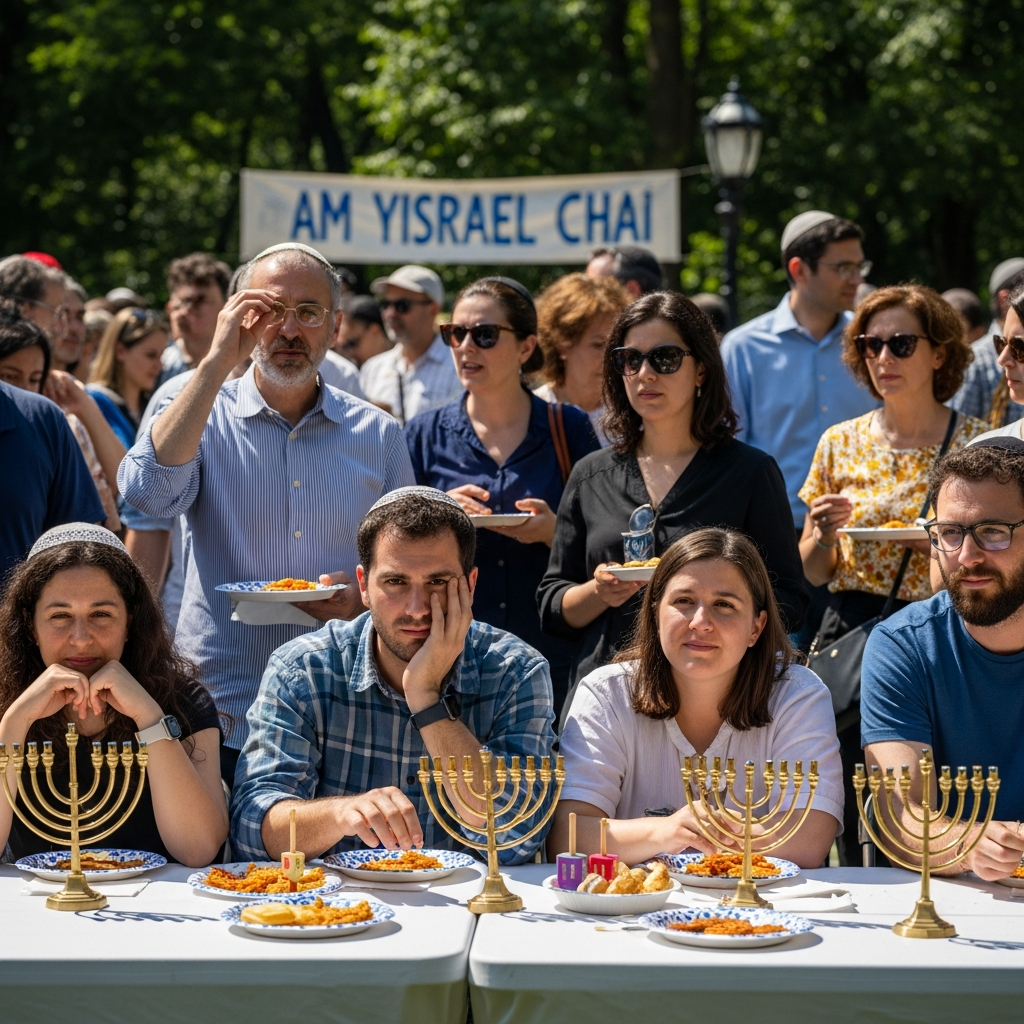
The warmth of summer, with its long days, sun-drenched beaches, and the joyous sounds of children, should usher in a season of light and celebration. For Jewish communities, particularly in the Southern Hemisphere, this period often aligns with Hanukkah, a time traditionally marked by joy and communal gathering. Yet, an increasingly unsettling reality casts a shadow over these moments: the stark, undeniable rise of antisemitism, forcing Jewish people worldwide to confront fear and a painful sense of isolation. This pervasive challenge demands urgent attention and unwavering solidarity.
The Unsettling Reality: A Season of Fear
Across the globe, Jewish communities are experiencing a disturbing surge in hate-fueled incidents. From synagogue gates fortified with armed guards to peaceful vigils disrupted by violence, the sense of vulnerability has intensified. In Boulder, Colorado, attorney Sarah Morris poignantly described her daily routine of taking her toddler to a Jewish Community Center, a place of warmth that requires constant protection. This heightened awareness exploded into stark reality on June 1, 2025, when a peaceful group of Jews on Pearl Street Mall, many elderly, families, and children, were attacked with Molotov cocktails and a flamethrower during a vigil for hostages. Twelve people were burned, and tragically, 82-year-old Karen Diamond later died from her injuries. Morris emphasizes that such attacks cause profound psychological distress and are unambiguously hate crimes.
A Disturbing Pattern of Violence
This Boulder incident is not isolated. Rabbi Ari Jun, from Cincinnati’s Temple Sholom, highlights it as part of a horrifying pattern. He notes that fewer than 60 days prior, a Jewish governor’s mansion was firebombed. Less than two weeks before the Boulder attack, two Israeli Embassy staffers, Yaron Lischinsky and Sarah Lynn Milgrim, were tragically murdered in Washington D.C., outside the Capital Jewish Museum on May 21, 2025. The suspect reportedly shouted “Free, free Palestine” upon arrest, leading American Jewish Committee CEO Ted Deutch to conclude it was an attack motivated by hate against Jewish people and the Jewish state. These incidents, alongside violent antisemitic protests at universities and an arson attack on Pennsylvania Governor Josh Shapiro’s home during Passover, paint a grim picture of escalating antisemitism across the United States. FBI reports from 2023 reveal that nearly 70% of religion-based hate crimes targeted Jews, who comprise only about 2% of the U.S. population, underscoring the disproportionate threat faced by the Jewish community.
Navigating the Tightropes: Identity, Politics, and Empathy
Jay Michaelson, writing for Forward, aptly describes “being Jewish in America today feels like walking multiple tightropes at once.” For many, particularly liberal Zionists, this involves supporting Israel while opposing the brutality of the Gaza war. Michaelson stresses the moral imperative to condemn all violence, whether against Jews, Palestinians, or activists of any stripe. He warns that incitement, such as shouts of “Globalize the Intifada,” can constitute “stochastic terrorism” leading to violence against Jews. While not all anti-Zionism is antisemitism, the line is crossed when Jews or Jewish institutions are targeted.
The Perilous Intersection of Identity and Geopolitics
The discussion around antisemitism is further complicated by the Israeli-Palestinian conflict and the contentious concept of “settler colonialism.” As examined in Carlin Romano’s review of Adam Kirsch’s On Settler Colonialism and Peter Beinart’s Being Jewish After the Destruction of Gaza, intellectuals often find themselves on opposing sides. Kirsch argues that Israel does not fit the settler colonial framework, pointing out that Israelis lack a “colonial” mother country, the Palestinian Arab population within Israel has grown significantly, and Jews have an ancient connection to the land. Conversely, Beinart describes Israel’s actions in Gaza as “mass killing of children” and suggests that if Israel is a settler colonial entity, then all Jews who support it are complicit, criticizing Jewish support for Israel as “idolatry.” This intellectual battle highlights how Jewish identity and safety are often made conditional or politicized, a theme echoed by Morris, who argues that framing Jewish safety through the lens of Zionism makes Jewish pain a “political liability.”
Reframing Jewish Suffering: A Critical Discourse
Michaelson cautions against allowing fear to be “weaponized, exploited and hijacked by nationalist conservatives,” noting that many Jews distrust both the anti-Zionist far-left and the anti-antisemitic right. He urges a distinction between historical pogroms and current terrorist acts, which are often connected to Israel’s actions in Gaza. While these acts are unequivocally antisemitic, lumping them together without acknowledging context can inadvertently generate more fear. Yet, the overwhelming feeling among Jewish communities, as expressed by Rabbi Jun, is that their suffering is often dismissed or “both-sided,” leading to a lack of reciprocal condemnation when Jews are targeted.
The Weight of Silence: Why Solidarity Matters
Perhaps most distressing to the Jewish community is the pervasive silence from non-Jewish friends, colleagues, and civic leaders. Sarah Morris experienced painful disengagement from progressive friends, attributing it to fear of “saying the wrong thing.” Jonathan Lev, CEO of the Boulder JCC, succinctly puts it: “Silence is not neutral. It’s permission.” Rabbi Jun describes how Jewish social media feeds are inundated with discussions of attacks, yet direct support from non-Jewish acquaintances is rare.
The Cost of Indifference
This silence stems partly from what Rabbi Jun identifies as “ignorance”—the failure of many to understand that phrases like “globalize the intifada” can directly lead to violence against Jews. There’s a persistent question of whether critics of Israel will ever recognize these dangerous consequences, or if they will continue to categorize such acts as isolated incidents or, worse, as deserved retribution for Israeli government actions. This conditional empathy is deeply hurtful, making Jewish pain seem less valid if it doesn’t fit convenient narratives.
Beyond Conditional Condemnation
The core plea from the Jewish community is not for political alignment or support for Israel’s government, but for basic human empathy and unequivocal condemnation of violence against Jews for simply being Jewish. Nicole Russell, in her piece on the D.C. embassy murders, asks, “If Jews serving in Washington, D.C., where security should be robust, can be shot and killed in public, where are they safe?” This question underscores the urgent need for a united front against antisemitism, without caveats related to the Middle East.
A Collective Call to Action: Demanding Better
The responsibility to combat rising antisemitism extends far beyond the Jewish community. Sarah Morris issues a strong call for coalition and action:
Elected officials, bar associations, and universities must explicitly name Jewish hatred, track and address it, and confront those within their ranks who politicize Jewish suffering.
Progressive allies and organizations are implored to treat antisemitism as a real issue, understanding that Jewish identity is diverse and cannot be dismissed when condemnation is conditional.
- The broader public is asked to engage with Jewish neighbors, show empathy, understand that Jewish grief is valid and doesn’t negate others’, and express outrage over attacks on Jews for simply existing.
- coloradosun.com
- forward.com
- www.cincinnati.com
- www.usatoday.com
- momentmag.com
Pathways to Genuine Support
This commitment to fight antisemitism means taking concrete steps: speaking out against hate speech, educating oneself and others, and fostering inclusive environments where Jewish people feel safe and valued. It requires recognizing antisemitism as a unique and persistent form of prejudice, distinct from criticism of Israel, but often intertwined in dangerous ways. Rabbi Jonathan Sacks described antisemitism as a mutating virus that consistently scapegoats Jews for problems for which all sides are responsible. This “mutating virus” continues to find new forms, and confronting it requires constant vigilance and an unwavering moral compass.
Cultivating Resilience, Not Paranoia
While the situation is grave, Michaelson advises against “fanning the flames of fear and paranoia.” He advocates for a path of “vigilance but not paranoia, security but not panic, honoring our emotions without handing our lives over to them.” The Jewish community, with its deep history of resilience, seeks not only to survive but to thrive, embracing Jewishness with joy and pride, free from constant caution. This vital work, however, cannot be accomplished alone. It demands collective action and a shared commitment to a world where no one fears for their life simply for being who they are.
Frequently Asked Questions
What constitutes antisemitism in the context of recent attacks, and how does it differ from criticism of Israeli policies?
Antisemitism directly targets Jews or Jewish institutions with hate, violence, or discrimination because of their Jewish identity, heritage, or perceived connection to Israel. Recent attacks, such as the Molotov cocktail assault in Boulder or the murder of Israeli Embassy staffers in D.C., cross the line when individuals are attacked for being Jewish or representing Israeli interests. While criticism of Israeli government policies is legitimate and distinct from antisemitism, it can become antisemitic if it uses antisemitic tropes, holds Jews collectively responsible for Israeli actions, or denies Israel’s right to exist as a Jewish state.
How are Jewish communities in places like the U.S. and Australia responding to rising antisemitism and feelings of isolation?
Jewish communities are responding with increased security measures, advocacy, and calls for solidarity. Synagogues and community centers have armed guards, a stark reality for places meant for gathering and celebration. Leaders are appealing to elected officials, progressive allies, and the broader public to explicitly condemn antisemitism and provide unconditional support. There’s a concerted effort to foster internal resilience while also reaching out to non-Jewish communities, urging them to break their silence and engage empathetically, recognizing that this fight requires collective action.
What actionable steps can individuals and civic leaders take to better support Jewish community safety and combat antisemitism?
Individuals can educate themselves, speak out against hate speech, show empathy to Jewish neighbors without political caveats, and engage with Jewish community organizations. Civic leaders and elected officials must unequivocally name and condemn Jewish hatred, track antisemitic incidents, and confront those who politicize Jewish suffering. Progressive allies are urged to treat antisemitism as a real issue, separate from disagreements with Israeli policy. Breaking the “silence,” showing active solidarity, and advocating for robust security measures are crucial steps.
The fight against rising antisemitism is a profoundly complex and deeply personal struggle for Jewish communities worldwide. It is a battle against a mutating virus of hate that demands not just recognition, but active, unwavering solidarity. The longing for seasons of joy, free from fear, can only be realized when leaders, allies, and the general public collectively commit to defending Jewish safety as non-negotiable, ensuring that no community ever feels they are fighting alone.