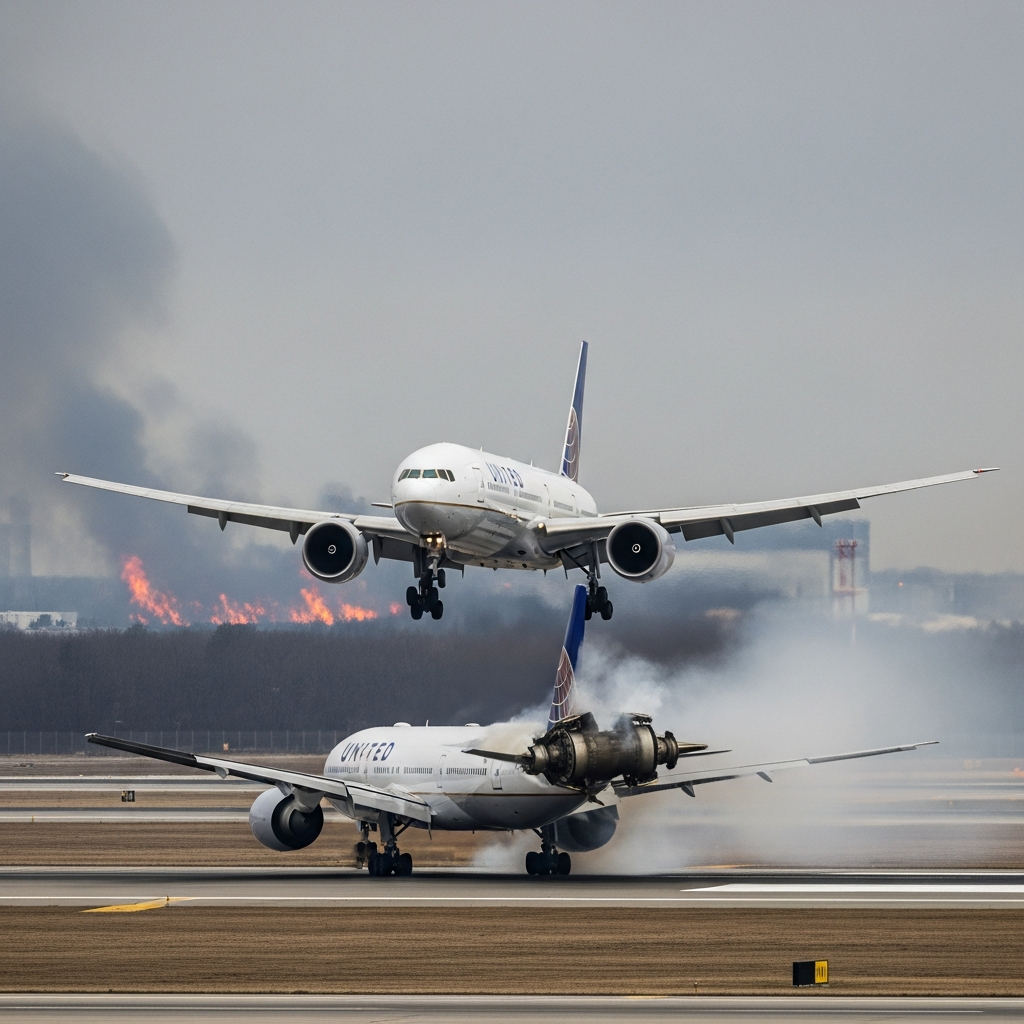
A dramatic scene unfolded at Washington Dulles International Airport (IAD) on Saturday, December 13, 2025, when United Airlines Flight 803, a Boeing 777 bound for Tokyo, was forced into an emergency return shortly after takeoff. The aircraft, carrying 275 passengers and 15 crew members, experienced a critical engine failure that sparked a brush fire near the runway and necessitated an urgent, yet ultimately safe, landing. This high-stakes incident, while alarming, showcased the professionalism of the flight crew and the effectiveness of aviation emergency protocols, ensuring no injuries were reported.
The Tokyo-Haneda bound flight, identified as United 803, had just departed from Dulles International when one of its two General Electric engines lost power. According to Transportation Secretary Sean Duffy, a piece of the engine cover separated during this malfunction, igniting a small brush fire on the ground near the departure runway. Airport fire responders swiftly extinguished this ground fire, as confirmed by Emily McGee, a spokesperson for the Metropolitan Washington Airports Authority. The rapid response on the ground prevented any further escalation of the initial blaze.
The Mid-Air Emergency: Fuel Dumping and Calm Coordination
Following the engine failure, the flight crew immediately declared an emergency. Rather than attempting an immediate landing, which would have been unsafe given the aircraft’s heavy takeoff weight, the pilots initiated standard emergency procedures. This involved circling the airport for approximately 45 minutes to burn off and dump excess fuel. Residents in Dale City and Fredericksburg, Virginia, nearly 40 miles away, captured video of the Boeing 777 releasing fuel over their communities.
Air traffic control audio revealed a calm but urgent coordination effort to guide the stricken aircraft back to Dulles. Controllers efficiently cleared airspace and placed ground crews on high alert for the impending emergency landing. Fuel dumping is a critical safety measure, reducing the aircraft’s weight to a safe level for landing. This minimizes the risk of structural damage upon impact, especially to landing gear, and ensures the aircraft can land at a slower, safer speed. The crew’s adherence to these protocols was paramount in securing a safe return.
A Safe Landing and Immediate Response
United Flight 803 successfully landed back at Washington Dulles International Airport around 1:20 p.m. to 1:30 p.m. local time, approximately an hour after its initial departure. Upon landing, airport fire responders were immediately on hand to inspect the aircraft and ensure all systems were safe. Crucially, the airline confirmed that all 275 passengers and 15 crew members disembarked without a single injury. This outcome stands as a testament to the rigorous training pilots receive for such critical situations and the robust safety systems inherent in modern aviation.
The Federal Aviation Administration (FAA) has announced a full investigation into the engine failure. This probe will delve into the precise cause of the malfunction, the separation of the engine cover, and any contributing factors. Such investigations are standard practice after any significant aviation incident and are vital for continuous improvements in aircraft safety and operational procedures. Understanding the mechanics of the failure will inform future maintenance and design considerations for the Boeing 777-200ER, an aircraft delivered in November 1998 and regularly operating this long-haul route.
Aviation Safety in Focus: A Broader Context
This incident, while serious, unfolds against a backdrop of a broader “turbulent year for air travel,” as noted by reports. While high-profile safety scares, runway incursions, and severe turbulence injuries have captured headlines, it is important to contextualize such events. Modern aviation maintains an incredibly high safety record, with redundancies built into every system to manage failures. The quick and effective response to United Flight 803’s engine issue underscores the effectiveness of these safety nets and the expertise of flight crews.
Airline operations, especially for long-haul carriers like United, are under constant scrutiny. Even minor emergencies can trigger public concern, but the industry’s commitment to safety is unwavering. Following the incident, United Airlines promptly closed a United Club lounge at Dulles to provide immediate assistance and rebooking services for the affected passengers. A different aircraft was arranged to operate the flight to Tokyo later that same Saturday, ensuring travelers could continue their journeys with minimal further delay. This swift resolution highlighted the airline’s commitment to passenger well-being and operational resilience.
Ensuring Passenger Well-being and Future Travel Confidence
For passengers, experiencing an emergency landing can be deeply unsettling. However, the smooth handling of United Flight 803’s return provides reassurance regarding the aviation industry’s capacity to manage crises. The absence of injuries is the paramount indicator of a successful emergency response. Ongoing investigations by the FAA will provide transparent findings, further solidifying confidence in air travel. These incidents, while rare, serve as critical learning opportunities for airlines, manufacturers, and regulatory bodies alike.
The event also brings to light the sophisticated emergency protocols that are meticulously practiced by flight crews. From recognizing engine failure to executing complex maneuvers like fuel dumping and coordinating with air traffic control, every step is designed to maximize safety. Travelers can take solace in the fact that these systems are in place and regularly tested, contributing to the overall reliability and safety of commercial flights worldwide.
Frequently Asked Questions
What exactly happened during the United Flight 803 engine failure?
On December 13, 2025, United Airlines Flight 803, a Boeing 777-200ER departing Washington Dulles for Tokyo, experienced a critical engine failure shortly after takeoff. One of its two engines lost power, and a piece of the engine cover separated. This debris then ignited a small brush fire on the ground near the runway, which airport fire responders quickly extinguished. The aircraft subsequently circled the airport, dumped fuel, and made a safe emergency landing back at Dulles with no injuries reported.
What are the standard emergency procedures for an aircraft engine failure during takeoff?
When an aircraft experiences an engine failure during takeoff, standard emergency procedures are immediately activated. The flight crew declares an emergency and typically prepares to return to the airport. If the aircraft is too heavy for an immediate safe landing, pilots will dump fuel to reduce the plane’s weight to a level that minimizes stress on the landing gear and structure upon impact. Air traffic control is alerted to clear airspace, and ground emergency crews are put on standby, as was the case for United Flight 803.
How does this incident impact passenger safety and confidence in air travel?
While an engine failure is a serious event, the safe outcome of United Flight 803 underscores the high safety standards and robust emergency protocols in modern aviation. No injuries were sustained, demonstrating effective crew training and aircraft design redundancies. Incidents like these, though unsettling, highlight that safety systems work as intended. The FAA’s ongoing investigation will provide transparency, ultimately strengthening public confidence by showing how the industry continuously learns and adapts to enhance passenger safety.
The incident involving United Flight 803 at Washington Dulles serves as a powerful reminder of the complex and highly regulated nature of commercial air travel. While a rare occurrence, engine failures demonstrate the critical importance of well-trained flight crews, advanced aircraft safety systems, and meticulously planned emergency responses. The swift and professional actions by United Airlines, airport emergency services, and air traffic control ensured that a potentially dangerous situation resulted in a completely safe outcome for everyone onboard. The ongoing FAA investigation will undoubtedly provide valuable insights, further contributing to the continuous enhancement of aviation safety for all travelers.