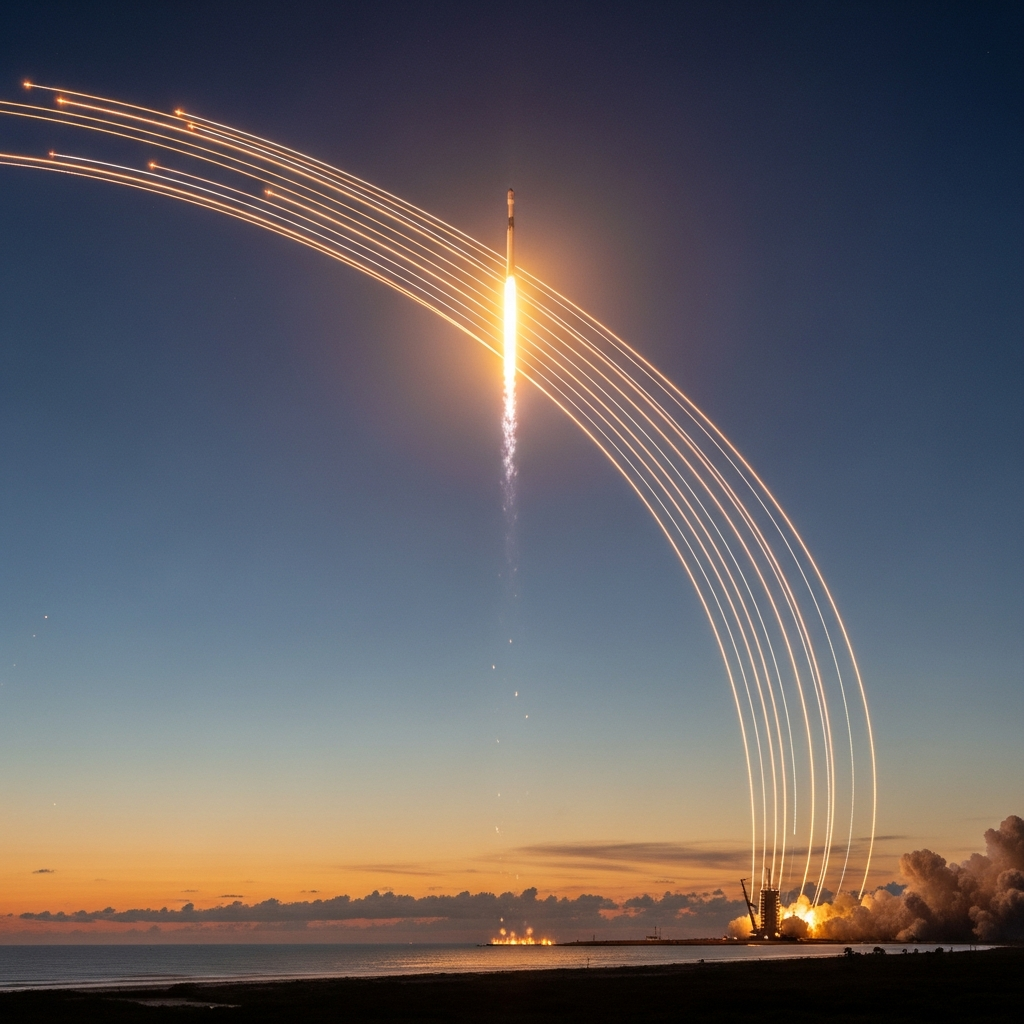
Florida’s Space Coast is experiencing an unprecedented era of activity, largely driven by SpaceX’s relentless Falcon 9 rocket. This workhorse of space exploration is not just launching satellites; it’s redefining access to orbit and setting new benchmarks for frequency and reusability. From critical national security missions to massive Starlink deployments, the Falcon 9 is cementing its legacy, marking its 15th anniversary as a transformative force in the global space industry. Residents across Central Florida are becoming increasingly familiar with the sights and sounds of these powerful launches, including the occasional sonic boom.
The Space Coast’s Unprecedented Launch Surge
The year 2025 is shaping up to be a historic period for Florida’s Space Coast. Projections indicate the region will surpass 110 launches, a significant leap from the 93 launches recorded in the previous year. This remarkable surge firmly establishes the Space Coast as a global leader in space exploration. At the heart of this boom is SpaceX, which is responsible for nearly all missions, with only a handful contributed by other entities. This dominance highlights SpaceX’s operational efficiency and the reliability of its Falcon 9 rocket.
December 2025 exemplified this intense launch cadence. The month kicked off with a successful Falcon 9 mission on December 1st, deploying 29 Starlink satellites from Kennedy Space Center. This particular mission also showcased the impressive reusability of the Falcon 9, with its first-stage booster achieving its fourth successful recovery. This launch alone marked the 102nd mission from either Kennedy Space Center or Cape Canaveral for the year, underscoring the rapid pace.
A Look at SpaceX’s Busy Launch Schedule
SpaceX’s ambitious December schedule extended far beyond single commercial deployments. A second Falcon 9 mission for Starlink was swiftly planned for December 2nd, featuring a booster on an incredible 25th flight, slated for landing on the droneship “A Shortfall of Gravitas.” Further demonstrating the technological and economic advantages of reusable rocket technology, another launch scheduled for December 6th aimed to use a booster for its record 32nd journey into space.
Beyond commercial endeavors, SpaceX is also an indispensable partner for national security. A Falcon 9 rocket was scheduled for December 9th, carrying a classified NROL-77 satellite for the US National Reconnaissance Office. This particular mission, launched from Space Launch Complex 40 at Cape Canaveral Space Force Station, was a critical component of ensuring assured access to space for national security purposes, marking SpaceX’s 11th such launch of the year.
The Sonic Booms Heard Across Florida
Following the launch of the NROL-77 mission, a significant event for residents in Central Florida was the anticipated sonic boom. Approximately eight minutes after liftoff, the Falcon 9’s first stage was expected to execute a precision landing at SpaceX’s Landing Zone 2, situated at Cape Canaveral. This landing sequence was projected to create distinct sonic booms, a phenomenon familiar to many who live near the Space Coast.
Residents across several Florida counties were advised about the potential for these booms. The affected areas included Brevard, Orange, Osceola, Indian River, Seminole, Volusia, Polk, St. Lucie, and Okeechobee. The intensity and audibility of these sonic booms are, however, subject to variation based on prevailing weather and other environmental conditions. This ongoing activity is a vivid reminder of Florida’s pivotal role in global space exploration.
Falcon 9: A Legacy of Innovation and Reusability
Celebrating its 15th anniversary since its inaugural launch from Cape Canaveral on June 4, 2010, the Falcon 9 rocket has fundamentally transformed the space industry. It stands as the most frequently launched rocket from Florida and a global workhorse. Its groundbreaking reusability has been a true game-changer, dramatically reducing launch costs and democratizing access to space for a wider array of users, including smaller businesses and novel payloads.
Jonathan McDowell, an astrophysicist at the Harvard-Smithsonian Center for Astrophysics, has highlighted the “remarkable” sustained cadence and reliable recovery of Falcon 9 first stages. This capability has not only quantitatively but also qualitatively altered the entire launch industry. This year, with over 100 launches projected from Florida, the vast majority are Falcon 9 missions. Out of 47 launches so far this calendar year, 45 were SpaceX rockets, dwarfing competitors like Blue Origin’s New Glenn and ULA’s Atlas V, which each launched only once.
Driving Down Costs and Opening Up Space
The rapid reusability of the Falcon 9 has compelled competitors to actively pursue similar technologies. More importantly, it has opened up space to previously unimaginable ventures. Small satellite companies, once financially barred from launching their payloads, can now access orbit through SpaceX’s Ride Share Program for as little as $325,000. While other private companies, such as Blue Origin with its New Glenn, have developed multi-stage rockets with reusable first stages, none have yet matched the Falcon 9’s consistent success in recovery and reusability.
Beyond commercial success, the Falcon 9 has secured critical contracts with NASA, delivering scientific missions and astronauts, including payloads destined for the Moon and beyond. It also plays a vital role in national security and military launches, consistently leading in this category over rivals like ULA’s Atlas V and Vulcan rockets. The rocket’s unparalleled launch frequency, often flying almost twice a week from both the Space Coast and Vandenberg Space Force Base in California, is largely dedicated to deploying SpaceX’s Starlink satellites, which provide global internet connectivity.
Overcoming Challenges and Ensuring Reliability
Even with its impressive track record, the intensive pace of operations presents its own challenges. The Starlink 12-21 mission, for instance, launched on Wednesday, March 12th, at 10:35 p.m. EDT from pad 40 at Cape Canaveral Space Force Station, after a series of postponements. This mission, which sent 21 Starlink V2 Mini satellites (including 13 with new Direct to Cell capabilities) into orbit, marked SpaceX’s first Starlink launch in over a week due to various operational challenges and weather conditions.
The Falcon 9 first stage booster 1069, flying for an impressive 22nd time, executed a precise landing on the droneship ‘A Shortfall of Gravitas’ approximately eight minutes after liftoff. This landing marked the 101st booster recovery for ASOG and the 333rd overall for SpaceX. Weather conditions at launch were highly favorable, with the 45th Weather Squadron forecasting a greater than 95 percent chance of clear skies.
Prior to this successful launch, the mission experienced several scrubs. High ground-level winds prevented an attempt on Monday. On Tuesday, SpaceX opted not to fuel its rocket after successfully completing the NASA SPHEREx and PUNCH missions from Vandenberg Space Force Base. More significantly, the Starlink 12-21 mission followed a period of heightened scrutiny due to a fuel leak during the Starlink 12-20 mission on March 2nd. This incident unfortunately resulted in the loss of first stage booster B1086 less than a minute after it landed on the droneship ‘Just Read the Instructions.’
Kiko Dontchev, SpaceX’s Vice President of Launch, provided valuable insights into the recent delays. He cited “historically bad” sea states on the West Coast throughout the winter, which severely hampered the efficient recovery of both boosters and fairings. This slowed down refurbishment timelines and increased the need for less efficient highway transport methods. Dontchev also emphasized that the issue with booster B1086 served as a crucial learning opportunity, enabling SpaceX to enhance the reliability of its entire fleet and leading to a temporary stand-down in launches. He reiterated that SpaceX prioritizes safety and reliability above all else, often pausing missions to thoroughly verify systems, especially for critical government and customer payloads.
Notably, even as the root cause of the B1086 fuel leak remained under review, NASA cleared the Falcon 9 rocket to launch the Crew-10 mission. NASA leaders reviewed data from a static fire test of the Crew-10 booster’s first stage, inspected its engine bay, and conducted “sniff” checks, finding no indications of leaks. This provided NASA with sufficient confidence to proceed with future crewed launches, highlighting their comfort with SpaceX’s understanding and management of the recent anomaly.
The Future Trajectory of Space Exploration from Florida
The Falcon 9’s legacy builds upon SpaceX’s earlier endeavors. Founded in 2002 by Elon Musk with the aim of lowering launch costs and fostering a spacefaring humanity, the company first developed the smaller, single-engine Falcon 1. After three initial failures, Falcon 1 successfully reached orbit on its fourth flight in September 2008, making SpaceX the first privately funded company to achieve orbit with a liquid-fueled rocket. Its fifth and final flight occurred in July 2009, just as the more powerful, nine-engine Falcon 9 was poised for its debut.
A pivotal moment for reusability occurred on December 21, 2015, when a Falcon 9 booster successfully returned to land at Cape Canaveral Landing Zone, a feat previously considered science fiction. This was followed by the first successful drone ship landing on April 8, 2016, after several earlier attempts resulted in booster loss. These milestones cemented SpaceX’s reusability strategy as fundamental to cost reduction.
The Falcon Heavy, a super heavy-lift variant using three Falcon 9 first stages, first launched on February 6, 2018, famously carrying a Tesla Roadster into space. While its side boosters are routinely recovered, the central core booster recovery proved difficult and is no longer attempted to optimize payload mass and fuel. In May 2019, SpaceX launched the first batch of its Starlink internet satellites from Florida. Now, with over 6,000 satellites in orbit, Starlink launches are a routine fixture on the Space Coast.
A landmark achievement came on May 30, 2020, during the COVID-19 pandemic, when a Falcon 9 launched the Crew Dragon spacecraft carrying NASA astronauts Bob Behnken and Douglas Hurley to the ISS. This mission marked the first time a private company transported humans to orbit and the first human spaceflight from American soil since the space shuttle’s retirement in 2011. SpaceX’s commercial crew contract with NASA is now worth nearly $5 billion and extends into the 2030s, with Falcon 9 having launched 10 additional NASA crew missions, three Axiom Space crews, and three private spaceflights.
Looking ahead, SpaceX plans to eventually retire the Falcon 9 in favor of its much larger Starship, currently undergoing test flights from Texas. Starship aims for even greater cost reduction and launch frequency by returning both its booster and upper stage directly to the launch tower. While Starship’s booster return to the tower has been demonstrated, the full system is still under development. Until Starship is fully operational, the Falcon 9 will continue as SpaceX’s primary launch vehicle. In fact, SpaceX has proposed increasing Falcon 9 launches to 120 per year from Cape Canaveral Launch Complex 40, along with a new booster landing zone, signaling its continued dominance for the foreseeable future.
SpaceX’s unparalleled success has also spurred competition. Amazon’s satellite project, now known as Leo 4, is scheduled for an Atlas V launch from Canaveral on December 15th, aiming to rival SpaceX’s Starlink. This indicates a broader push in the global satellite constellation market, promising even more activity and innovation in the years to come.
Frequently Asked Questions
Why are there so many Falcon 9 launches from Florida’s Space Coast now?
The surge in Falcon 9 launches from Florida’s Space Coast is primarily due to SpaceX’s innovative reusability strategy and its aggressive deployment of Starlink internet satellites. By recovering and reusing rocket boosters, SpaceX dramatically reduces launch costs and turnaround times. This operational efficiency, combined with significant contracts for national security and commercial missions, allows for an unprecedented launch cadence, leading to over 100 projected launches from the region in 2025.
Which Florida counties might experience sonic booms from Falcon 9 landings?
When a Falcon 9 first-stage booster returns for a landing at Cape Canaveral’s Landing Zone 2, it can generate sonic booms. Residents in several Florida counties are advised that they might experience these sounds. These counties typically include Brevard, Orange, Osceola, Indian River, Seminole, Volusia, Polk, St. Lucie, and Okeechobee. The intensity and audibility of these sonic booms can vary significantly based on prevailing weather conditions and other environmental factors.
How has SpaceX’s Falcon 9 transformed the global space industry?
The Falcon 9 has profoundly transformed the global space industry through its pioneering reusability, which has drastically lowered launch costs. This cost reduction has democratized access to space, enabling smaller businesses and novel payloads to reach orbit via programs like SpaceX’s Ride Share for as little as $325,000. It has also enabled unprecedented launch frequency, forced competitors to develop similar technologies, and secured critical contracts for NASA and national security missions, making space more accessible and commercially viable than ever before.
In conclusion, the Falcon 9’s ongoing success and SpaceX’s relentless innovation are propelling Florida’s Space Coast into a future of unparalleled activity and strategic importance. From record-breaking launch numbers to pioneering human spaceflight and global internet connectivity, the impact of this rocket extends far beyond the launchpad. As the region gears up for an even busier future, the Falcon 9 remains the principal engine behind this remarkable growth, solidifying its place as a monumental achievement in space exploration.