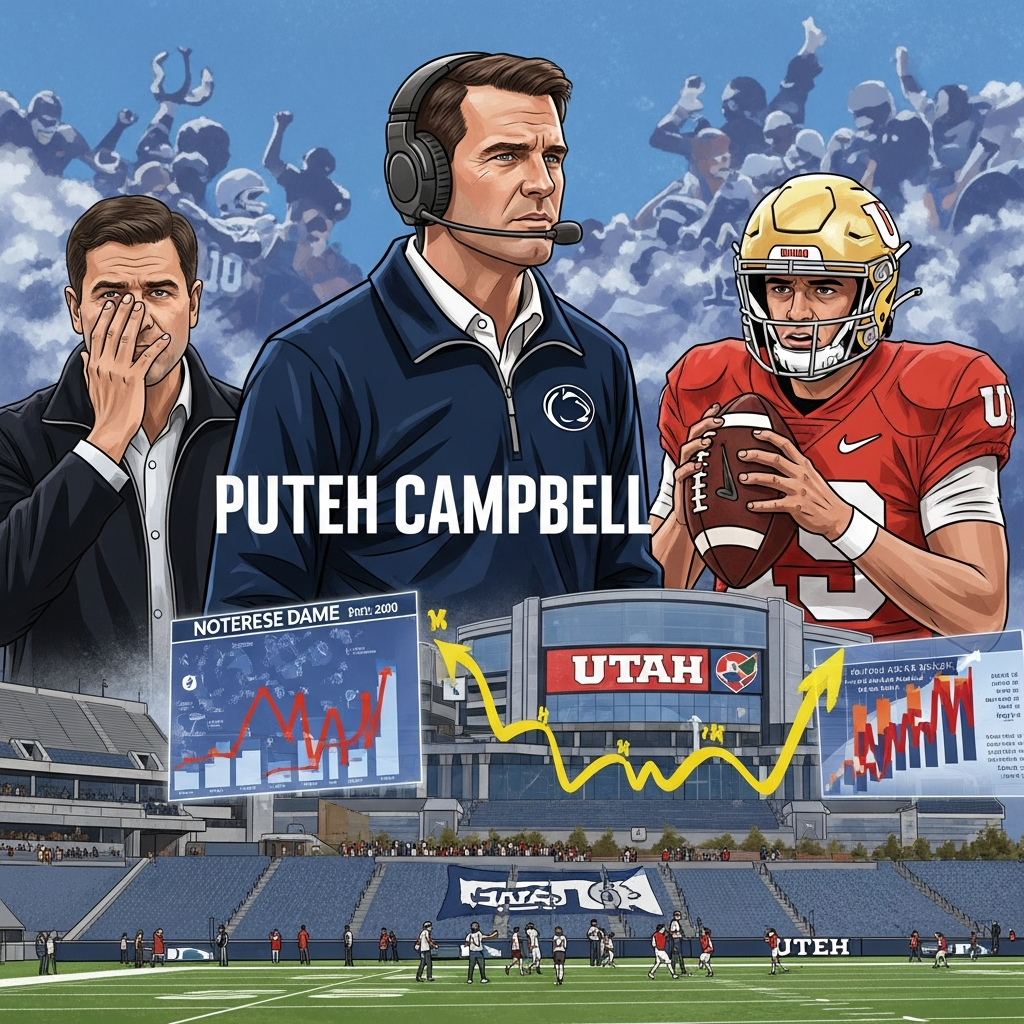
The world of college football is buzzing with pivotal developments, even days after the intense College Football Playoff (CFP) selection. A dramatic shift is underway, impacting elite independent programs, coaching giants, and the very financial future of collegiate athletics. From South Bend’s frustration to Happy Valley’s new leadership and Salt Lake City’s groundbreaking financial move, the sport is navigating a complex landscape of conference realignments, playoff politics, and innovative revenue streams.
Notre Dame’s CFP Snub Ignites Conference Firestorm
The drama surrounding the College Football Playoff selection continues, with Notre Dame at the epicenter of a heated debate. Despite a formidable 10-2 season, the Fighting Irish were left out of the playoff field. This decision sparked immediate outrage from Notre Dame Athletic Director Pete Bevacqua. Appearing on “The Dan Patrick Show” just a day before this report, Bevacqua vehemently declared that the ACC’s handling of the Playoff situation had inflicted “permanent damage to the relationship” between Notre Dame and the conference.
Bevacqua’s criticism didn’t stop there. He characterized the CFP’s weekly ranking shows as a “farce,” asserting that the playoff “was stolen from our student-athletes.” The final at-large spot went to Miami, also 10-2, despite Notre Dame consistently ranking higher throughout the season. Miami’s Week 1 victory over Notre Dame ultimately proved decisive in the committee’s final deliberation, a critical head-to-head factor.
A War of Words: ACC, Big 12, and the Irish Independent Stance
The fallout rapidly escalated into a public spat between influential figures. Bevacqua directly accused the ACC of actively advocating for Miami’s inclusion over Notre Dame. He stated, “We didn’t appreciate the fact that we were singled out repeatedly and compared to Miami, not by Miami… But it raised a lot of eyebrows here that the conference was taking shots at us.” This accusation painted a picture of internal conflict within Notre Dame’s partial conference affiliation.
ACC Commissioner Jim Phillips quickly responded, affirming Notre Dame as “an incredibly valued member of the ACC.” However, he clarified the ACC’s responsibility to “support and advocate for all 17 of our football-playing member institutions” in football. Phillips explicitly denied any suggestion that the ACC disparaged Notre Dame’s candidacy.
Adding another layer to the controversy, Big 12 Commissioner Brett Yormark publicly criticized Bevacqua. Yormark labeled Bevacqua’s behavior “egregious” and “totally out of bounds.” He emphasized that selection decisions are final, part of a system everyone agreed to. Despite this, Bevacqua, emboldened by Notre Dame’s independent football status, appeared unconcerned by such criticisms. He described Notre Dame’s performance after its early losses as “one of the most dominant 10-game runs in the history of college football.” Following the snub, the Notre Dame team, led by its captains, opted out of any bowl games for the season, amplifying the protest.
The Future of Notre Dame’s Independence and CFP Pathway
This ongoing “shaky relationship” raises serious questions about Notre Dame’s long-term future. Experts are now openly debating whether the time has come for the Fighting Irish to sever ties with the ACC completely. A potential new scheduling deal with power conferences like the Big Ten or the SEC could offer a more stable and less contentious pathway to playoff contention.
Adding complexity is a crucial rule set to take effect for the 2026 season. This rule would grant Notre Dame an automatic CFP berth if they are ranked in the Top 12. However, discussions have emerged questioning whether this vital rule could potentially be voided amidst the current conference tensions and political maneuvering. The controversy highlights the inherent challenges of maintaining independence within a college football system increasingly shaped by conference interests and championship games, leaving many to ponder if the benefits of independence are still “worth the playoff price.”
Penn State Welcomes Matt Campbell to Lead the Nittany Lions
Away from the conference skirmishes, the coaching carousel, which had significantly slowed, delivered a major development in Happy Valley. Penn State has officially named Matt Campbell as its new head coach, bringing a fresh perspective to the Nittany Lions. Campbell arrives with a decade of experience, having previously led the Iowa State program with notable success.
This hire has been met with enthusiasm from analysts and fans alike. Campbell is known for building consistent programs and fostering player development. The discussion now shifts to what Campbell needs to implement to succeed at Penn State. Key areas for focus will likely include recruiting within the Big Ten footprint, establishing a clear offensive and defensive identity, and navigating the high expectations that come with leading a perennial power. His tenure at Iowa State demonstrated an ability to maximize talent and create a competitive culture, attributes that will be essential for success in the demanding Big Ten conference. The Nittany Lions faithful eagerly anticipate the dawn of the Matt Campbell era.
Utah Forges Groundbreaking $500 Million Private Equity Deal
In a move that could redefine collegiate sports finance, the University of Utah Athletics has struck a groundbreaking private equity deal. This significant agreement, forged with Otro Capital, is projected to bring in over $500 million for the Utes’ athletic department. This news, initially broken during the recording of the “College Football Enquirer” podcast, has sent ripples across the NCAA landscape.
The deal marks a potential turning point for how athletic programs generate revenue and secure their financial futures. Experts are keenly discussing whether this arrangement could “open the floodgates” for similar private equity investments across other major college athletic programs. Such deals offer substantial upfront capital, providing immediate financial stability and resources for facility upgrades, coaching salaries, and enhanced athlete support. However, they also raise questions about long-term implications, potential oversight from external financial entities, and the balance between athletic mission and investor returns. While initial expectations are high for Utah’s enhanced competitive position, the broader collegiate sports world watches closely for the hesitations and expectations to unfold as this innovative financial model takes shape.
Frequently Asked Questions
What were the primary reasons cited for Notre Dame’s exclusion from the College Football Playoff?
Notre Dame’s exclusion from the 2025 College Football Playoff was primarily due to two early-season losses against Miami and Texas A&M. Despite a strong 10-game winning streak to finish the season, the head-to-head loss to Miami (both teams finished 10-2) proved decisive for the selection committee. Additionally, Notre Dame’s status as an independent program meant it lacked a conference championship game, which often provides a crucial “high-profile data point” for other teams late in the season. The committee’s final ranking decisions, which saw Miami leapfrog Notre Dame, also sparked controversy.
How might Notre Dame’s relationship with the ACC evolve after Athletic Director Bevacqua’s strong criticisms?
Notre Dame Athletic Director Pete Bevacqua’s strong criticisms, including claims of “permanent damage” to the relationship and accusations that the ACC advocated for Miami over Notre Dame, suggest a highly strained future. While the ACC Commissioner affirmed Notre Dame’s value, the public dispute highlights deep-seated tensions. This could lead Notre Dame to further distance itself from the ACC, potentially exploring new scheduling alliances or even full conference membership with the Big Ten or SEC. The continued debate over its 2026 automatic CFP berth rule also underscores the instability.
What does Utah’s $500 million private equity deal signify for the future of college athletics finance?
Utah’s groundbreaking $500 million private equity deal with Otro Capital represents a significant potential shift in how college athletic programs secure funding. It signifies a new frontier for revenue generation beyond traditional sources like media rights, ticket sales, and donations. This deal could “open the floodgates” for other universities to pursue similar external investments, providing substantial capital for facilities, coaching, and student-athlete resources. However, it also raises important questions about the long-term impact of private equity involvement on the governance, financial priorities, and overall ethos of collegiate sports.
Shaping the Future of College Football
The current landscape of college football is undeniably dynamic, marked by dramatic shifts in conference power, coaching leadership, and economic models. Notre Dame’s playoff snub and its outspoken athletic director have thrown a spotlight on the challenges of independence and the political complexities of conference allegiances. Penn State’s strategic hire of Matt Campbell signals a new chapter for a storied program. Meanwhile, Utah’s innovative private equity deal is a harbinger of potential financial revolutions across the NCAA. These interwoven narratives underscore a sport in constant evolution, where every decision has far-reaching consequences for traditions, rivalries, and financial stability. Keep watching as these pivotal stories continue to unfold and reshape the future of college football.