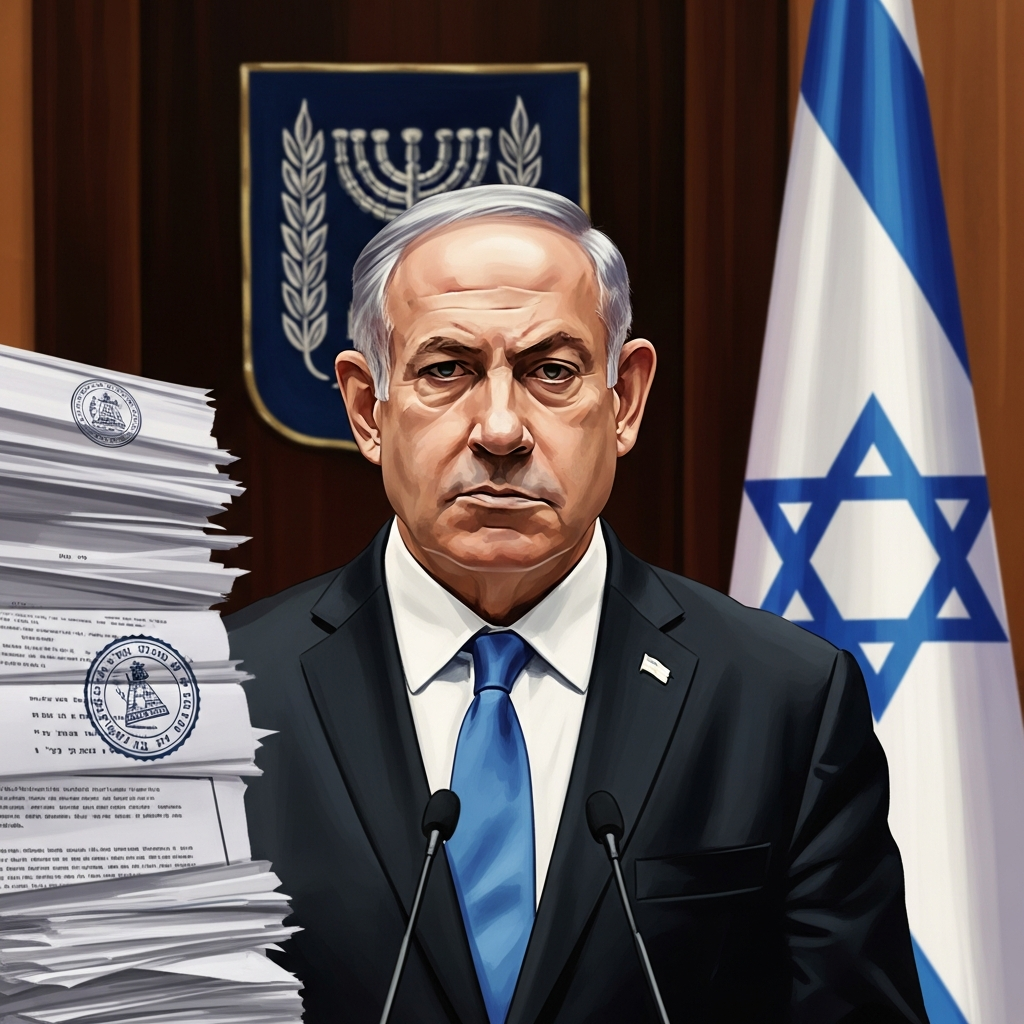
Israeli Prime Minister Benjamin Netanyahu has launched an extraordinary bid for a presidential pardon, seeking to halt his long-running corruption trial. This unprecedented move has sent shockwaves across Israel, igniting intense debate about national unity, the rule of law, and the very foundations of its democracy. While Netanyahu vehemently denies all charges of bribery, fraud, and breach of trust, he argues the ongoing legal proceedings are severely impeding his ability to govern and deepening societal divides. The request now rests with President Isaac Herzog, whose decision carries immense weight for the future of Israeli politics.
An Unprecedented Plea for Forgiveness
Prime Minister Netanyahu formally submitted his request to President Isaac Herzog’s office on a Sunday, initiating a process that legal experts describe as highly unusual. This “extraordinary” appeal seeks a pre-conviction pardon, a stark departure from the typical Israeli legal protocol where pardons are considered only after a conviction has been secured and all appeals exhausted. Netanyahu, Israel’s longest-serving prime minister, has been on trial for five years, facing accusations across three distinct but related cases. These allegations center on claims that he granted favors to influential business figures and political supporters in exchange for gifts and positive media coverage.
In his concise, one-page letter, Netanyahu did not admit guilt. Instead, he framed his request on grounds of “broad public and ethical responsibility.” He asserts that granting him a pardon would foster national unity and reconciliation, especially crucial during a period of significant regional tension and internal division following the October 7, 2023, Hamas attacks, which have themselves frequently delayed court proceedings. The prime minister also claims that the requirement to testify “three times a week” is an “impossible demand” for any citizen, let alone a sitting head of government, significantly distracting him from his critical national duties.
The Legal Maze: Understanding Israel’s Pardon Process
The path to a presidential pardon in Israel is a complex one, typically reserved for individuals who have already been convicted. The process usually involves a request being forwarded to the pardons department within the Justice Ministry for legal opinions. These opinions are then submitted to the President’s legal adviser, who formulates a recommendation for the President. However, Netanyahu’s request challenges this established order by seeking a pardon while his trial is still underway and before any verdict has been reached.
Legal scholars and former officials have voiced significant concerns. Emi Palmor, a former director-general of the Justice Ministry, emphasized that stopping an ongoing trial through a presidential pardon is “impossible” if the accused continues to maintain their innocence. She noted that only the attorney general has the power to suspend such a case. The Israel Democracy Institute further highlighted the rarity and danger of a “pre-conviction pardon,” warning that it “threatens the rule of law and seriously undermines the principle of equality before the law.” President Herzog’s office, acknowledging the request’s “significant implications,” has pledged to consider it “responsibly and sincerely” after gathering all relevant legal opinions through formal channels.
A Nation Divided: Intense Reactions and Political Fallout
Netanyahu’s pardon request has immediately polarized the Israeli political landscape and fueled public protests. Opposition leader Yair Lapid explicitly stated that a pardon should only be granted if Netanyahu admits guilt, expresses remorse, and immediately retires from political life. Prominent protest leader Shikma Bressler asserted that Netanyahu is not seeking a pardon but rather a complete cancellation of his trial without any accountability, linking his actions to the “massacre of 7th of October.” Protesters have also rallied outside President Herzog’s residence, voicing strong opposition to the pre-verdict pardon.
Conversely, Netanyahu’s coalition allies have swiftly come to his defense. National Security Minister Itamar Ben-Gvir and Finance Minister Bezalel Smotrich have publicly supported the pardon request, aligning with the prime minister’s narrative that the trial is politically motivated. This internal support within his Likud party and its right-wing partners underscores the deep ideological fault lines within Israeli society.
International and Historical Context
Adding an international dimension, former US President Donald Trump recently intervened, sending a letter to President Herzog advocating for a pardon. Trump characterized the case against Netanyahu as “political” and “unjustified prosecution,” echoing Netanyahu’s own claims of a “witch hunt” orchestrated by the media, police, and judiciary. This external pressure further complicates Herzog’s decision-making process.
The current situation also casts a shadow on Netanyahu’s past actions. In 2008, as opposition leader, he famously called for then-Prime Minister Ehud Olmert to resign amidst his own corruption scandal. Netanyahu argued that a leader “up to his neck” in scandal lacked the mandate to govern and risked prioritizing personal interests. Olmert ultimately resigned before indictment and later served prison time. Critics now highlight this stark contrast between Netanyahu’s past demands and his current defiant stance, where he portrays himself as a victim of a “deep state” conspiracy. This political maneuvering unfolds with the next Israeli election due by October 2026, where current polls suggest Netanyahu’s most right-wing coalition might struggle to secure enough seats.
Beyond the Trial: Broader Implications for Israel
Netanyahu’s pardon request is not merely a personal legal matter; it carries profound implications for Israel’s democratic institutions and its system of checks and balances. Critics argue that granting such a pardon would establish a dangerous precedent, implying that the prime minister is above the rule of law and that political expediency can trump legal accountability. The Movement for Quality Government in Israel warned that pardoning a prime minister accused of serious offenses would send a dangerous message that some citizens are exempt from the law, potentially undermining public trust in the judiciary.
The request also needs to be viewed in the context of Netanyahu’s controversial attempt in late 2022 to overhaul Israel’s justice system. Opponents widely saw these proposed reforms as a direct effort to weaken the judiciary and compromise the country’s system of checks and balances, a clear conflict of interest given his ongoing trial. These events triggered widespread street protests and were perceived by critics as a move that could weaken Israel internally and externally. The ongoing conflicts and unrest following the October 7 attacks have ironically provided repeated delays to Netanyahu’s trial proceedings, adding another layer of complexity to an already tumultuous political period.
Frequently Asked Questions
What charges does Benjamin Netanyahu face in his corruption trial?
Benjamin Netanyahu, as the first sitting Israeli prime minister to stand trial, faces charges across three separate cases. These include serious accusations of bribery, fraud, and breach of trust. The allegations center on claims that he exchanged political favors with wealthy associates in return for gifts and sympathetic media coverage. Despite these charges, Netanyahu maintains his innocence, labeling the prosecution a politically motivated “witch hunt.”
How unusual is Netanyahu’s request for a presidential pardon in Israel?
Netanyahu’s request is considered highly unusual and “extraordinary” by legal experts and President Herzog’s office. Pardons in Israel are typically granted only after legal proceedings have concluded and a conviction has been secured. Seeking a pardon while a trial is ongoing and before any verdict, especially while vehemently denying guilt, is a rare and challenging legal maneuver that deviates significantly from established legal norms.
What are the main arguments for and against granting Netanyahu a pardon?
Arguments for a pardon, primarily put forth by Netanyahu and his allies, center on the idea of national unity, claiming the trial deeply divides the country and impedes his ability to govern effectively, particularly during crises. They also argue the trial is politically motivated. Opponents, including protest leaders and opposition politicians, strongly argue against it, asserting that a pardon would undermine Israel’s democratic institutions, create a dangerous precedent that places the prime minister above the law, and remove accountability for serious alleged offenses. Many demand an admission of guilt and political retirement as preconditions for any pardon consideration.
The Road Ahead: An Unpredictable Future
As President Isaac Herzog and his legal team deliberate, the ramifications of this “extraordinary” pardon request will undoubtedly continue to shape Israel’s political discourse and future. The decision will not only affect Benjamin Netanyahu’s personal fate but will also send a powerful message about accountability, the rule of law, and the strength of Israel’s democratic institutions. With deep societal divisions and a crucial election on the horizon, the path forward remains fraught with uncertainty, highlighting a pivotal moment in the nation’s history.