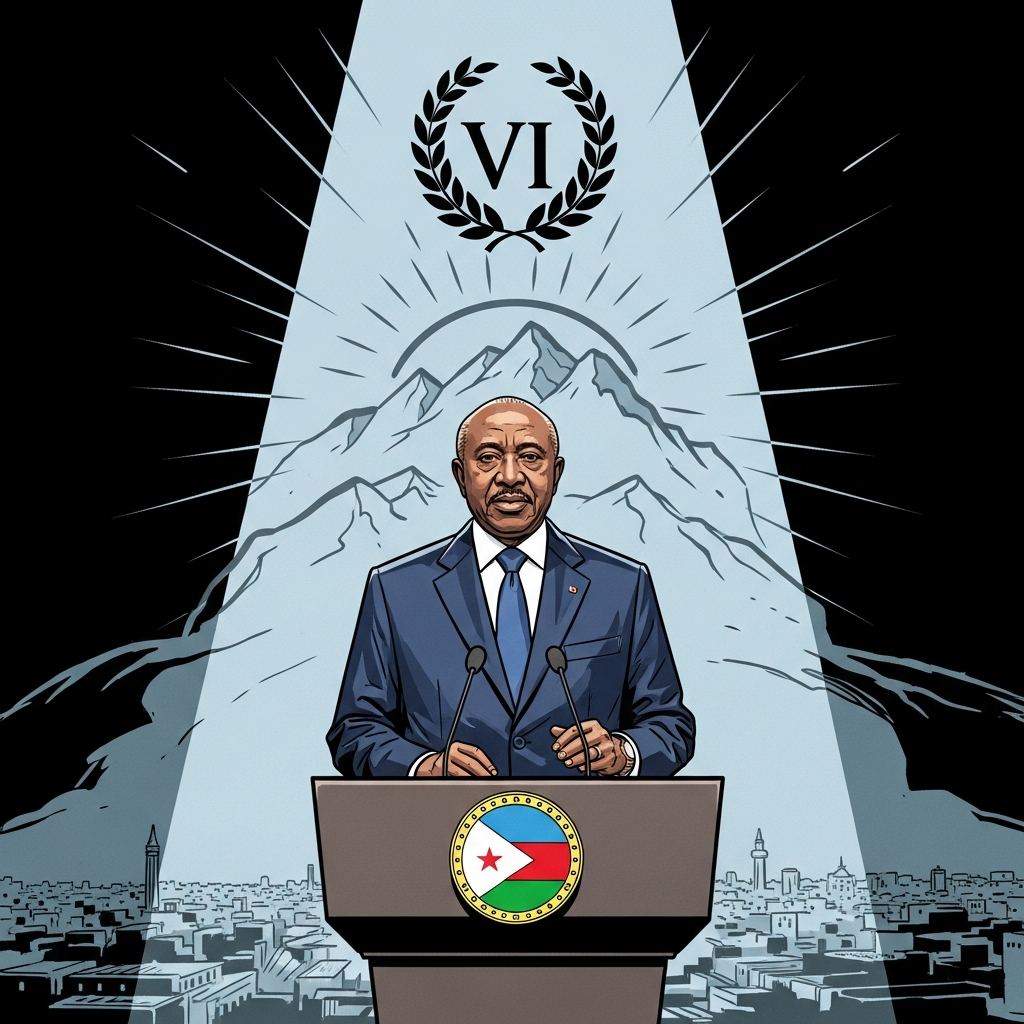
Djibouti’s political landscape recently saw its long-serving president, Ismail Omar Guelleh, secure an unprecedented sixth term in office. This decisive victory, achieved with an overwhelming 97.8% of the vote, reaffirms Guelleh’s entrenched power in the strategically vital Horn of Africa nation. However, the election, held on April 10, 2026, was largely overshadowed by a widespread boycott from most opposition parties, raising questions about the fairness and inclusivity of Djibouti’s democratic process.
This article delves into the details of Guelleh’s recent win, the constitutional changes that paved the way for his continued rule, Djibouti’s critical geopolitical importance, and the persistent challenges facing its political opposition and human rights landscape.
A Resounding Victory Amidst Controversy
Preliminary official results, released by Djibouti’s interior ministry on April 11, 2026, confirmed that Ismail Omar Guelleh, 78, had clinched another five-year presidential term. His sole challenger, Mohamed Farah Samatar of the Unified Democratic Centre (CDU), managed to secure only 2.19% of the vote. Guelleh’s victory was widely anticipated, especially given the significant opposition boycott.
Following the announcement, Guelleh celebrated his re-election at his home, declaring the outcome a victory for the entire nation. Despite the absence of major opposition groups, officials reported a robust voter turnout, with more than 80% of approximately 256,000 registered voters casting their ballots. The results now await formal validation by judges on the constitutional council, a final step before Guelleh’s official swearing-in.
The Path to an Unprecedented Sixth Term
Ismail Omar Guelleh has continuously led Djibouti since 1999, accumulating an impressive 27 years in power. He initially succeeded his uncle, Hassan Gouled Aptidon, becoming only the second president since Djibouti gained independence from France in 1977. His extensive tenure has been marked by significant constitutional amendments designed to facilitate his ongoing leadership.
In 2010, Djibouti’s parliament first scrapped presidential term limits, while also shortening mandates from six to five years. More recently, in a critical move in October 2025, lawmakers removed the 75-year upper age limit for presidential candidates. This crucial amendment directly enabled Guelleh, then 78, to seek re-election. His previous victory in 2021 also saw him secure a similar overwhelming margin of over 97% of the vote.
Mohamed Farah Samatar, Guelleh’s challenger, heads a small party lacking parliamentary representation. Reports indicated Samatar struggled significantly to gain public recognition or generate substantial support during his campaign, a stark contrast to the thousands who reportedly attended Guelleh’s rallies.
Djibouti’s Enduring Geopolitical Significance
Djibouti’s strategic importance on the global stage cannot be overstated. Situated on the Bab el-Mandeb Strait, it serves as a vital gateway to the Red Sea from the Gulf of Aden. This location is paramount, linking maritime trade routes to the Suez Canal, one of the world’s busiest shipping arteries. A local insight aptly summarizes its value: “Our geography is our oil.”
This prime location has made Djibouti a critical hub for international military presence. The nation currently hosts military bases for several major global powers, including:
The United States
China
France
Italy
- Japan
- www.bbc.com
- www.aljazeera.com
- apnews.com
- tribune.com.pk
- www.aljazeera.com
These military arrangements, alongside revenue generated from providing essential port services to landlocked neighboring Ethiopia, form the backbone of Djibouti’s economy. The port’s crucial role has been further highlighted recently, serving as a docking point for commercial ships damaged in attacks by Yemen’s Houthi militants. Guelleh’s campaign heavily emphasized his government’s success in maintaining stability within Djibouti, a narrative that resonates powerfully given the ongoing conflicts and unrest in surrounding regional states and the wider Middle East.
Opposition Challenges and Human Rights Concerns
Despite Djibouti’s strategic importance and relative internal stability, the country faces consistent criticism regarding its electoral process and human rights record. Two of Djibouti’s main opposition parties, including prominent leaders like Dahir Ahmed Farah, have systematically boycotted elections since 2016. They cite a persistent lack of free political activity and concerns about the impartiality of election authorities as primary reasons for their abstention.
Human rights organizations frequently accuse the Djiboutian government of repressing freedom of speech and political dissent. Allegations include the suppression of political opponents, activists, and journalists. The government, however, steadfastly denies these widespread abuses and rejects criticisms concerning its electoral framework. A notable incident occurred in 2020 when security forces violently suppressed rare anti-government street protests that erupted following the arrest of a former air force pilot who had publicly denounced alleged corruption and clan-based discrimination.
The disparity in public engagement during the recent election underscored the limited opposition presence. While Guelleh’s campaign enjoyed widespread visibility and large rallies, Samatar’s events reportedly attracted only a few dozen attendees. This imbalance contributes to the perception of a political environment where genuine competition struggles to flourish.
What This Sixth Term Means for Djibouti
President Guelleh’s sixth term signals a continuation of the political status quo and regime continuity in Djibouti. His government will likely maintain its focus on leveraging Djibouti’s strategic location for economic development, particularly through port infrastructure expansion and cultivating foreign investment. This includes strengthening existing partnerships with global powers that maintain military bases within its borders.
Analysts suggest international actors often prioritize stability in Djibouti, given its critical role in Red Sea security and global trade routes, especially amid ongoing tensions. While this continuity offers a predictable environment for foreign partners, it simultaneously raises questions about the future of political reforms and the expansion of democratic space within the nation. The government faces the ongoing challenge of balancing international strategic demands with domestic calls for greater political freedoms and accountability.
Frequently Asked Questions
What factors contributed to President Guelleh’s dominant sixth-term victory?
President Ismail Omar Guelleh secured his sixth term with 97.8% of the vote primarily due to several key factors. Constitutional amendments in 2010 (removing term limits) and October 2025 (removing the age limit) cleared his path to re-election. His campaign effectively leveraged his image as a guarantor of stability in a volatile region. Furthermore, the election was significantly shaped by a widespread boycott from most opposition parties, who cited a lack of free political activity, effectively removing substantial competition.
Why is Djibouti’s geographical location considered so strategically important globally?
Djibouti holds immense strategic importance due to its position on the Bab el-Mandeb Strait, a narrow choke point connecting the Red Sea to the Gulf of Aden. This location makes it a vital gateway to the Suez Canal, a critical artery for global maritime trade. Its strategic value is further amplified by its role as a key hub for international military presence, hosting bases for major powers like the US, China, and France. This unique geography impacts Red Sea security, global trade routes, and regional stability.
What are the main criticisms regarding political freedoms and elections in Djibouti?
Criticisms surrounding Djibouti’s political landscape primarily stem from the lack of genuine electoral competition and concerns about human rights. Most opposition parties have boycotted elections since 2016, citing restrictions on free political activity and an impartial electoral process. Human rights organizations frequently accuse the government of suppressing freedom of speech, repressing political opponents, activists, and journalists. These allegations contribute to a perception of limited political freedoms despite government denials.
Conclusion: Navigating a Complex Future
President Ismail Omar Guelleh’s overwhelming victory in the recent Djibouti election underscores his deep entrenchment in the nation’s political fabric. As he embarks on an unprecedented sixth term, Djibouti remains a country defined by a duality: a stable and indispensable geopolitical lynchpin for global powers, yet also a nation where political dissent is reportedly suppressed and electoral competition is largely absent. The path ahead will undoubtedly involve navigating the complex interplay between maintaining crucial international partnerships, fostering economic growth, and addressing the persistent calls for greater political openness and respect for human rights within its borders.