As humanity prepares for its bold return to the Moon, the focus isn’t just on raw power or cutting-edge propulsion. It’s about people. The Artemis II Orion design marks a pivotal shift in spacecraft engineering, prioritizing genuine human comfort and psychological well-being alongside unwavering safety. This groundbreaking approach ensures that astronauts embarking on deep space missions can not only survive but thrive, even as their capsule hurtles through the cosmos at incredible speeds. This article explores how NASA’s Artemis II Orion capsule blends extreme engineering with thoughtful interior design to create a habitable home away from home.
Beyond Engineering: The Rise of Human-Centered Spacecraft Design
Traditional spacecraft design primarily focused on sheer engineering prowess and system functionality. Today, a new philosophy is at the forefront: “human factors.” This term encompasses optimizing technology for intuitive interaction, enhancing daily life, and promoting overall crew well-being. It’s about more than just fitting components; it’s about crafting an environment where astronauts can be productive and resilient during demanding deep space missions. This means integrating insights from psychologists and sociologists alongside traditional engineers.
Olga Bannova, director of the space architecture graduate program at the University of Houston, emphasizes that design is fundamentally about the “organization of information.” She asserts that comfort is no longer a luxury in space but a critical requirement for productive work. Sebastian Aristotelis, lead architect at SAGA, echoes this sentiment, stating that human factors are now a “design requirement, not just a nice-to-have.” This holistic perspective directly contributes to a profound sense of safety and confidence for the crew.
Prioritizing Safety: Built for Extreme Conditions
The Artemis II mission is a testament to rigorous safety standards. Before the crew even considers comfort, the Orion capsule must withstand unimaginable forces. This includes the immense G-forces of launch aboard NASA’s mighty Space Launch System (SLS) and the fiery, almost 25,000 mph reentry into Earth’s atmosphere. Rigorous testing is performed on every single component, from the propulsion systems to the seemingly mundane objects that become crucially important in microgravity.
A prime example of this critical design is the astronaut’s seat. As Bannova succinctly puts it, “Seats can save lives.” Orion’s advanced seats are engineered to accommodate nearly 99 percent of the human population. They are fully adjustable for individual variation and allow astronauts access to controls even while wearing bulky pressure suits. Cleverly, these seats can also be dismantled and stowed, providing valuable additional living space within the cramped 5-meter-wide by 3-meter-high capsule once in orbit. For interacting with the spacecraft during high-G maneuvers, specialized control devices, such as joystick-like rotational hand controllers and gamepad-like cursor control devices, are provided, enabling precise actions when larger physical movements are difficult.
Life Aboard Orion: Crafting a Habitable Deep Space Environment
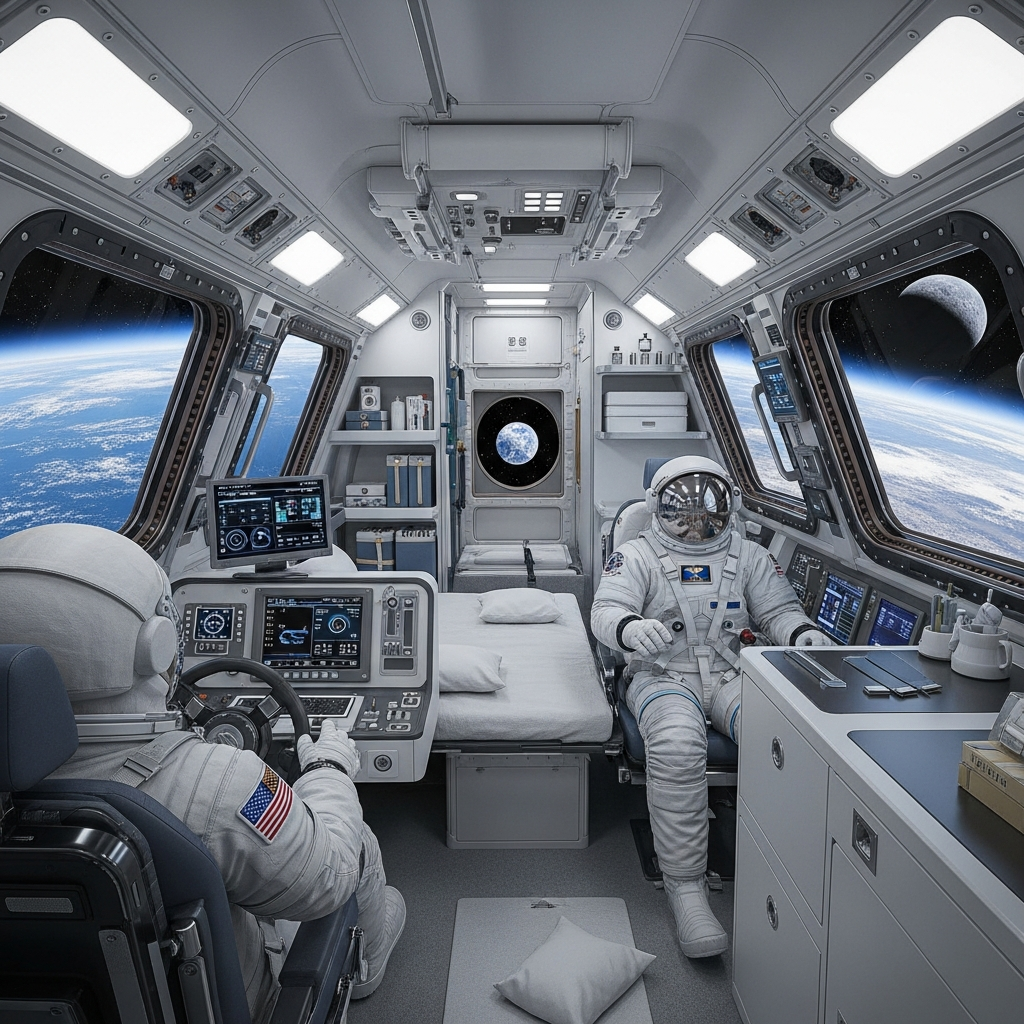
Life aboard the Orion capsule will be intimate, often compared to the confines of a minibus. Yet, this compact interior represents a significant modernization compared to the Apollo-era capsules. Astronauts will benefit from stowable seats, a water dispenser, and custom-designed meals. To maintain physical health during their 10-day journey, a flywheel exercise machine is included for daily cardiovascular and resistance training.
Beyond physical needs, psychological factors are actively addressed. Designers consider elements like privacy, acoustics, and odor control. The onboard toilet, while a major upgrade from Apollo, is located under the floor in a shared space, presenting privacy challenges that crew member Christina Koch has noted. However, specialized odor control systems are in place, even if they faced “teething issues” during initial testing. Individual preferences are also catered for; Commander Reid Wiseman prefers sleeping near displays, while Christina Koch might be “suspended like a bat,” and Victor Glover utilizes a tucked-away nook. A well-designed environment, as Aristotelis suggests, offers a crucial psychological boost, signaling that significant resources and thorough design have gone into the crew’s well-being.
The Deep Space Difference: Orion vs. Crew Dragon
When comparing the Artemis II Orion design to other contemporary spacecraft like SpaceX’s Crew Dragon, distinct philosophies emerge. Orion embodies a “pragmatic engineering approach,” characterized by numerous physical buttons and switches in its interface. In contrast, the Crew Dragon presents a more “vertically integrated, branded look,” with three large touchscreens dominating its cockpit. These differences are partly functional; Orion is specifically engineered for deep space missions, requiring greater cargo capacity and flexibility, factors less critical for low Earth orbit vehicles.
This distinction also reflects differing approaches to information display. While providing comprehensive data seems logical, designers recognize that too much information can overwhelm astronauts. The role of the designer is critical in creating interfaces that deliver “the right information at the right time,” thereby enhancing both efficiency and safety, especially during complex deep space maneuvers.
The Human Touch: Astronauts as Supervisors, Not Just Operators
The role of astronauts in spacecraft control is evolving with advancements in AI and software. Increasingly, automated systems manage functions like altitude and speed, transitioning astronauts into a supervisory role. Artemis II pilot Victor Glover notes, “The software is the primary flyer… now it’s almost like we are helping the software.” This doesn’t diminish the astronaut’s importance; rather, it shifts their focus. A critical principle remains: humans must always retain the ability to override software and assume full control, especially in emergencies, leveraging their unique capacity for calm, creative problem-solving.
Astronauts also desire control over their personal environment within the Orion spacecraft design. While essential systems like life support are engineered to near perfection, personal spaces, like crew quarters, allow for individual choices in lighting, temperature, and even minor decorations. This human-centered approach, involving collaboration with psychologists and sociologists, aims to make the spacecraft truly feel like “home” during extended deep space missions. Furthermore, autonomy in task scheduling, a proven benefit on longer missions like the International Space Station, is recognized as vital for human well-being.
The Artemis II Crew: Pioneers of a New Era
The Artemis II mission will carry four highly experienced astronauts: Commander Reid Wiseman (US Navy veteran), Pilot Victor Glover (US, former test pilot), Mission Specialist Christina Koch (US, electrical engineer and veteran of the first all-female spacewalk), and Specialist Jeremy Hansen (Canada, fighter pilot). All but one are veterans, and they have trained rigorously for over two years, building strong camaraderie essential for life in their confined space. This preparation even included “Artemis sleepovers” to adapt to the compact living conditions, showcasing the dedication to ensuring astronaut comfort and team cohesion.
The Mission Ahead: Testing the Limits of Human and Machine
The Artemis II mission is a pioneering 10-day test flight, scheduled to launch as early as April 1. It will carry its four astronauts further from Earth than anyone has been in over 50 years, on a journey spanning more than half a million miles around the Moon and back. The journey begins with the powerful SLS rocket, blasting off from Kennedy Space Center in Florida. Once in space, the crew will spend their first day orbiting Earth at a high altitude of 70,000 km (45,000 miles), testing Orion’s life-support systems and practicing manual control.
The mission then executes a critical trans-lunar injection burn, propelling Orion on a four-day course covering 370,000 km (230,000 miles) to the Moon. Throughout the journey, the crew will act as “guinea pigs” for experiments studying the effects of deep space on the human body. Radiation exposure is a major concern, with astronauts carrying dosimeters and rehearsing rapid entry into an onboard radiation shelter in case of solar storms. Other health monitoring includes tests on balance, muscle performance, microbiome changes, eye and brain health, and saliva samples to analyze immune system responses.
The mission’s highlight is the lunar fly-by, where the crew will observe the Moon’s far side, unseen from Earth, from distances of 6,500 to 9,500 km (4,000-6,000 miles). This phase dedicates three hours to lunar observation, capturing images and studying geology for future landing preparations. During this period, Orion will temporarily lose communication with Earth, a tense 30-50 minutes for mission control. The return journey is equally critical, with the capsule’s heat shield enduring fiery re-entry temperatures of approximately 2,700°C (half the Sun’s surface temperature) while slowing for a gentle splashdown in the Pacific Ocean. Confidence in heat shield fixes, learned from Artemis I, is high. A recovery team will then retrieve the capsule and its pioneering crew.
Frequently Asked Questions
What makes the Artemis II Orion capsule’s design unique for human comfort?
The Artemis II Orion design represents a significant evolution, moving beyond basic engineering to embrace “human factors.” This means prioritizing not just safety but also astronaut comfort, psychological well-being, and intuitive interaction with technology. Features like adjustable, stowable seats that accommodate nearly 99% of the population, specialized control devices, thoughtful environmental controls for privacy and acoustics, and even individual sleeping preferences contribute to making the cramped 5m x 3m capsule a more habitable and productive space for deep space missions.
Where will the Artemis II mission travel and what are its key phases?
The Artemis II mission is a pioneering 10-day test flight taking four astronauts over half a million miles around the Moon. Key phases include launching from Kennedy Space Center on the SLS rocket, an initial Earth-orbiting phase at 70,000 km to test systems and practice manual control, a four-day trans-lunar injection burn covering 370,000 km to reach the Moon, a lunar fly-by around the far side at 6,500-9,500 km for observation, and a four-day return journey culminating in a fiery re-entry and splashdown in the Pacific Ocean.
Why is “human factors” engineering now critical for deep space missions like Artemis II?
“Human factors” engineering is crucial for deep space missions because extended periods in confinement, isolation, and high-stakes environments demand more than just technical functionality. It enhances crew productivity, resilience, and overall mission success by addressing psychological well-being, comfort, and intuitive interaction. Experts like Olga Bannova and Sebastian Aristotelis emphasize that comfort is now a requirement for productive work, and a well-designed environment acts as a psychological boost, ultimately contributing to the safety and effectiveness of the crew.
The comprehensive Artemis II Orion design, from its intricate interfaces to its advanced life support systems, profoundly influences an astronaut’s sense of safety, community, pride, and purpose. This mission, with its blend of cutting-edge technology and human-centered design, is not just about reaching the Moon; it’s about learning to live and work there. The insights gathered from this journey will lay crucial groundwork for future lunar landings, the establishment of a sustainable Moon base, and ultimately, humanity’s ambitious goal of living on other worlds. Good design, as Bannova aptly summarizes, is not just for “pretty pictures,” but for the people living in it, using it, and finding beauty within it as they push the boundaries of human exploration.