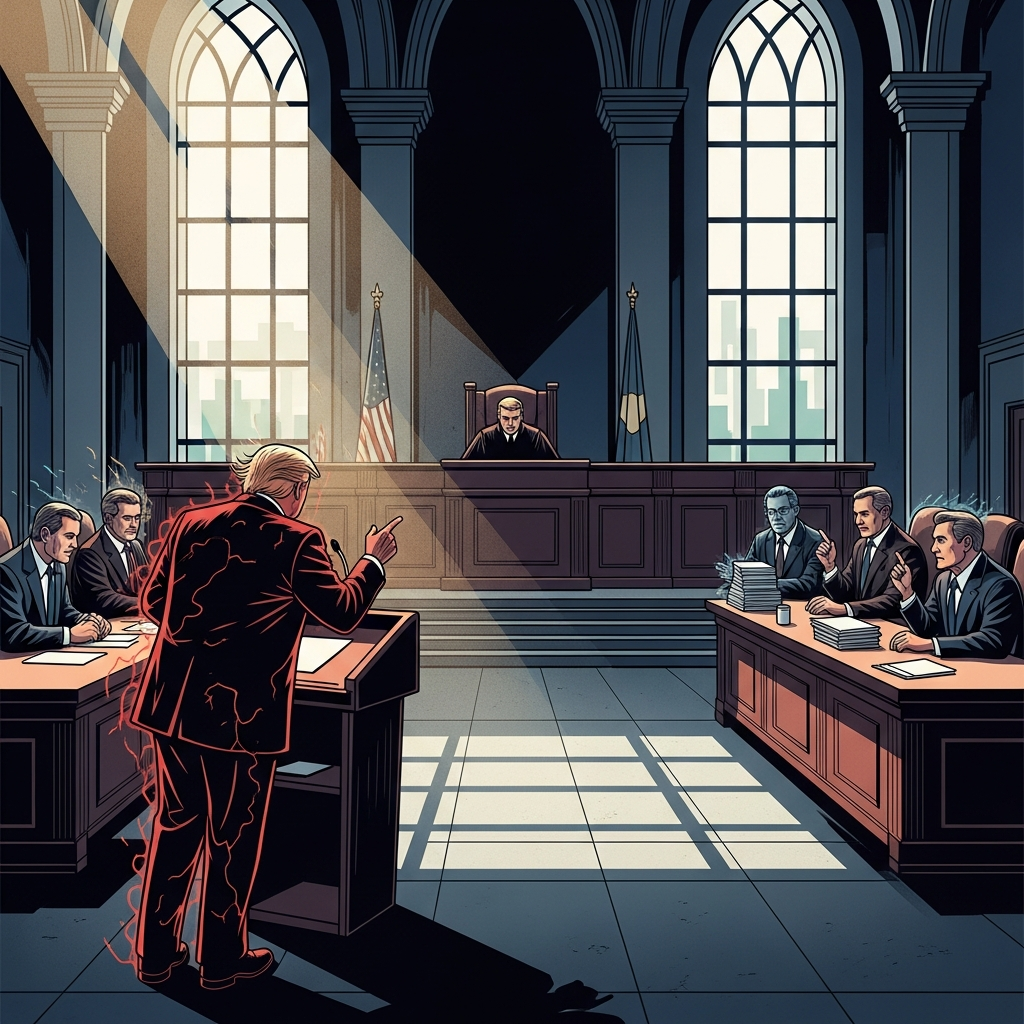
A significant legal confrontation is brewing as the Democratic National Committee (DNC) and a coalition of top Democratic leaders have filed a lawsuit challenging a newly signed executive order by former President Donald Trump. This order aims to exert federal influence over state-level mail-in voting procedures. Filed in a Washington D.C. federal court, the suit marks the first major legal pushback against Trump’s latest attempt to reshape election rules, igniting a high-stakes battle over states’ rights, constitutional authority, and the future of American elections.
The Democrats argue that the executive action represents an unconstitutional overreach, directly infringing upon the powers explicitly granted to individual states and Congress to regulate elections. They contend that the U.S. Constitution provides no direct authority for the President to unilaterally dictate the conduct of federal elections, framing the order as a calculated move to gain partisan advantage.
The Executive Order: Federalizing Mail-In Voting
President Trump’s executive order, issued on March 31, 2026, lays out several controversial directives aimed at federalizing aspects of mail-in voting. At its core, the order mandates that the Secretary of Homeland Security work in conjunction with the Social Security Administration to compile federally approved lists of eligible U.S. citizens for voting within each state.
Key Provisions of Trump’s Order:
National Voter List Creation: Directs the Department of Homeland Security (DHS) to collaborate with the Social Security Administration (SSA) to create state-specific lists of eligible voters, using federal records including citizenship status.
USPS Restrictions: Instructs the U.S. Postal Service (USPS) to deliver absentee ballots exclusively to individuals appearing on these new, federally compiled lists.
Funding Threats: Signals that states not complying with the executive order risk losing federal funding for elections.
Prosecution Directive: Directs the U.S. Attorney General to prioritize the investigation and prosecution of any state election official deemed to have “wrongfully” distributed mail-in ballots.
This sweeping executive action has drawn immediate and fierce condemnation, with critics questioning its feasibility, reliability, and ultimate intent given the tight timeframe before fall elections commence as early as September.
Democrats Launch Legal Barrage
The lawsuit, known as DSCC v. Trump, was filed by a powerful coalition of Democratic entities and leaders. Plaintiffs include the Democratic National Committee (DNC), the Democratic Senatorial Campaign Committee (DSCC), the Democratic Congressional Campaign Committee (DCCC), and the Democratic Governors Association (DGA). They are joined by top congressional Democrats: Senate Minority Leader Chuck Schumer (D-N.Y.) and House Minority Leader Hakeem Jeffries (D-N.Y.).
The Core of the Legal Challenge: Constitutional Overreach
Represented by prominent attorney Marc Elias, the Democratic groups argue that the executive order “dramatically restricts the ability of Americans to vote by mail, impinging on traditional state authority.” Their 64-page complaint asserts that the order “dramatically exceeds his highly limited constitutional and statutory authority when it comes to regulating elections.”
The lawsuit specifically cites violations of the First, Fourth, Fifth, and Tenth Amendments, as well as the separation of powers doctrine, the Administrative Procedure Act, and the Voting Rights Act. Democrats contend that the Constitution’s Framers intentionally dispersed control over elections to states and Congress, precisely to prevent the kind of “desire for absolute power” they perceive in Trump’s actions. They argue that the established division of authority has historically withstood such “President Trump’s attacks,” and that the order is “convoluted and confusing,” designed to “rewrite election rules for his own perceived partisan advantage.”
A Pattern of Disputed Election Interference
This latest executive order is not an isolated incident but rather another chapter in President Trump’s long-standing public campaign against mail-in voting and his broader efforts to influence election procedures. Since his return to office, Trump has repeatedly voiced “baseless claims of mass fraud” regarding mail voting, despite casting his own ballot by mail in a recent Florida election.
Trump’s History of Election Claims and Actions:
Unsubstantiated Fraud Allegations: Trump has consistently promoted disproven falsehoods about widespread fraud costing him the presidency in 2020, even though numerous investigations, including those by Republicans, found no significant evidence of such fraud.
“SAVE America Act” Push: He has pushed Congress to pass the GOP-backed “SAVE America Act,” a proposed legislative measure that would impose new voting hurdles, such as requiring in-person, documentary proof of citizenship for voter registration and photo identification for casting a ballot. This bill has stalled in the U.S. Senate due to Democratic opposition.
Calls for Federal Takeover: Trump has previously called for his administration to “take over” voting in Democratic areas and launched probes fueled by election conspiracy theories.
This current legal battle marks a “second round of battles” over presidential authority in election matters, echoing a successful first round where opponents blocked a similar executive order issued by Trump in April 2025.
Legal Precedent: Previous Executive Order Struck Down
In April 2025, President Trump issued a similar executive order that attempted to impose proof-of-citizenship requirements on federal mail voter registration forms and threatened to withhold federal funds from states not complying. That prior order was ultimately struck down in multiple courts. U.S. District Judge Colleen Kollar-Kotelly explicitly ruled that the president lacks the authority to unilaterally direct changes to federal election procedures, emphasizing that the Constitution assigns this responsibility to the states and Congress. This precedent strengthens the Democrats’ current legal position, making them confident in a repeat victory. As Senator Schumer stated, “We will see him in court and we will beat him again.”
Broad Reactions and Implications
The executive order has elicited immediate and predictably partisan reactions, highlighting a deep divide over election integrity versus voter access and constitutional authority.
Partisan Responses and State Resistance:
Republican Support: Republican National Committee Chair Joe Gruters lauded the order, stating that “Voters deserve elections they can trust, and with today’s executive order, President Trump is restoring that confidence.” Other Republicans, including the Republican Study Committee and former Arizona gubernatorial candidate Kari Lake, echoed this sentiment, advocating for measures like the SAVE America Act and claiming mail-in voting facilitates fraud.
- Democratic State Officials’ Outcry: Democratic Attorneys General and Secretaries of State have swiftly condemned the order. Arizona’s Secretary of State Adrian Fontes, a Democrat, called the order “un-American” and vowed to combat it, emphasizing that 80% of Arizona’s voters utilize a mail-in system he describes as the “gold standard.” Oregon Attorney General Dan Rayfield and California Attorney General Rob Bonta also pledged to use all legal avenues to challenge the order, reiterating that the power to regulate elections belongs to the states and Congress.
- www.cbsnews.com
- www.wgem.com
- www.middletownpress.com
- www.thedailynewsonline.com
- spectrumlocalnews.com
Advocacy Groups and Public Opinion:
Consumer and democracy advocacy groups have also raised alarms. Lisa Gilbert, co-president of Public Citizen, criticized the EO as “voter suppression” and an unconstitutional attempt to “federalize our elections.” The Brennan Center for Justice, which previously sued to block Trump’s 2025 election executive order, warned of the significant negative impact, citing incomplete government citizenship lists and an overburdened USPS.
Public opinion, as polled by Scott Rasmussen, reflects a desire for election confidence measures. While only 34% of registered voters are “Very Confident” in recent election counts, 55% believe requiring photo ID would do the most to restore confidence, and 92% desire clean voter rolls. This complex public sentiment underscores the contentious nature of election reforms and the ongoing debate over the balance between access and security.
Frequently Asked Questions
What are the key provisions of President Trump’s new executive order on mail-in voting?
President Trump’s executive order, signed on March 31, 2026, mandates that the Department of Homeland Security (DHS), in collaboration with the Social Security Administration (SSA), compiles lists of eligible U.S. citizens for voting in each state. It then directs the U.S. Postal Service (USPS) to restrict the mailing of absentee ballots only to individuals on these new, federally approved lists. The order also threatens to withhold federal funds from states that do not comply and instructs the U.S. Attorney General to investigate any election official deemed to have wrongfully distributed ballots.
On what constitutional grounds are Democratic leaders challenging this executive order?
Democratic leaders and organizations are challenging the executive order primarily on the grounds of constitutional overreach and infringement upon states’ rights. They argue that the U.S. Constitution does not grant the President direct authority over federal elections, assigning that power to individual states and Congress. Specifically, the lawsuit cites violations of the First, Fourth, Fifth, and Tenth Amendments, as well as the separation of powers doctrine, asserting that the order dramatically exceeds the President’s lawful authority and attempts to “rewrite election rules for his own perceived partisan advantage.”
How does this new lawsuit compare to previous legal challenges against President Trump’s election-related executive actions?
This current lawsuit is considered a “second round of battles” regarding presidential authority over elections. It follows a similar executive order issued by President Trump in April 2025, which attempted to impose proof-of-citizenship requirements on federal mail voter registration forms and threatened to withhold funds from non-compliant states. That previous order was successfully challenged and struck down in multiple federal courts, with judges affirming that the President lacks unilateral authority to alter federal election procedures. This prior legal precedent strengthens the Democrats’ position in the current challenge, indicating a pattern of executive actions being deemed unconstitutional.
Conclusion: A Defining Battle for Election Governance
The lawsuit filed by Democratic leaders against the Trump administration’s executive order on mail-in voting represents a defining moment in the ongoing national debate over election governance. It encapsulates the fundamental tension between federal oversight and states’ constitutional authority, as well as the competing priorities of election integrity and voter access. With the midterm elections on the horizon, the outcome of this legal battle will have profound implications, shaping how Americans vote and reaffirming the balance of power within the nation’s democratic processes. Both sides are digging in for a protracted legal fight, promising that the courts will once again be the arena for these critical questions.