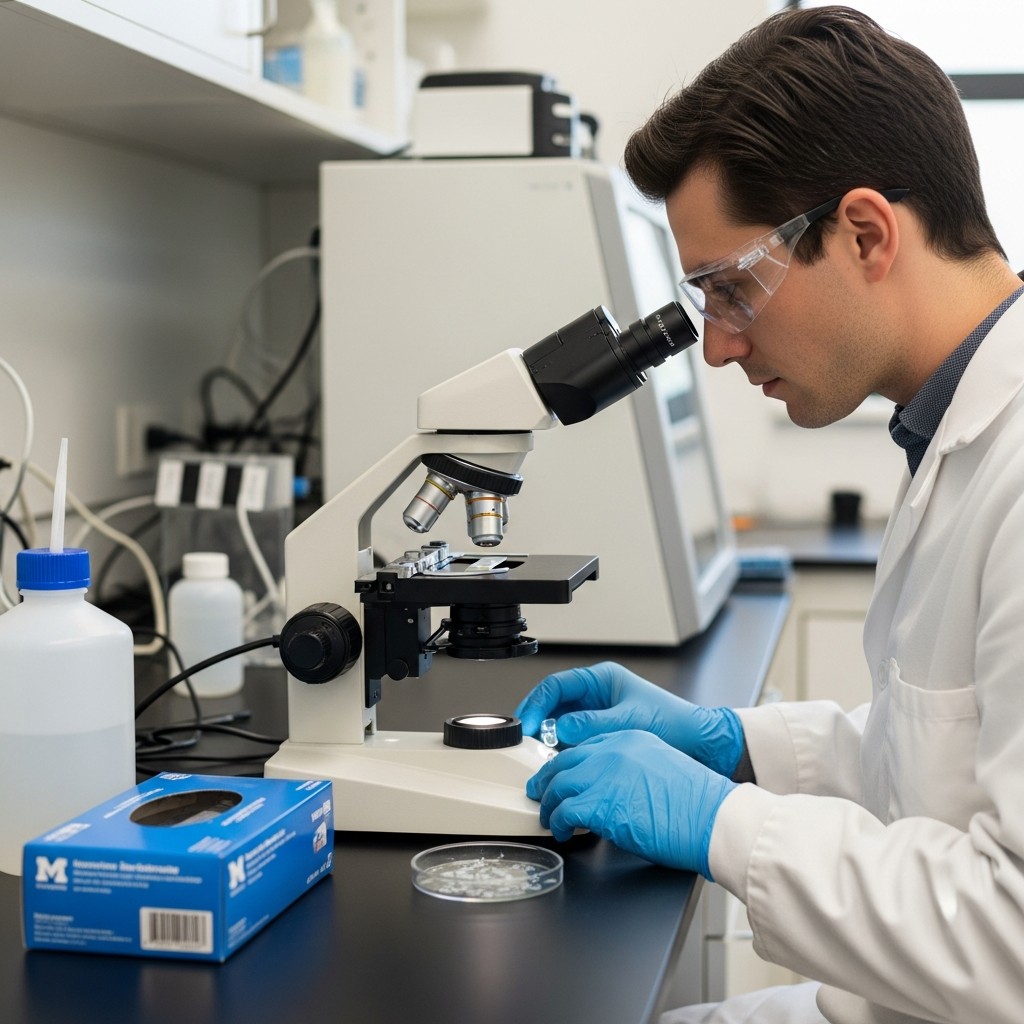
The global crisis of microplastic pollution is a pressing environmental concern. Scientists worldwide strive to understand its true extent and impact. However, groundbreaking research from the University of Michigan suggests a significant, overlooked source of error in these crucial studies. Common laboratory gloves, routinely used for sample handling, may be inadvertently inflating microplastic measurements. This discovery challenges existing data and calls for refined analytical protocols. It highlights how minute, non-plastic particles called stearates, found in many gloves, are being misidentified as microplastics, potentially skewing our understanding of environmental pollution levels.
The Unseen Contaminant: How Lab Gloves Skew Microplastic Counts
Scientists from the University of Michigan embarked on a critical mission. Their goal was to quantify the microplastics inhaled by residents of Michigan. They followed stringent laboratory protocols. This included avoiding plastic products and wearing specialized clothing. A dedicated chamber minimized air contamination. Yet, their air samples showed surprisingly high plastic counts. These levels were over 1,000 times greater than any previous reports. This alarming discrepancy prompted an exhaustive investigation.
The team, led by doctoral graduate Madeline Clough and Professor Anne McNeil, discovered the culprit. Standard laboratory gloves were the source of contamination. These gloves transferred tiny, non-plastic particles to samples. The particles were identified as stearate salts. Glove manufacturers use stearates as a release agent. They help gloves detach cleanly from their molds during production. While not harmful like plastics, stearates pose a serious problem for microplastic detection.
Why Stearates Mimic Microplastics: A Chemical Impersonation
The core issue lies in how microplastics are identified. Scientists often use vibrational spectroscopy. This method analyzes how particles interact with light. It creates a unique “chemical fingerprint.” Unfortunately, stearate salts possess a chemical structure very similar to polyethylene. Polyethylene is a common type of environmental plastic. This structural resemblance causes stearates to produce a nearly identical chemical fingerprint. Consequently, analytical instruments frequently misidentify them as microplastics.
This problem is exacerbated by automated analysis methods. As more labs adopt these systems, the risk of misattributing glove residue to actual microplastic contamination increases. The University of Michigan study further revealed a concerning detail. A large proportion of these misidentified particles were smaller than 5 micrometers (µm). This size range is particularly impactful for human and ecosystem health. Such small particles are more easily absorbed into biological systems. Inflated counts of these tiny imposters could seriously compromise studies. These studies often inform future health policies and environmental regulations.
Quantifying the Problem: A Widespread Overestimation
To assess the scale of this contamination, researchers tested seven different types of gloves. This included common nitrile and latex options. They also examined specialized cleanroom gloves. Their findings were stark. Standard gloves introduced over 7,000 particles per square millimeter that were incorrectly identified as microplastics. This dramatic number strongly suggests a potentially broad overestimation of microplastic abundance across many environmental studies.
The study from the University of Michigan demonstrated clear evidence of particle transfer. Controlled experiments simulated typical lab interactions. Gloved hands touched sample surfaces, filters, and microscope slides. The results consistently showed significant contamination. Cleanroom gloves, however, were an exception. They generated significantly fewer particles. This is likely because their manufacturing process omits stearate coatings. These findings underscore the critical need for scientists to reconsider their lab practices.
Repercussions for Policy and Research Integrity
This discovery holds substantial ramifications. It indicates that some perceived increases in microplastic presence may be methodological artifacts. They might not reflect genuine pollution levels. This complicates the already challenging task of accurate microplastic quantification. Such errors can significantly skew environmental data. Subsequently, this could lead to flawed policy decisions. Health policies and environmental regulations rely on accurate scientific data. If the underlying data is compromised, these vital interventions could be misdirected.
The research serves as a crucial reminder. Science is an iterative process. Emerging fields, like environmental microplastics, often present unforeseen challenges. Contamination sources, initially overlooked, can significantly impact results. While the University of Michigan team had to discard their initial dataset, their perseverance led to a vital discovery. They emphasize that even if actual microplastic abundance is lower than previously reported, any amount remains a concern. The established negative effects on human health and ecosystems are well-documented.
Paving the Way Forward: Solutions for Accurate Microplastic Detection
The University of Michigan team offers concrete recommendations for the scientific community. To mitigate future microplastic contamination, scientists should consider avoiding glove use whenever feasible. If gloves are essential, such as for handling biological samples, specific alternatives exist. Using gloves designed without stearates is crucial. Options include those made for electronics manufacturing or specialized cleanroom environments. These alternatives can drastically reduce the risk of false positives.
Furthermore, the team has developed critical new tools. Clough and McNeil, collaborating with graduate student Eduardo Ochoa Rivera and statistics professor Ambuj Tewari, created novel methods. These techniques can differentiate the chemical fingerprints of stearate salts from actual microplastics. This breakthrough offers a path forward. It allows for the re-evaluation of existing, potentially contaminated datasets. By recalibrating past findings, scientists can refine and improve the accuracy of microplastic level estimates. This underscores the indispensable role of chemical expertise in microplastic research. It ensures robust identification and quantification, which is vital for informed policy and remediation efforts.
Frequently Asked Questions
What are stearates, and why do they cause microplastic overestimation?
Stearates are soap-like, salt-based substances. Manufacturers add them to disposable lab gloves to help them release from molds. At a chemical level, stearates share a structural resemblance with common plastics like polyethylene. This similarity causes them to produce similar “chemical fingerprints” when analyzed by methods like vibrational spectroscopy. As a result, scientific instruments can misidentify stearates as actual microplastics, leading to an overestimation of microplastic counts in environmental samples. The University of Michigan study found this can introduce thousands of false positives per square millimeter.
How can scientists prevent stearate contamination in microplastic research?
Scientists can adopt several strategies to prevent stearate contamination. The primary recommendation is to avoid using gloves whenever possible, especially when handling samples for microplastic analysis. If gloves are necessary for safety or specific protocols, researchers should opt for specialized gloves designed without stearate coatings. These include certain cleanroom gloves or those used in electronics manufacturing. Additionally, the University of Michigan team has developed new analytical methods to distinguish stearates from genuine microplastics, which can be applied to re-analyze existing data and improve future detection accuracy.
Does this new research mean microplastic pollution is less severe than we thought?
No, this new research does not diminish the severity of microplastic pollution. It means that our measurement techniques may have previously overestimated the quantity of microplastics due to contamination from lab gloves. While actual microplastic levels might be lower than some previous reports, any amount of microplastic in the environment remains a significant global threat. The study aims to improve the accuracy of our understanding, not to downplay the problem. It highlights the importance of rigorous methodology in scientific research to ensure we have the most precise data to inform policy and public health interventions.
Conclusion: Sharpening Our Lens on Environmental Microplastics
The University of Michigan’s groundbreaking research reveals a hidden challenge in microplastic detection. It demonstrates how common laboratory practices can inadvertently skew critical environmental data. By identifying stearate salts from lab gloves as a source of false positives, the study paves the way for more accurate measurements of environmental microplastic contamination. This crucial discovery enhances the integrity of scientific research. It also ensures a more precise understanding of the global plastic pollution crisis. While the issue of microplastics remains a serious threat, this new understanding allows the scientific community to refine its methods and provide more reliable data. This precision is essential for developing effective strategies to protect our planet and our health. Continued vigilance and interdisciplinary collaboration will be key to addressing this pervasive environmental challenge.