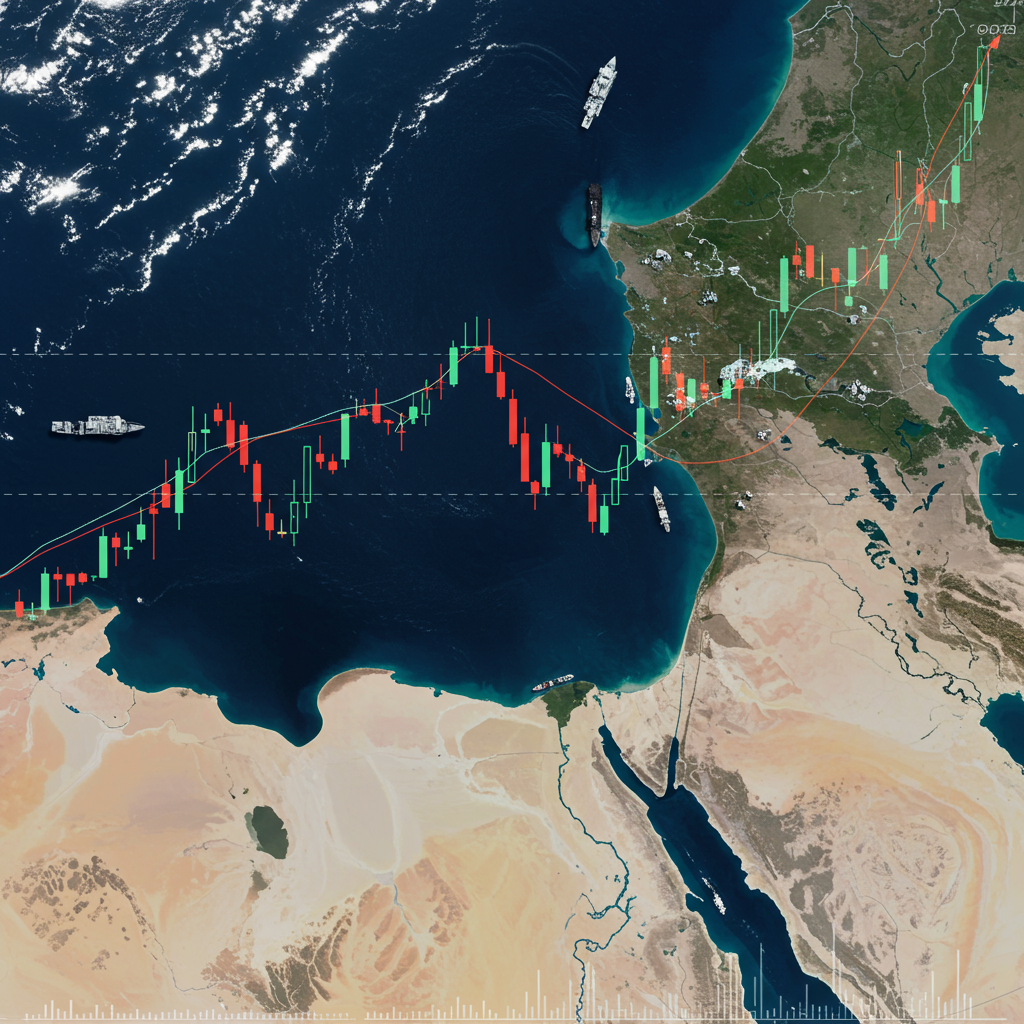
Global financial markets are grappling with significant uncertainty, as surging oil prices and escalating geopolitical tensions send U.S. stocks on a tumultuous ride. This period of heightened volatility, marked by a critical “correction” for major indexes, highlights the profound impact of global events on investor sentiment and economic stability. As fears of inflation mount, stakeholders are closely watching for signs of resolution or further escalation that could dictate the market’s trajectory.
U.S. Stocks Face Renewed Pressure
Monday saw American equities experiencing dramatic swings. The S&P 500, a key market benchmark, continued its downward trend, deepening losses from its worst week since a significant geopolitical conflict began. This downturn pushed the index approximately 9% below its January all-time high. Meanwhile, the Dow Jones Industrial Average showed a modest gain, while the Nasdaq composite slipped, illustrating a mixed market reaction.
This widespread caution dominated trading. The S&P 500 initially surged, only to quickly surrender most of those gains. It then seesawed throughout the day. European stock indexes managed to climb, but several Asian markets experienced sharp declines. These divergent movements underscore the localized and global nature of investor reactions to current events.
Oil Prices Spike Amid Geopolitical Instability
A primary driver of this market unrest is the relentless climb in crude oil prices. Benchmark U.S. crude surged over 3%, settling above $102 a barrel. This spike is directly linked to intense uncertainty surrounding the duration and resolution of the ongoing conflict, particularly concerns over the steady flow of oil and natural gas from the Persian Gulf. Any disruption here could trigger a severe inflationary shock globally.
Geopolitical conflicts, as seen in other regions like Ukraine, vividly demonstrate how such instability translates into economic costs. Recent reports from the Ukraine conflict, for instance, detail successful strikes against advanced military systems such as the S-400 Triumf anti-aircraft missile launcher, valued at approximately $1 billion per system, and the $25 million Tor missile system. These incidents highlight the immense financial burden and resource drain associated with modern warfare, creating a ripple effect of uncertainty across global commodity markets, similar to the fears currently impacting oil prices due to the Strait of Hormuz.
The Impact of Political Rhetoric
Adding to the market’s unease is the unpredictable nature of political pronouncements. In one instance, President Donald Trump used his social media platform to suggest “great progress has been made” toward ending military operations, hinting at a “NEW, AND MORE REASONABLE, REGIME.” However, these optimistic statements were immediately undercut by severe threats to “blow up and completely obliterate” Iranian power plants if a swift deal isn’t reached and the critical Strait of Hormuz isn’t immediately reopened.
This pattern of contradictory messaging, alternating between hope and threat, has become a hallmark of the conflict. Consequently, some investors are reportedly assigning less weight to such pronouncements. Despite this, stock valuations are now more attractive than before the conflict began, prompting some investors to scout for opportune buying moments.
Market Correction and Valuation Opportunities
Both the Dow and Nasdaq concluded the previous week more than 10% below their record highs. This constitutes a “correction” in professional investment terms—a significant enough fall to potentially signal a turning point. Analysts at Morgan Stanley, led by strategist Michael Wilson, observe that the S&P 500 appears roughly 17% cheaper than pre-conflict levels, when evaluated against expected corporate profit growth. This valuation range often signals the nearing end of market corrections driven by growth scares.
However, a critical caveat remains: this positive outlook hinges on preventing a broader recession or aggressive interest rate hikes by the Federal Reserve.
The Federal Reserve’s Balancing Act
The Federal Reserve’s role looms large in this scenario. Should oil prices remain elevated for an extended period, the Fed might be compelled to raise interest rates to curb inflation. While higher rates could stabilize prices, they would also inevitably slow economic activity, potentially pushing down the value of various investments. This delicate balancing act creates further market anxiety.
Concerns over potential rate hikes have caused Treasury yields to surge in the bond market since the conflict’s outset. Although yields eased slightly on Monday, the 10-year Treasury yield remains significantly higher than its pre-conflict levels, signaling ongoing caution among bond investors.
Corporate Reactions and Global Market Snapshots
Beyond the broad market movements, specific companies have seen notable shifts. Sysco, a food distribution giant, saw its shares drop sharply following its announcement to acquire Jetro Restaurant Depot for a massive $21.6 billion in cash and Sysco shares, valuing the deal at approximately $29.1 billion. Conversely, aluminum producer Alcoa experienced a significant jump in its stock price amid speculation of increased business opportunities. This followed reports of attacks damaging rival aluminum facilities in the Middle East over the weekend, highlighting how geopolitical events can create unexpected winners and losers in specific sectors.
Across international markets, London’s FTSE 100 and Paris’s CAC 40 both climbed, demonstrating pockets of resilience. However, this contrasted sharply with significant drops in Seoul’s Kospi, Tokyo’s Nikkei 225, and Hong Kong’s Hang Seng, further illustrating the varied global impact of the unfolding crisis.
Navigating Volatility: Investor Insights
During periods of such intense market volatility driven by geopolitical events and inflation concerns, maintaining a strategic investment approach is paramount. Investors should focus on long-term goals, understanding that short-term swings are often temporary. Diversification across different asset classes and geographic regions can help mitigate risks. Staying informed about both market fundamentals and geopolitical developments allows for more informed decision-making. While the allure of “cheaper” stocks might be tempting, thorough due diligence and a clear understanding of personal risk tolerance are crucial before making significant investment moves. The market’s current state offers both challenges and potential opportunities for those prepared to navigate uncertainty with a disciplined strategy.
Frequently Asked Questions
How does geopolitical conflict influence global oil prices and stock markets?
Geopolitical conflicts create immense uncertainty, directly impacting global oil prices and stock markets. Disruptions to critical supply routes, like the Strait of Hormuz, can restrict oil flow, leading to price surges due to reduced supply and heightened speculation. For stock markets, conflict erodes investor confidence, increases risk aversion, and fuels fears of inflation and economic slowdowns. This often results in widespread selling, market corrections, and shifts in investment towards safer assets, as seen with rising Treasury yields.
What strategies can investors employ during periods of significant market correction?
During a market correction, investors can consider several strategies. For those with a long-term horizon, dips can present buying opportunities for fundamentally strong companies whose stocks are now “cheaper.” Dollar-cost averaging, investing a fixed amount regularly regardless of price, can also mitigate risk. Diversification across asset classes (equities, bonds, real estate) and geographic regions is crucial to spread risk. Re-evaluating portfolio allocation and maintaining an emergency fund are also prudent steps.
How do central bank actions like interest rate hikes impact market stability during global crises?
Central banks, such as the Federal Reserve, use interest rate hikes as a tool to combat inflation, which often accelerates during global crises due to commodity price surges. While effective at cooling inflation, higher interest rates also increase borrowing costs for businesses and consumers, slowing economic growth. This can depress corporate earnings, reduce investment in riskier assets, and potentially push stock prices down further. Central banks face a delicate balance, aiming to stabilize prices without triggering a recession, a decision that profoundly affects market stability.