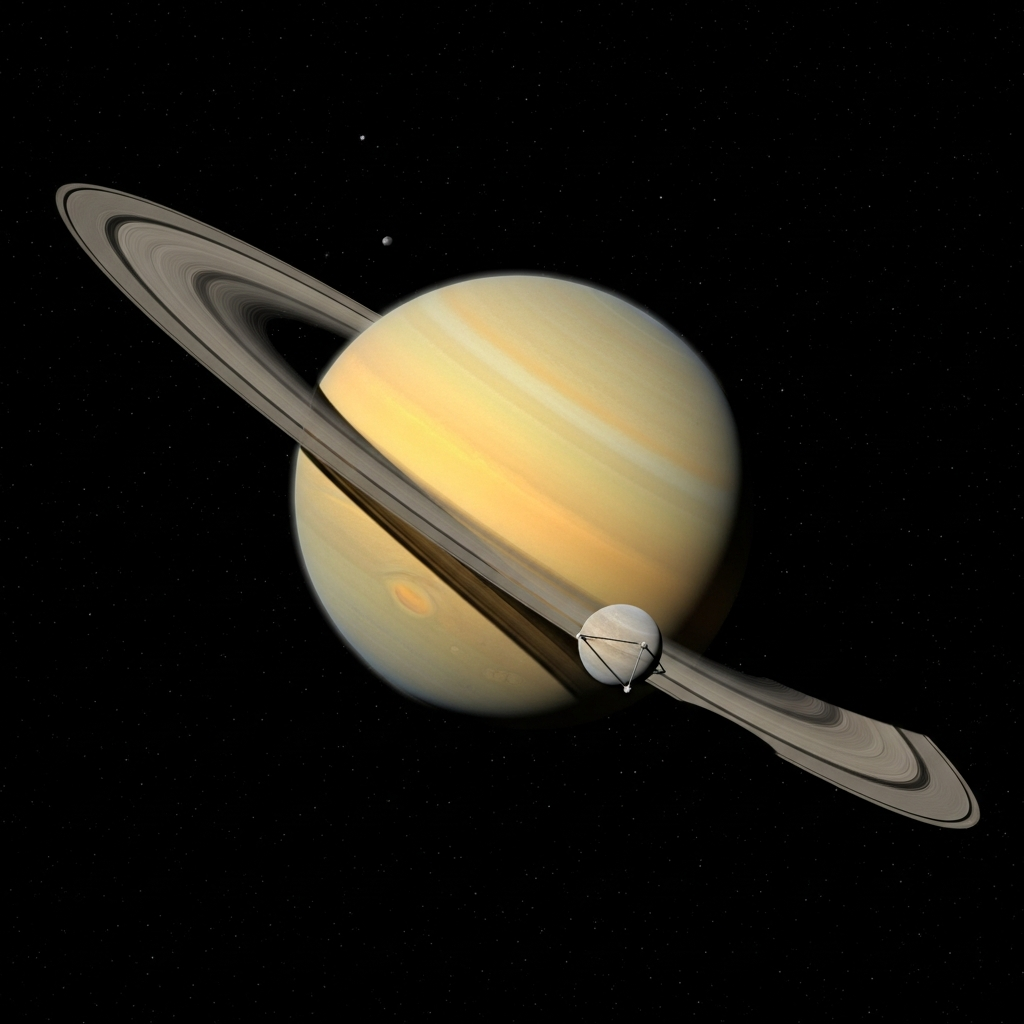
Witness Saturn like never before! NASA’s iconic Hubble Space Telescope and the revolutionary James Webb Space Telescope have teamed up. They deliver the most detailed, multi-spectral views of the ringed gas giant to date. This unprecedented collaboration offers scientists a truly layered understanding. It reveals the complex dynamics of Saturn’s atmosphere, its icy rings, and orbiting moons with astonishing clarity. These combined observations mark a new era. They redefine our grasp of this mesmerizing world.
A New Era of Planetary Observation: Webb & Hubble’s Synergy
NASA’s James Webb Space Telescope (JWST) and the Hubble Space Telescope are pioneering a new chapter in planetary science. Their combined observations of Saturn offer a scientific feast. By viewing Saturn in complementary wavelengths of light, these two space observatories provide distinct, yet synergistic, data. This approach yields a richer, multi-layered understanding of Saturn’s dynamic atmosphere.
Hubble, a veteran in visible light, expertly captures subtle color variations. These appear across Saturn’s banded clouds and hazes. In contrast, Webb’s powerful infrared capabilities delve deeper. It senses clouds and chemicals at various atmospheric depths. This ranges from the lowest cloud decks to the tenuous upper atmosphere. Imagine “slicing” through Saturn’s atmosphere, much like peeling an onion. This combined approach allows researchers to do exactly that. They can now understand how Saturn’s three-dimensional system truly functions. These incredible new views, captured in 2024, also significantly expand upon the vast dataset compiled by NASA’s Cassini orbiter. Cassini diligently studied the Saturnian system from 1997 to 2017.
Peeling Back Saturn’s Atmospheric Layers
The images discussed here were captured mere months apart. Hubble’s view, taken in August 2024, is part of its Outer Planet Atmospheres Legacy (OPAL) monitoring program. Webb’s image followed in November. Together, they highlight Saturn’s incredibly busy atmosphere. Webb’s infrared perspective distinctly reveals a long-lived “ribbon wave.” This jet stream meanders across Saturn’s northern mid-latitudes. It is influenced by atmospheric waves that are otherwise undetectable. Just beneath it, a small spot persists. This marks a lingering remnant of the “Great Springtime Storm” from 2010-2012. Additionally, Webb’s image showcases several other storms dotting Saturn’s southern hemisphere. These powerful atmospheric features are driven by strong winds and waves. These lie beneath the visible cloud deck. This makes Saturn an exceptional natural laboratory. It’s perfect for studying fluid dynamics under extreme planetary conditions.
Unveiling Saturn’s Dynamic Atmosphere
Both telescopes also faintly capture the iconic hexagon-shaped jet stream. This remarkable feature resides at Saturn’s north pole. NASA’s Voyager spacecraft first discovered it in 1981. The hexagon’s persistence over decades is noteworthy. It underscores the remarkable stability of certain large-scale atmospheric processes on giant planets. However, these 2024 observations are likely among the last high-resolution views of this famous hexagon. Saturn’s northern pole is entering a 15-year period of winter darkness. We may not see it clearly again until the 2040s.
Mysterious Polar Hues and Auroral Clues
A truly unique insight comes from Webb’s infrared observations. Saturn’s poles appear distinctly grey-green. This indicates light emitting at wavelengths around 4.3 microns. This distinctive polar feature could have a couple of explanations. It might stem from a layer of high-altitude aerosols. These scatter light differently at those specific latitudes. Another possibility is auroral activity. Charged molecules interacting with Saturn’s magnetic field can produce glowing emissions near the poles. Both Hubble and Webb have proven invaluable in studying auroras across our solar system. They have explored Saturn’s auroras and provided insights into Jupiter’s spectacular light shows. Hubble confirmed Uranus’s auroras, and Webb even detected Neptune’s auroras for the first time.
Rings of Ice and Light: A Detailed Examination
Saturn’s magnificent rings shine exceptionally bright in Webb’s infrared image. This is due to their composition. They are made of highly reflective water ice. Both the Webb and Hubble images showcase the sunlit face of the rings. Hubble’s view, however, shows more pronounced shadows cast on the planet below.
Subtle ring features also appear differently between the two observatories. Take the “spokes” and structures within the B ring. This is the thick central region of the rings. These details are seen with varying clarity. The F ring, Saturn’s outermost ring, looks thin and crisp in the Webb image. In contrast, it only glows faintly in the Hubble image. Saturn’s orbit around the Sun, combined with Earth’s annual position, dictates our changing viewing angle of the planet and its rings.
Tracking Saturn’s Seasons
These 2024 observations, taken 14 weeks apart, offer a snapshot of Saturn’s seasonal transition. The planet is currently moving from its northern summer toward the 2025 equinox. As Saturn progresses into southern spring, and later southern summer in the 2030s, both Hubble and Webb will gain progressively better views of that hemisphere. Hubble’s decades-long monitoring programs, like OPAL, have built a crucial record. They track Saturn’s evolving atmosphere, storms, banding patterns, and seasonal shifts over time. Webb now adds powerful infrared capabilities to this ongoing record. It significantly enhances what researchers can measure about Saturn’s atmospheric structure and dynamic processes. This extends our fundamental understanding of the planet dramatically.
The Enduring Legacy: Hubble’s Decades, Webb’s Dawn
The collaboration between the James Webb Space Telescope and the Hubble Space Telescope represents the pinnacle of modern astronomy. Hubble, operational for over three decades, continues to make groundbreaking discoveries. Its impact is profound, reshaping our fundamental understanding of the universe. Beyond Saturn, Hubble has played a pivotal role in determining the age of the universe. In 2002, it identified the oldest burned-out stars—ancient white dwarfs—within our Milky Way Galaxy. These “clockwork stars” provide an independent method to date the cosmos. This invaluable insight reinforced earlier estimates that put the universe’s age between 13 and 14 billion years. Hubble’s resilience is also legendary; it returned to full science operations in 2021 after a technical issue, a testament to NASA’s dedicated mission teams.
The James Webb Space Telescope, the world’s premier space science observatory, now joins Hubble in this quest. Webb is actively solving mysteries within our solar system. It gazes beyond to distant exoplanets and probes the very origins of our universe. Together, these two remarkable instruments offer a truly unparalleled window into the cosmos. Their combined vision allows humanity to explore deeper, see clearer, and understand more than ever before. This partnership ensures that the future of space exploration remains bright.
Frequently Asked Questions
How do the James Webb and Hubble telescopes combine to view Saturn?
The James Webb Space Telescope and the Hubble Space Telescope offer complementary views by observing Saturn in different wavelengths of light. Hubble, operating in visible light, excels at capturing subtle color variations across Saturn’s clouds and hazes. Webb, using infrared light, can penetrate deeper into the atmosphere, sensing clouds and chemicals at various depths, from the lowest cloud decks to the tenuous upper atmosphere. This combined approach allows scientists to “slice” through Saturn’s atmosphere, providing a richer, multi-layered understanding of its three-dimensional system.
What unique features were revealed in the latest Webb and Hubble images of Saturn?
The 2024 observations unveiled several key features. Webb’s infrared view distinctly showed a long-lived “ribbon wave” jet stream in Saturn’s northern mid-latitudes, influenced by previously undetectable atmospheric waves. A small spot, a remnant of the “Great Springtime Storm” (2010-2012), was also visible. Both telescopes faintly captured the iconic polar hexagon, though these may be the last high-resolution views for 15 years. Webb also uniquely revealed Saturn’s poles as distinctly grey-green, possibly due to high-altitude aerosols or auroral activity. Subtle details like ring spokes and structures in the B ring also appeared differently between the observatories.
Why are these new observations of Saturn significant for future planetary science?
These new observations are profoundly significant for advancing planetary science. They build upon decades of data, including extensive studies by the Cassini orbiter, by adding powerful infrared capabilities. The ability to “slice” through Saturn’s atmosphere helps scientists understand its complex, three-dimensional dynamics. Tracking features like the ribbon wave, persistent storms, and the enduring hexagon provides a natural laboratory for fluid dynamics. Furthermore, Hubble’s long-term monitoring programs, now enhanced by Webb, allow scientists to track seasonal shifts and atmospheric evolution, crucial for modeling giant planets and preparing for future missions.
A Combined Vision for Cosmic Discovery
The unparalleled partnership between NASA’s Webb and Hubble telescopes is truly transformative. It allows us to unravel the complex secrets of our solar system’s gas giants. These new, comprehensive views of Saturn are more than just stunning images. They are a testament to scientific collaboration and technological prowess. By observing in tandem, these space observatories provide an intricate understanding of Saturn’s atmosphere, rings, and moons. This combined vision extends humanity’s reach further into the cosmos. It ensures that our quest for knowledge about the universe continues with unprecedented depth and clarity.