Humanity stands at the precipice of a new era of lunar exploration. The Artemis II mission, a pivotal step in NASA’s ambitious program to return humans to the Moon, continues its rigorous preparations for a groundbreaking journey. This mission marks the first crewed flight around our celestial neighbor in over five decades, setting the stage for future lunar landings and eventual deep-space exploration to Mars. While the journey unfolds, teams rigorously manage every detail, from complex rocket systems to external factors that could impact the mission.
The Artemis II mission, currently targeting a launch window in early April 2026, represents a monumental leap forward. It will send four astronauts aboard the Orion spacecraft, propelled by the colossal Space Launch System (SLS) rocket, on a historic flyby of the Moon. This approximately 10-day round trip will not involve a lunar landing but rather a critical test of hardware, systems, and human adaptability in deep space.
Ensuring Mission Readiness: Addressing Minor Hurdles
Even with a mission of such magnitude, routine occurrences in space operations draw attention. Recently, Starlink confirmed the loss of contact with one of its satellites, designated 34343, at an altitude of 560 kilometers. This anomaly, which occurred on-orbit, did not pose any new risk to the International Space Station, its crew, or, crucially, the upcoming Artemis II mission. Starlink teams actively investigate the root cause and plan to implement corrective actions. They continue to monitor the satellite and any trackable debris, coordinating closely with NASA and the United States Space Force. This incident underscores the constant vigilance required in orbital mechanics, even as the focus remains firmly on lunar aspirations.
The Historic Crew: A New Era of Diversity
The Artemis II mission embraces a profound commitment to diversity, reflecting a stark contrast to the all-male Apollo program. The four-person crew embodies this forward-thinking vision. NASA astronauts Reid Wiseman will serve as commander, Victor Glover as pilot, and Christina Koch as a mission specialist. Joining them is Canadian Space Agency (CSA) astronaut Jeremy Hansen, also a mission specialist.
Victor Glover, a Black astronaut, articulates the crew’s hope to inspire young people globally. He envisions young girls recognizing “Girl power” and young brown boys and girls seeing themselves in the crew, realizing their vast potential. This mission aims for a future where such “firsts” become commonplace, transforming space exploration into an all-encompassing “human history.”
Mastering the Countdown: Rehearsals and Technical Progress
The path to launch requires meticulous preparation and exhaustive testing. NASA has conducted multiple “wet dress rehearsals” for Artemis II, comprehensive simulations that prepare the entire launch team for mission day. These rehearsals involve running through the full suite of pre-launch operations, crucially without the astronauts present.
A key challenge identified during earlier tests was a persistent liquid hydrogen fuel leak. Engineers successfully resolved this issue by replacing a ground support equipment filter, a significant step forward. The second wet dress rehearsal, completed on February 19, 2026, demonstrated substantial progress. During this nearly 50-hour countdown simulation, engineers successfully loaded cryogenic propellant into the SLS rocket. They also practiced vital procedures like clock recycles and scrub procedures, securing the Orion capsule.
Initial setbacks, including cold weather, audio communication problems, and a valve issue, had previously pushed back the launch schedule. However, with the successful completion of the second rehearsal, NASA has made substantial strides toward its target launch window. The comprehensive wet dress rehearsals are essential for identifying and resolving potential issues well before the actual launch, ensuring optimal safety and mission success.
The Intricate Dance of Launch: Understanding the Countdown
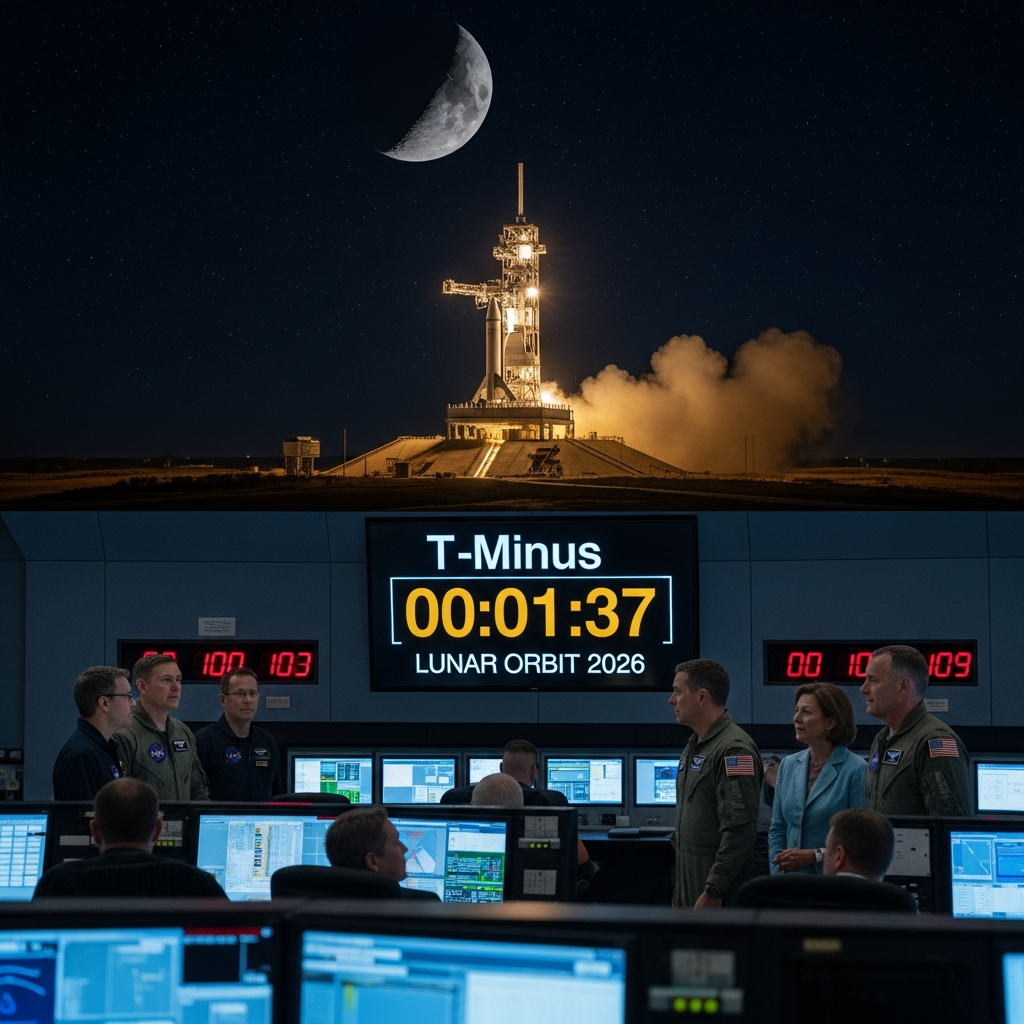
The Artemis II launch countdown is an extraordinarily complex, multi-day sequence. It begins approximately 49 hours and 50 minutes before liftoff. This timeline incorporates “L minus” (overall time remaining) and “T minus” (sequence of specific events) indicators. Planned pauses, or “holds,” are strategically built into the schedule. These holds allow the launch team to target precise launch windows and manage tasks without disrupting the overall flow. During a hold, the “T minus” clock stops, but the “L minus” clock continues.
Key milestones in the countdown include:
L-49 hours 50 minutes: Launch team arrives, countdown begins. Preparations start for the Liquid Oxygen (LOX) and Liquid Hydrogen (LH2) system. The Orion spacecraft, core stage, and Interim Cryogenic Propulsion Stage (ICPS) are powered up.
L-35 hours: Flight batteries for the ICPS, core stage, and Orion are charged.
L-16 hours: Non-essential personnel evacuate Launch Complex 39B at Kennedy Space Center in Florida.
L-13 hours: A significant 2-hour 45-minute hold occurs. The launch team makes a critical “go” or “no-go” decision for tanking the rocket. Chilldown procedures for propellant lines begin.
L-10 hours: Cryogenic loading intensifies, with slow and then fast fills of LH2 and LOX for both the core stage and ICPS. Orion’s communication system activates.
L-6 hours: The flight crew receives a weather brief. A 1-hour 10-minute hold begins. The closeout crew assists the flight crew in boarding the Orion spacecraft. Hatch closure and leak checks follow.
L-50 minutes: Closeout crew departs Launch Complex 39B.
L-40 minutes: A 30-minute hold occurs. The launch director polls the team for a final “go” or “no-go” decision.
T-10 minutes (Terminal Count): The automated Ground Launch Sequencer (GLS) begins its final sequence. The Crew Access Arm retracts, and Orion switches to internal power.
T-6.36 seconds: The RS-25 engines begin their ignition sequence.
- T-0: Booster ignition, umbilical separation, and liftoff occur.
- www.pbs.org
- www.nasa.gov
- www.skyatnightmagazine.com
- sundayguardianlive.com
- www.nasa.gov
The launch team maintains operational flexibility during the terminal count. They can sustain a hold at T-6 minutes for almost the entire launch window. Shorter holds are possible closer to launch. However, once the automated launch sequencer takes full control, any issue necessitates scrubbing the launch attempt for that day.
The Mission Profile: A Journey Beyond Earth
Upon launch from Kennedy Space Center in Florida, the SLS rocket will propel the Orion spacecraft and its crew into Earth orbit. Approximately 24 hours later, Orion will execute a crucial “trans-lunar injection” burn, setting its precise trajectory toward the Moon. The mission will involve a fly-around of the Moon’s far side, providing unprecedented views from a close proximity of 5,000 miles (8,000 km).
This journey serves vital objectives. Primarily, it will comprehensively test and validate the SLS rocket and Orion spacecraft in a crewed configuration for the first time. This validation is essential for ensuring the safety and reliability of hardware for future missions, including human lunar landings. Beyond hardware testing, the crew will conduct crucial scientific and biomedical experiments. These will help scientists understand how the human body adapts to the extreme conditions of deep space, including microgravity and deep-space radiation. Continuous daily communications with Earth are planned, alongside the exciting possibility of a ship-to-ship call with the International Space Station.
After roughly 10 days, the Orion spacecraft, with its crew, will return to Earth for a planned splashdown off the coast of San Diego in the Pacific Ocean. A collaborative recovery operation between NASA and the U.S. Navy will ensure the safe return of the astronauts.
Frequently Asked Questions
What is the primary objective of the Artemis II mission?
The Artemis II mission’s primary objective is to test and validate the Space Launch System (SLS) rocket and the Orion spacecraft in a crewed configuration for the very first time. It is a critical stepping stone toward a sustained human presence on the Moon and future human exploration of Mars. While it won’t land on the lunar surface, the mission aims to demonstrate hardware safety, conduct biomedical experiments, and gather data on human adaptation to deep-space conditions during its 10-day lunar flyby.
How can I follow the Artemis II launch and mission live?
NASA commits to providing extensive public access to this historic event. The launch and subsequent mission milestones will be covered live via NASA’s official TV app and other official NASA channels. Free live streaming will also be accessible online, leveraging external cameras mounted on the Orion spacecraft for nearly continuous footage of the vessel and its crew. Expect real-time updates on the crew, spacecraft status, and mission objectives during the countdown and throughout the journey.
Why is the Artemis II mission significant for future space exploration?
Artemis II holds immense significance as humanity’s first return to lunar space in over 50 years, laying the foundation for our sustained presence beyond Earth orbit. It validates critical technologies like the SLS rocket and Orion spacecraft with a human crew, which are essential for future lunar landings and eventual missions to Mars. Furthermore, its diverse crew inspires a new generation and aims to make space exploration a truly inclusive “human history,” moving beyond past limitations and fostering global participation in humanity’s greatest adventure.
Conclusion
The Artemis II mission stands as a testament to human ingenuity and perseverance. Despite technical hurdles and the complexity of deep-space travel, the dedicated teams at NASA and its partners are meticulously preparing for this monumental journey. From resolving technical issues during wet dress rehearsals to managing orbital anomalies like the Starlink satellite incident, every challenge is met with precision and expertise. As the 2026 launch window approaches, the world watches eagerly, ready to witness a new chapter in human spaceflight. This mission is not just about returning to the Moon; it’s about building a sustainable future in space, driven by a diverse crew and fueled by the boundless potential of humanity.