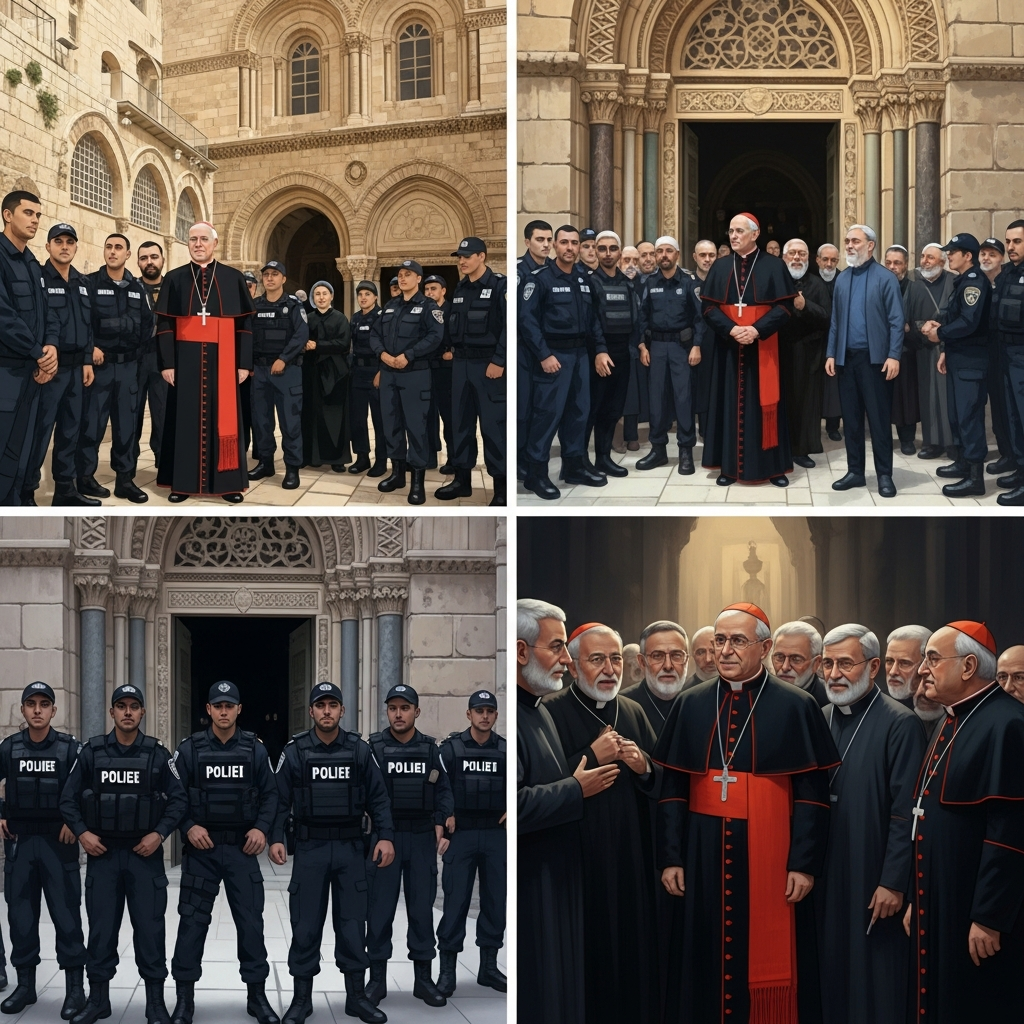
On March 29, 2026, a deeply concerning incident unfolded in Jerusalem’s Old City, as Israeli police prevented prominent Catholic leaders, including Cardinal Pierbattista Pizzaballa, the Latin Patriarch of Jerusalem, from accessing the sacred Church of the Holy Sepulchre for Palm Sunday Mass. This unprecedented event, described by church officials as the “first time in centuries” such a blockage had occurred, immediately ignited a firestorm of international condemnation and sparked critical debates about religious freedom amidst escalating regional tensions. The clash between security directives and the inviolable right to worship cast a somber shadow over one of Christianity’s holiest days.
The Unfolding Crisis: Palm Sunday, 2026
Palm Sunday marks the solemn beginning of Holy Week for Christians worldwide, commemorating Jesus’ triumphant entry into Jerusalem before his crucifixion. Traditionally, the week culminates in Easter Sunday, a period of profound spiritual significance. In Jerusalem, thousands of pilgrims and local Christians would typically participate in a grand procession from the Mount of Olives into the Old City, reenacting the biblical journey.
However, in 2026, the traditional Palm Sunday procession had already been canceled due to Israeli restrictions on large public gatherings, citing security concerns during an alleged “US-Israel war with Iran.” Despite this, Cardinal Pizzaballa and Father Francesco Ielpo, the official guardian of the Church of the Holy Sepulchre, attempted a private entry to the church for Mass. They were reportedly proceeding without any ceremonial characteristics, aiming for a discreet observance. Yet, they were stopped en route within the Old City and compelled to turn back.
A Sacred Site Barred
The Church of the Holy Sepulchre stands as the holiest site in Christianity, revered as the location of Jesus’ crucifixion, burial, and resurrection. For centuries, its doors have remained open to Christian leaders and worshippers, particularly during Holy Week. The Latin Patriarchate of Jerusalem vehemently condemned the police action, labeling it a “grave precedent” and a “manifestly unreasonable and grossly disproportionate measure.” They emphasized that the decision disregarded the deep sensitivities of billions of Christians globally who look to Jerusalem during this sacred time.
Israeli Justifications: Security Amidst Regional Conflict
Israeli authorities offered a range of explanations for their actions, primarily citing pressing security concerns. The Israeli police stated that all holy sites in Jerusalem’s Old City had been closed to worshippers since the “beginning of the US-Israel war with Iran” in February 2026. This broader closure, they argued, was necessary to protect lives from alleged threats.
Complexities of the Old City
A key justification highlighted the Old City’s unique logistical challenges. Police explained that the area’s narrow streets and ancient infrastructure make it difficult for large emergency and rescue vehicles to access, particularly in the event of a “mass casualty incident.” They claimed that approving Pizzaballa’s request would pose a “real risk to human life.” This argument suggested that the safety of the religious leaders and potential worshippers could not be guaranteed under the prevailing conditions.
Allegations of Iranian Threats
The office of Israeli Prime Minister Benjamin Netanyahu further elaborated on the security rationale. They asserted that the police intervention was “out of special concern for his safety,” denying any “malicious intent whatsoever.” Netanyahu’s office alleged that “Iran has repeatedly targeted the holy sites of all three monotheistic religions in Jerusalem with ballistic missiles,” even citing an instance where missile fragments supposedly crashed meters from the Church of the Holy Sepulchre. This narrative framed the restrictions as a defensive measure against external aggression. The alleged targeting also included a synagogue in Beit Shemesh on March 1, 2026, which reportedly resulted in multiple casualties.
Global Condemnation and Diplomatic Fallout
The blocking of Catholic leaders sparked immediate and widespread international outrage, highlighting the delicate balance of religious freedom and security in Jerusalem. World leaders and diplomats swiftly denounced the incident, expressing solidarity with the Christian community.
International Outcry
United States: U.S. Ambassador to Israel Mike Huckabee publicly criticized the decision on X (formerly Twitter), calling it an “unfortunate overreach” that was “difficult to understand or justify.” He pointed out that the private gathering of only a few church representatives was well below the Home Front Command’s 50-person limit for gatherings.
Italy: Italian Prime Minister Giorgia Meloni expressed “solidarity” with Cardinal Pizzaballa and Father Ielpo, both Italian nationals. She condemned the denial of entry as “an offense not only against believers but against every community that recognizes religious freedom.” Italy’s Foreign Minister Antonio Tajani went further, announcing that the Israeli ambassador to Italy would be formally summoned to provide an explanation.
France: French President Emmanuel Macron also condemned the decision on X, linking it to a “worrying series of violations of the status of the holy sites in Jerusalem.” Macron demanded that the “free exercise of worship in Jerusalem must be guaranteed for all religions.”
European Union: The EU’s top diplomat, Kaja Kallas, denounced the incident as a “violation of religious freedom and long-standing protections governing holy sites,” emphasizing that Jerusalem’s multi-religious character and freedom of worship must be fully guaranteed.
Spain: Spanish Prime Minister Pedro Sanchez echoed these sentiments, calling it an “unjustified attack on religious freedom” and urging Israel to “respect the diversity of faiths and international law” for coexistence.
Jordan: Jordan’s foreign ministry also condemned the move as a “flagrant violation” and called for an end to restrictions on worshippers’ access to holy sites.
Domestic Criticism
Even within Israel, the incident drew criticism. Opposition figures, including The Democrats MK Gilad Kariv and opposition leader Yair Lapid, lamented the damage to Israel’s international standing and questioned the professionalism of the police actions. They attributed responsibility to figures like National Security Minister Itamar Ben-Gvir.
Netanyahu’s Intervention and Aftermath
Following the significant international backlash, Prime Minister Benjamin Netanyahu intervened personally. He quickly issued a statement on X promising “full and immediate access” to the holy site for Cardinal Pizzaballa. Netanyahu reiterated that while the restrictions were intended for the protection of worshippers, he ensured that Pizzaballa could hold his prayers.
Later that Sunday evening, the Prime Minister’s office announced that Israeli authorities would develop “a plan to enable church leaders to worship at the holy site in the coming days” for the remainder of Easter week. Israeli police also confirmed an agreement with the Latin Patriarchate to allow “limited groups” of Christians to pray at the Church of the Holy Sepulchre, confirming their commitment to balancing freedom of worship with public safety. This swift intervention aimed to de-escalate the diplomatic crisis and uphold the principle of religious freedom.
Historical Context and the Status Quo
The Church of the Holy Sepulchre operates under a complex set of centuries-old agreements known as the “Status Quo.” This 19th-century understanding dictates access, arrangements, and rights for various Christian denominations, including Catholic, Greek Orthodox, Armenian Apostolic, Coptic, Syriac, and Ethiopian Orthodox worshippers. The “first time in centuries” claim by the Latin Patriarchate underscores the profound historical significance of the alleged violation. The Status Quo is a crucial framework designed to prevent conflicts between denominations and preserve the sanctity of the site. Any perceived breach of these historical arrangements is typically met with strong reactions, as it threatens the delicate balance maintained over generations.
Parallel Restrictions
The incident also occurred amidst similar restrictions placed on Muslim worshippers during the holy month of Ramadan. Reports indicated that access to the Al-Aqsa Mosque on the Temple Mount was also closed, and worshippers were at times violently dispersed while attempting to pray outside the Old City walls. This parallel highlights a broader pattern of heightened security measures impacting religious communities in Jerusalem during a period of perceived conflict.
Implications for Religious Freedom in Jerusalem
The Palm Sunday incident of 2026 serves as a stark reminder of the fragile nature of religious freedom in Jerusalem, a city sacred to billions across three Abrahamic faiths. While security concerns are undeniably critical in a conflict-ridden region, the international community’s unified condemnation underscores the importance of upholding fundamental rights, particularly the right to worship without undue obstruction.
The event sparked essential questions about the proportionality of security measures and the potential for such actions to be misinterpreted or, worse, to inadvertently escalate tensions. Preserving the multi-religious character of Jerusalem requires constant vigilance and a commitment to dialogue, ensuring that religious leaders can perform their duties and worshippers can access their holy sites. This delicate balance is vital for regional stability and global interfaith relations.
Frequently Asked Questions
What prompted Israeli police to block Catholic leaders from Palm Sunday Mass in Jerusalem?
Israeli police stated their actions were due to security concerns amid an alleged “US-Israel war with Iran.” They cited the Old City’s complexity for emergency vehicle access, making it a “real risk to human life” in case of a mass casualty incident. Prime Minister Netanyahu’s office added that the decision was for “special concern for his safety,” claiming Iran had “repeatedly targeted holy sites” in Jerusalem with missiles. This led to the closure of all holy sites to worshippers.
Which international figures condemned the blocking of Cardinal Pizzaballa at the Church of the Holy Sepulchre?
The incident drew widespread international condemnation. Key figures included U.S. Ambassador Mike Huckabee, who called it “unfortunate overreach”; Italian Prime Minister Giorgia Meloni, who saw it as “an offense to the faithful”; and French President Emmanuel Macron, who linked it to a “worrying series of violations of the status of holy sites.” Other condemnations came from Italy’s Foreign Minister (who summoned Israel’s ambassador), the EU’s top diplomat, Spain’s Prime Minister, and Jordan’s foreign ministry.
What is the ‘Status Quo’ and why is its violation concerning for religious freedom in Jerusalem?
The “Status Quo” is a 19th-century agreement governing access and arrangements for various Christian denominations at the Church of the Holy Sepulchre and other holy sites in Jerusalem. Its purpose is to prevent conflicts and preserve the sanctity of these shared spaces. The blocking of Cardinal Pizzaballa was termed the “first time in centuries” such an event occurred, signaling a grave violation of this historical agreement. This is concerning because breaches of the Status Quo can destabilize interfaith relations, erode trust, and compromise the fundamental principle of religious freedom for billions of worshippers globally.
The Palm Sunday incident of 2026 ultimately served as a powerful reminder of Jerusalem’s unique and often volatile position at the intersection of faith, politics, and security. While Prime Minister Netanyahu’s swift intervention helped to resolve the immediate crisis, the event underscored the ongoing challenges in safeguarding religious freedoms while addressing legitimate security concerns in one of the world’s most sacred and contested cities. The incident will undoubtedly resonate in future discussions concerning human rights and diplomatic relations in the Middle East.