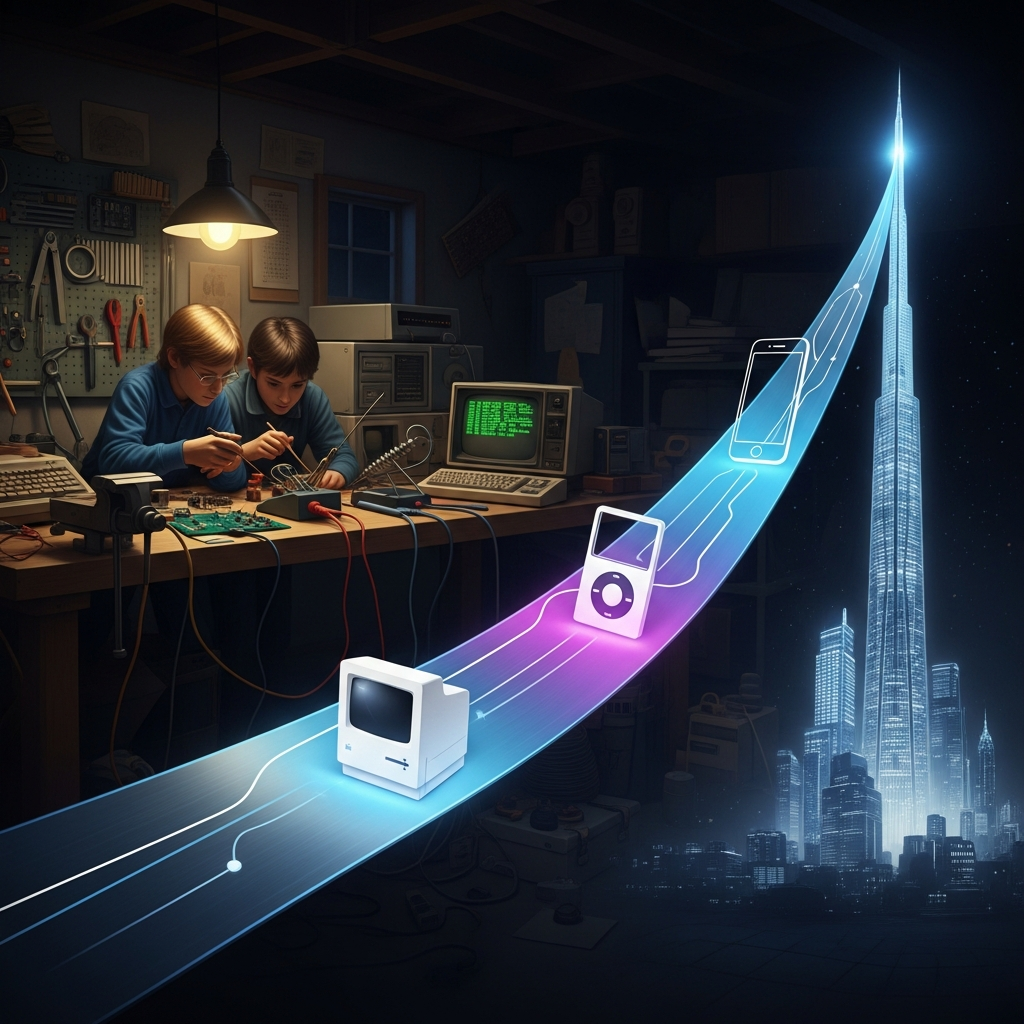
As Apple approaches its monumental 50th anniversary in 2026, the Cupertino giant stands as a testament to relentless innovation and a profound ability to reshape the technological landscape. From its humble beginnings in a garage to a multi-trillion-dollar titan, Apple’s journey has been defined by groundbreaking products that didn’t just meet demand but often created entirely new categories. This half-century mark prompts us to reflect on the company’s enduring legacy, showcasing how it consistently pushed boundaries and set industry standards.
Among its pantheon of iconic inventions—the iPod, iPhone, and iPad—one product quietly, yet profoundly, redefined an entire industry: the MacBook Air. Often underestimated, its influence on modern laptops is unparalleled. Without the MacBook Air, the sleek, powerful, and highly portable machines we use today might simply not exist. Its evolution mirrors Apple’s broader philosophy: taking bold risks, embracing vertical integration, and prioritizing user experience above all else. Understanding the MacBook Air’s impact helps illuminate the core genius behind Apple’s 50 years of success.
The Dawn of a New Era: The MacBook Air’s Unveiling
The year was 2008. In a moment that would become legendary, Steve Jobs dramatically pulled the first MacBook Air from a manila envelope. This wasn’t just a product launch; it was a declaration. Apple was signaling a future where compromise was not a barrier to elegance. Windows PC executives at CES, then immersed in bulkier, less refined designs, found themselves scrambling. They knew immediately they had to chase this new standard of thinness.
Initial reactions to the $1,799 MacBook Air were mixed. Critics, including then-reporter Joanna Stern, pointed to its perceived shortcomings: a 3-pound weight that wasn’t exceptionally light for the price, the absence of a DVD drive, a single USB port, and only 2GB of RAM. Yet, its aluminum unibody design, full-size keyboard, and vibrant display were revolutionary compared to the plastic-clad offerings of competitors. Tim Cook later clarified the first Air wasn’t about sales volume. Instead, it aimed to establish a foundational vision for what a laptop could and should be.
Act 1: An Overpriced Showpiece (2008–2010)
The inaugural MacBook Air, measuring 0.76 inches at its thickest, was undeniably a status symbol. Its innovative drop-down port door cleverly concealed essential connections like USB and a headphone jack, further emphasizing its minimalist aesthetic. However, its premium price tag and a list of “nos”—no DVD drive, no Ethernet, no FireWire, no easy battery swap, and no upgradeable RAM—made it a niche product. Even its 4,200rpm hard drive was slow, with a 64GB solid-state option adding a hefty $1,300.
Despite these limitations, Apple was selling a powerful vision of the future. The company foresaw a world where optical drives were obsolete, wired connections were becoming secondary, and heavy plastic casings were replaced by lighter, more durable materials. Competitors quickly tried to emulate the Air’s thinness, leading to commercially unsuccessful, yet aesthetically bold, attempts like Dell’s 0.39-inch thick Adamo XPS. These early efforts proved that mere thinness wasn’t enough; integration and experience mattered most.
From Niche to Mainstream: The MacBook Air’s Transformation
The true turning point for the MacBook Air came with its significant redesign in 2010. This iteration shed its “showpiece” label and became a “mainstream marvel.” The shift was propelled by several critical advancements. Flash storage became standard, making the laptop feel dramatically faster, akin to the responsive experience of an iPhone or iPad. Battery life saw a substantial boost, increasing from five to seven hours. A full-size, multitouch glass trackpad revolutionized navigation, enabling intuitive gestures. Crucially, it became available in both 11-inch and 13-inch models, with the smaller variant starting at a far more accessible $999.
This redesign positioned the MacBook Air not just as a luxury item but as a viable, everyday laptop for a much broader audience. Steve Jobs famously declared it “the future of notebooks.” Leveraging its robust vertical integration, Apple seamlessly incorporated features and performance benefits from its successful mobile devices, delivering faster boot times and extended battery life. The Windows PC market responded with Intel’s “ultrabooks,” a new category of thin and light laptops designed to compete directly with the Air.
The Trackpad Wars: Apple’s Advantage
Despite the surge of “ultrabooks,” many, like the Asus Zenbook UX31, struggled to match the MacBook Air’s overall user experience. Reviewers, including Stern, frequently highlighted the abysmal quality of PC trackpads. They were often described as “glitchy nightmares,” leading to a common refrain: “for $200 or $300 more, you could just get a MacBook Air.” This disparity was so pronounced that some reviewers even installed Windows 7 on a MacBook Air to demonstrate how its superior trackpad performed even with a rival operating system. This critical advantage stemmed from Apple’s unique vertical integration, controlling both hardware and software, unlike Windows manufacturers who often relied on inconsistent third-party trackpad drivers. Over time, PC makers did catch up, with machines like the redesigned Dell XPS 13 (2015) and Microsoft’s Surface Laptop (2017) finally offering comparable experiences. This competitive drive fueled by Apple’s innovation is a core part of Apple’s 50 years of influence.
The Silicon Era: Apple’s Ultimate Integration
The final, transformative act in the MacBook Air’s journey—and indeed for much of Apple’s computing lineup—unfolded in 2020. This was when Apple replaced Intel processors with its proprietary M-series silicon. This move completed Apple’s vertical integration, granting it unprecedented control over the entire laptop stack, from chip design to operating system. This strategic shift eliminated many long-standing compromises and turned previous absences into compelling selling points.
The M-series MacBook Air models arrived without a fan, largely eradicating heat issues and enabling silent operation. They boasted exceptional battery life, often lasting an entire workday, reducing the need for constant charging. This made the laptop feel more akin to an “iPad in laptop form,” delivering instant-on performance and remarkable efficiency (though still without a touchscreen). Once again, the PC industry is playing catch-up, with manufacturers partnering with Qualcomm and Intel pushing its own initiatives for thinner, cooler, and longer-lasting PCs. This ongoing cycle of innovation and competitive response encapsulates the dynamic nature of 50 years of Apple leadership.
Beyond the Air: Apple’s Enduring Influence and Future
While the MacBook Air may not have the instant cultural recognition of an iPod or iPhone, its fundamental impact on the computing industry is undeniable. It showcases Apple’s “manila envelope magic trick”—consistently transforming perceived compromises into desirable features and compelling the rest of the industry to follow suit. As Apple’s 50th Anniversary approaches, its influence continues unabated.
The company’s commitment to pushing boundaries is evident in its current product lines. For instance, the M5 Pro/M5 Max MacBook Pro models represent the pinnacle of professional computing. Recent market activities, like Amazon’s “Big Spring Sale” in March 2026, saw these high-end MacBook Pros receive significant discounts, with savings of up to $199. A 14-inch M5 Pro with 24GB unified memory and 1TB SSD could be found for $2,049.99, while a 16-inch M5 Pro with 48GB unified memory and 1TB SSD was reduced to $2,899.99. These sales underscore the premium, yet often accessible, nature of Apple’s latest hardware, continuing its tradition of combining powerful performance with sleek design.
Looking ahead, Apple’s journey will undoubtedly continue to be marked by ambitious projects and a steadfast focus on user experience. From pushing boundaries in augmented reality to further refining its silicon, the company remains at the forefront of technological advancement. Its half-century legacy is not just about the products it has created, but the profound ripple effect those products have had across the entire tech ecosystem, constantly raising the bar for what consumers expect from their devices.
Frequently Asked Questions
What was the initial reception of the first MacBook Air upon its launch?
The original MacBook Air, unveiled by Steve Jobs in 2008, received a mixed reception. While its groundbreaking thinness and elegant aluminum design were lauded, many critics initially found it overpriced at $1,799. It also faced criticism for its perceived compromises, such as a lack of a DVD drive, only one USB port, slow hard drive options, and non-upgradeable RAM. However, Apple clarified that its purpose was to establish a new foundation for laptops, signaling a future of thin, mobile computing.
How did the MacBook Air fundamentally redefine the modern laptop market?
The MacBook Air redefined laptops through three key phases. Initially, it was an “overpriced showpiece” that compelled competitors to chase thinness. Its 2010 redesign, introducing flash storage, improved battery life, and a full-size trackpad at a more accessible price, made it a “mainstream marvel” and the “future of notebooks.” Finally, the shift to M-series silicon in 2020 completed its transformation, eliminating heat and fan noise while delivering exceptional battery life, forcing the PC industry to once again play catch-up.
Are current MacBook Pro models still considered cutting-edge for professional use?
Yes, current MacBook Pro models, particularly those featuring Apple’s M5 Pro and M5 Max silicon, are considered at the forefront of professional computing. They offer industry-leading performance, exceptional energy efficiency, and extended battery life, making them ideal for demanding tasks like video editing, 3D rendering, and software development. Recent sales, such as Amazon’s “Big Spring Sale” in March 2026, highlighted these models as opportunities to acquire premium, cutting-edge hardware at competitive prices, demonstrating Apple’s continued innovation in the high-performance laptop segment.