From its humble beginnings in a California garage to a global technology titan, Apple Inc. is celebrating a monumental half-century. What began as a bold vision by young innovators in 1976 has blossomed into a company with a staggering $3.5 trillion market value, boasting over 2.5 billion active devices worldwide. This remarkable journey is not just a tale of technological breakthroughs; it’s a masterclass in relentless innovation, unwavering design principles, and a deep commitment to user experience that has forged an almost legendary customer loyalty.
This article delves into the core strategies that propelled Apple to such unprecedented heights, examines the pivotal moments that shaped its trajectory, and explores the critical challenges and promising opportunities defining its future, particularly amidst the evolving landscape of artificial intelligence and shifting market dynamics.
From Garage to Global Giant: Apple’s Humble Beginnings
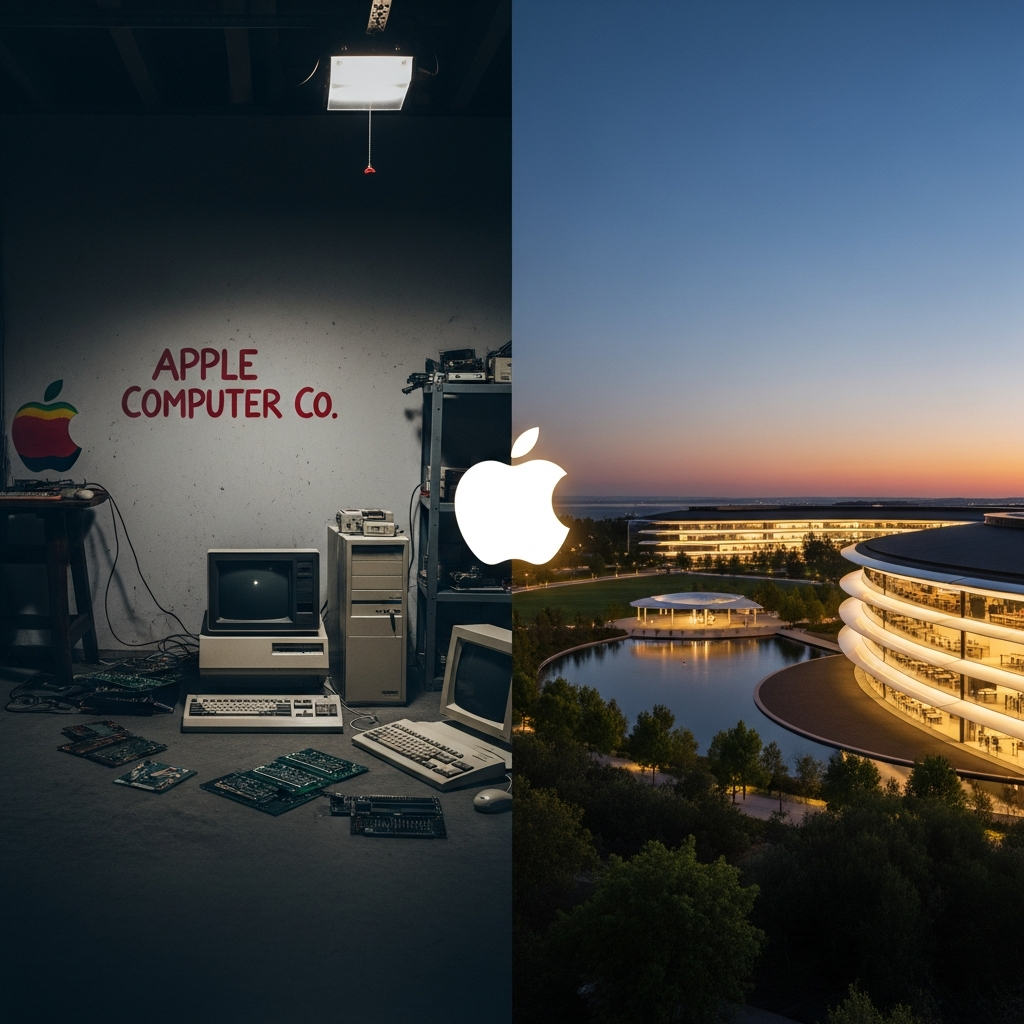
The year was 1976 when two ambitious young Steves, Wozniak and Jobs, alongside Ron Wayne, co-founded Apple. The venture sparked to life in Steve Jobs’ family garage on April 1st. Steve Wozniak, a brilliant engineer, had already built a groundbreaking personal computer. However, his then-employer, Hewlett-Packard, rejected the concept five times. This pivotal rejection spurred Wozniak and Jobs to embark on their own entrepreneurial journey.
At the time, personal computers were a rarity, prohibitively expensive, and far from user-friendly. Apple’s initial mission was revolutionary: to create innovative, intuitive, and beautifully designed gadgets that would bring computing power to the masses. This foundational ethos—combining cutting-edge technology with aesthetic appeal and ease of use—would become Apple’s enduring hallmark, setting the stage for its half-century of transformative influence.
The Core Principles Fueling Half a Century of Innovation
Apple’s sustained dominance is no accident. It stems from an almost “cultish obsession” with design, privacy, and excellence. This intense focus has cultivated an unparalleled loyalty among its vast customer base. Technology analyst Jacob Bourne aptly notes that “Apple is more than just a technology company; it’s really a cultural icon.” By crafting products that seamlessly blend work and enjoyment, Apple has fostered a profound emotional connection with its brand. Its robust stance on privacy and security further cements trust, inspiring legions of fans who eagerly line up for the latest releases.
Journalist David Pogue, author of “Apple: The First 50 Years,” highlights the almost “mania” for excellence pervading the company culture. He recounts meticulous product development, such as the rigorous testing of facial recognition technology. This included evaluations at Harley-Davidson motorcycle rallies and even enlisting Hollywood special effects artists. Their goal was to ensure no life-like mask could spoof the system, showcasing an extraordinary attention to detail. This relentless pursuit of perfection, described by Pogue as an “epic tale of frenetic all-nighters and creative rebellion,” underscores Apple’s unique approach to innovation.
Navigating Crises: Pivots, Products, and Leadership Shifts
Apple’s journey wasn’t without its severe trials. In the 1990s, the company faced dire financial straits, shedding a third of its workforce and teetering on the brink of bankruptcy. This precarious situation dramatically reversed with the return of Steve Jobs in 1997. Jobs had previously departed in 1985 after clashes with the board and then-CEO John Sculley. Sculley himself famously recalled Jobs’ compelling pitch: “Do you want to sell sugar water for the rest of your life, or do you want to come with me and change the world?”
Under Jobs’ renewed leadership, Apple unleashed a torrent of groundbreaking products. The iPod, iPhone (launched in 2007, sparking the smartphone revolution), and iPad redefined entire industries. Steve Wozniak noted Apple’s incredible flexibility, stating, “Apple kept up with it all… we’ve got so many different avenues.” Despite Jobs’ passing in 2011 from pancreatic cancer, which fueled initial uncertainty, Apple continued its innovative trajectory under Tim Cook. The company has also faced scrutiny over working conditions in its Chinese factories, a recurring challenge for many global manufacturers.
A Trillion-Dollar Empire: Financial Prowess and Market Standing
Today, Apple stands as one of the world’s most valuable and powerful corporations. Its market capitalization has soared past $3.5 trillion, making it the second-largest company globally after Nvidia. In its most recent fiscal year, Apple reported a staggering $416 billion in revenue and a net income of $112 billion. The company employs roughly 166,000 workers globally and operates a sprawling, ring-shaped headquarters in Cupertino, California.
Beyond its iconic hardware, Apple has strategically expanded its footprint into lucrative service sectors. In 2019, it launched Apple TV+, its streaming service renowned for acclaimed shows like “Severance” and “Ted Lasso.” A significant testament to its content success came in 2022 when “CODA” became the first streaming service film to win an Academy Award for Best Picture. This diversification into services underscores Apple’s ability to adapt and generate new revenue streams in an evolving digital landscape.
Apple’s 50th Anniversary: A Global Celebration of Vision
Apple’s half-century milestone has been marked by global celebrations reflecting its cultural impact. These included a surprise concert by artist Alicia Keys at its Grand Central Store in New York. The company also hosted events across China, Korea, Thailand, the United Kingdom, and Mexico, often showcasing local artists. A notable spectacle involved lighting up the iconic Sydney Opera House in Australia with iPad-designed art.
CEO Tim Cook shared a public letter reflecting on the anniversary, articulating a guiding philosophy: “Through every breakthrough, one idea has guided us — that the world is moved forward by people who think different.” The anniversary also spurred unique commemorative events. RR Auction held an auction featuring rare items, including a 1976 check signed by Jobs and Wozniak and an Apple I computer prototype board, both selling for over $2 million. The Computer History Museum in Mountain View, California, also opened a new exhibit, displaying rare prototypes and chronicling Apple’s incredible journey. Ron Wayne, one of Apple’s co-founders, made a rare appearance, reiterating his early departure due to perceived financial risks.
The Road Ahead: AI, Stock Volatility, and Future Leadership
As Apple looks toward its next half-century, it confronts new frontiers and significant challenges. The burgeoning artificial intelligence (AI) race is a prime example, where Apple is currently perceived to be trailing some competitors. Research firm Evercore ISI predicts potential delays for “Apple Intelligence 2.0,” an advanced phase of its personal AI system, citing “recent headwinds during the testing phase.” Apple’s commitment to privacy appears to be a “paramount importance,” potentially influencing a cautious, multi-phase rollout of new AI features throughout the current year, including a “complete overhaul of Siri” later in the fall. Steve Wozniak himself has voiced concerns about the ethical implications of AI, such as deepfakes, and the pervasive nature of technology fostering social media addiction.
On the financial front, Apple’s stock (AAPL) finds itself at a crossroads. Despite a year-to-date decline and recent struggles, options traders exhibit a paradoxical sentiment, with significant bullish call volumes. However, the rate of put buying has notably accelerated, suggesting increased caution or bearish hedging. The stock is currently in danger of breaching its 320-day moving average and faces a critical $250 pivot point. Interestingly, options on AAPL are considered “affordably priced” due to relatively low implied volatility. Prominent CNBC host Jim Cramer remains bullish, advocating for long-term ownership, echoed by Goldman Sachs and Bernstein with optimistic price targets of $330 and $325, respectively, citing strong App Store growth and record iPhone revenue. Amidst these dynamics, questions also swirl around the eventual retirement of current CEO Tim Cook. Despite these pressures, analyst Jacob Bourne believes Apple is well-positioned to “weather the current pressures at least for the foreseeable future.”
Frequently Asked Questions
How did Apple overcome its near-bankruptcy in the 1990s?
Apple faced severe financial difficulties in the 1990s, laying off a third of its workforce and nearing bankruptcy. Its resurgence was largely attributed to the return of co-founder Steve Jobs in 1997. After clashing with the board and then-CEO John Sculley, Jobs had left Apple in 1985. Upon his return, he revitalized the company’s product line and strategic direction, leading to the development and release of revolutionary products like the iPod, iPhone, and iPad, which fundamentally transformed the tech industry and user interaction with technology.
What were some key events and celebrations marking Apple’s 50th anniversary?
Apple marked its 50th anniversary with a series of global celebrations reflecting its immense cultural impact. These included a surprise concert featuring artist Alicia Keys at its Grand Central Store in New York and other events showcasing local artists in China, Korea, Thailand, the UK, and Mexico. The company also illuminated the Sydney Opera House with iPad-designed art. Additionally, commemorative auctions saw rare items like a 1976 check signed by Jobs and Wozniak sell for over $2 million, and the Computer History Museum in Mountain View, California, opened a new exhibit showcasing rare Apple prototypes.
How is Apple currently navigating the intense AI landscape, and what are its key challenges and opportunities?
Apple is actively engaged in the competitive AI landscape, though it is currently perceived to be trailing some rivals. A key challenge is the potential delay for its “Apple Intelligence 2.0” system, with Evercore ISI citing “headwinds during the testing phase.” Apple is prioritizing user privacy and seamless integration for its AI functionalities, which may lead to a multi-phase rollout of new features throughout the current year, including a significant overhaul of Siri later in the fall. The opportunity lies in leveraging its vast ecosystem and user base once its privacy-centric AI offerings are fully realized, which analysts believe will allow it to weather current pressures.