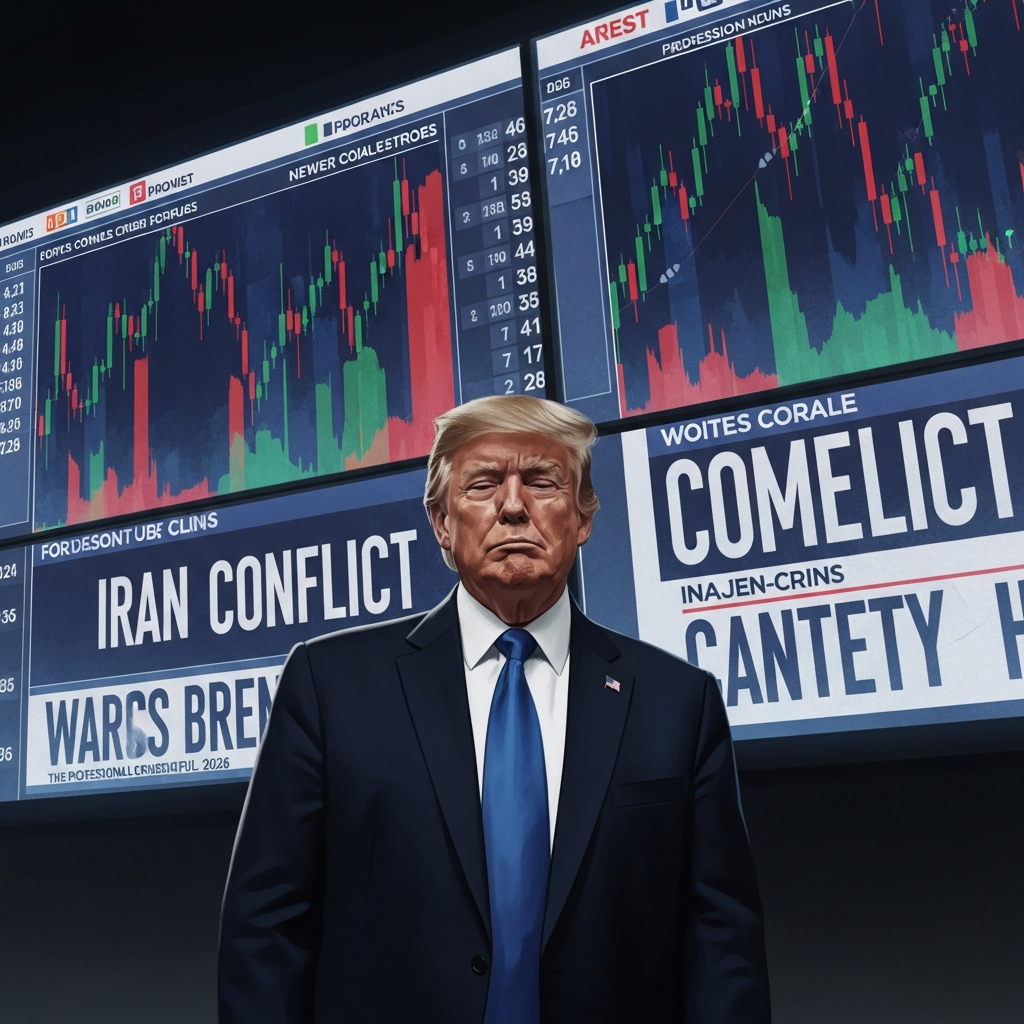
The global financial landscape is grappling with a significant challenge in 2026: a pronounced stock market correction driven by the escalating conflict with Iran. This market downturn signals investor fears over geopolitical instability and economic fallout, presenting a unique test for President Donald Trump, who has historically sought to reassure markets but now faces a physical reality he appears unable to “talk his way out of.” Major indices have entered correction territory, and oil prices are surging, signaling a broader economic impact that experts are scrambling to understand.
This article delves into the causes, immediate effects, and conflicting expert opinions surrounding the 2026 market instability. We’ll explore the complex interplay of geopolitical tensions, White House responses, and underlying economic vulnerabilities that are shaping investor sentiment. Understanding these dynamics is crucial for anyone navigating the current volatile investment climate.
Geopolitical Storm: The Iran War’s Market Dominance
The ongoing war with Iran has become the primary catalyst for the current stock market correction. Despite President Trump’s past successes in navigating global crises without major market disruptions, this conflict has presented a different challenge. The physical realities of war—strikes, blockades, and counter-attacks—have outpaced narrative control, leaving investors deeply unsettled.
Market indicators quickly reflected this unease. The Nasdaq 100 officially plummeted over 10% from its peak, signaling a deep correction. Simultaneously, the S&P 500 endured an unsettling five consecutive weeks of losses, its longest such streak since 2022. This widespread sell-off across equities underscores the depth of investor anxiety.
Oil Prices Surge Amidst Strait of Hormuz Uncertainty
A critical immediate impact has been the dramatic spike in global oil prices. Brent crude, the international benchmark, has neared $111 a barrel, while West Texas Intermediate (WTI) crude approached $97, with many analysts predicting it would soon breach the $100 mark. This surge is largely attributable to the conflict’s direct threat to global energy supplies. The Strait of Hormuz, a narrow waterway through which 20% of the world’s oil supply passes, has become a flashpoint. Iranian actions, including turning back two Chinese-owned container ships, have heightened fears. This move was particularly alarming as China had previously been largely exempt from Iran’s blockades. Such unpredictability amplifies the risk premium for oil tankers, pushing prices ever higher.
On March 27, U.S. crude oil prices had surged over 40% since the war began on February 28, and more than 60% since the start of the year. Heating oil, a proxy for jet fuel, spiked 8%, contributing to a nationwide average of $3.98 per gallon for unleaded gasoline.
Trump’s Narrative vs. Market Reality
President Trump’s administration has made several attempts to de-escalate market fears, but with limited success. He extended a deadline for striking Iran’s energy infrastructure by 10 days, following an initial threat. A “Talks are ongoing” post on Truth Social aimed to calm markets, yet failed to produce the desired “Truth Social effect” on oil prices. Energy trader John Arnold noted that traders were becoming “exhausted from the noise” and distrustful of the President’s statements.
Internally, senior White House aides reportedly indicated that Trump had grown “a little bored” with the conflict, shifting his focus to domestic policy, the economy, and upcoming midterm elections. This shift was evident in public communications, which included promoting the war effort with pop culture memes (Iron Man, Top Gun, SpongeBob SquarePants) and launching an official app for direct news, seemingly bypassing traditional media. This suggests an acknowledgement within the White House of a growing credibility gap regarding its messaging on the conflict.
Brief Market Reversal and Lingering Doubts
There was a brief respite in early March 2026. On March 9, President Trump’s remarks suggesting the war was “very complete, pretty much” and nearing an end triggered an immediate upside reversal in stock markets and a plunge in oil prices. WTI crude fell 6% to $83.89, while Brent crude dropped 1.55%. The Dow, S&P 500, and Nasdaq all rallied significantly. However, these gains proved temporary as the broader geopolitical realities continued to unfold. The March 27 reports confirmed that the initial optimism had been “crushed” by escalating tensions and Iran’s continued defiance.
Iranian officials publicly rejected a U.S. 15-point ceasefire proposal, delivered via intermediaries. Their counter-demands, including sovereignty over the critical Strait of Hormuz, were deemed “unrealistic.” This conflict is notably different from past disputes; it requires both parties to disengage. Despite Iran suffering severe setbacks, including the assassination of its supreme leader and decimated infrastructure, it maintains a strong motivation to prolong economic damage. The selection of hardliner Mojtaba Khamenei as Iran’s new supreme leader further solidified the perception that compromise was unlikely.
Divergent Economic Forecasts: Optimism vs. Reality
The potential long-term economic impact of the Iran conflict is a subject of intense debate among experts. European Central Bank President Christine Lagarde issued a stark warning, stating that markets are “overly optimistic” about the conflict’s true implications. She characterized the situation as a shock “probably beyond what we can imagine at the moment,” pointing to potential “second-order supply-chain effects.” These could include unexpected disruptions, such as helium shortages affecting semiconductor production, with effects that could last “years” and are not yet priced into investor expectations.
Conversely, some economists maintained a more optimistic outlook. Nordic American Tankers CEO Herbjørn Hansson expected the Strait of Hormuz to reopen “within weeks, not months,” based on historical precedents. Apollo’s chief economist, Torsten Slok, also argued that markets were “overreacting” to short-term volatility. Slok contended that the “Iran shock is not big enough to offset the strong tailwinds to the U.S. economy from AI spending, the industrial renaissance, and the One Big Beautiful Bill.” However, the unpredictable turning back of Chinese ships in the Strait significantly challenged this more hopeful perspective, suggesting an increasingly unstable situation.
Beyond Geopolitics: Broader Market Headwinds
While the Iran conflict is a dominant factor, the 2026 stock market correction also faces pressure from other significant economic headwinds, some largely independent of the Trump administration.
Fragile Consumer Spending
Consumer spending, typically a robust driver constituting approximately 70% of U.S. GDP, is showing signs of fragility. Data from the Federal Reserve Bank of Boston indicated that aggregate spending strength in 2025 was predominantly driven by high-income consumers. In stark contrast, spending among middle-income and lower-income households has stagnated. Moody’s reported that the top 10% of earners now account for nearly half of all U.S. consumer spending, painting a less robust overall economic picture. Alarming spikes in car repossessions and foreclosures serve as critical warning signs of a potential recession, which would particularly harm discretionary goods and services sectors.
Tariff Uncertainty and Fiscal Risks
The Trump administration’s sweeping tariffs, averaging around 18% on imports, introduce another layer of geopolitical instability and economic uncertainty. While these tariffs haven’t led to the predicted supercharged inflation (with many businesses absorbing costs), a critical Supreme Court ruling looms. The Court is set to decide on the White House’s constitutional authority to enact these policies. An adverse ruling could force the U.S. to refund hundreds of billions in collected levies, significantly impacting the nation’s fiscal condition and potentially causing investors to question its solvency. Such a scenario could lead to higher interest rates on U.S. Treasuries, raising capital costs across the economy and heavily burdening growth stocks that rely on debt financing.
The Looming Specter of AI Fatigue
Another significant, yet often overlooked, risk is the potential for AI fatigue. Harvard economist Jason Furman calculated that U.S. GDP growth in the first half of 2025 was almost exclusively fueled by data center spending. This spending, driven by major tech companies hoarding high-end GPUs from manufacturers like Nvidia, is problematic because the massive AI investment isn’t consistently translating into profits for these companies. For instance, ChatGPT creator OpenAI is projected to burn through approximately $17 billion in cash in 2026. A potential initial public offering (IPO) for OpenAI this year would expose the “arguably poor economics” underpinning the generative AI industry. This revelation could potentially burst what many perceive as a multi-trillion-dollar AI bubble, triggering a widespread correction across the technology sector and broader market given its extensive exposure.
Broader Economic Repercussions
The market downturn and geopolitical fears have already begun to manifest in broader economic indicators. The Organisation for Economic Co-operation and Development (OECD) projected that as a direct result of the Iran war, the average inflation rate for G20 countries would rise to 4% this year, a significant jump from its December prediction of 2.8%.
The bond market also experienced a sell-off, pushing yields higher. The 10-year U.S. Treasury bond yield climbed to 4.42%, directly influencing consumer lending rates. Consequently, mortgage rates escalated from approximately 6% at the war’s onset to over 6.5%. The market downturn wasn’t confined to the U.S.; stock indexes in Asia and Europe also registered significant declines, with tech company shares taking a notable hit globally.
Frequently Asked Questions
What are the main drivers behind the 2026 stock market correction?
The primary driver is the escalating war with Iran, causing significant geopolitical instability and fear. This conflict directly impacts global oil prices, especially due to tensions around the Strait of Hormuz. Additionally, underlying economic vulnerabilities like fragile consumer spending (particularly among middle and lower-income groups), uncertainty surrounding the constitutional validity of tariffs, and concerns about an “AI bubble” where massive investments aren’t translating to profits, are contributing to the correction.
How has President Trump’s administration responded to the market downturn?
President Trump’s administration has attempted to de-escalate fears through statements and social media posts, such as extending deadlines for military action and claiming “talks are ongoing.” However, these efforts have largely failed to calm markets, with energy traders reportedly growing “exhausted from the noise.” Internally, there’s a perceived shift in focus towards domestic policy, and public communications have included pop culture memes, indicating a struggle to control the narrative amidst the physical realities of the conflict.
What are the long-term economic outlooks for the current market instability?
Experts hold divided views. European Central Bank President Christine Lagarde warns that markets are “overly optimistic” and that the conflict could lead to “second-order supply-chain effects” (e.g., helium shortages impacting semiconductors) with impacts lasting “years.” Conversely, some economists like Torsten Slok believe the market is “overreacting” and that the “Iran shock is not big enough” to offset strong economic tailwinds from AI spending and industrial growth. However, the increasing unpredictability in critical areas like the Strait of Hormuz suggests the long-term outlook remains highly uncertain.
Conclusion
The 2026 stock market correction is a complex phenomenon rooted deeply in the ongoing Iran war and amplified by other systemic economic pressures. While President Trump’s administration has attempted to manage the narrative, the physical realities of the conflict and market reactions demonstrate a clear shift where rhetorical influence falls short. Divided expert opinions on the long-term economic impact highlight the profound uncertainty facing investors.
As geopolitical tensions persist and underlying economic vulnerabilities—from consumer spending habits to the sustainability of the AI boom—continue to evolve, vigilance remains paramount. Investors should consider these multifaceted risks and understand that market stability in the coming months will likely hinge on both de-escalation in the Middle East and the resilience of fundamental economic drivers. Navigating this period requires a keen awareness of both global events and domestic financial health.