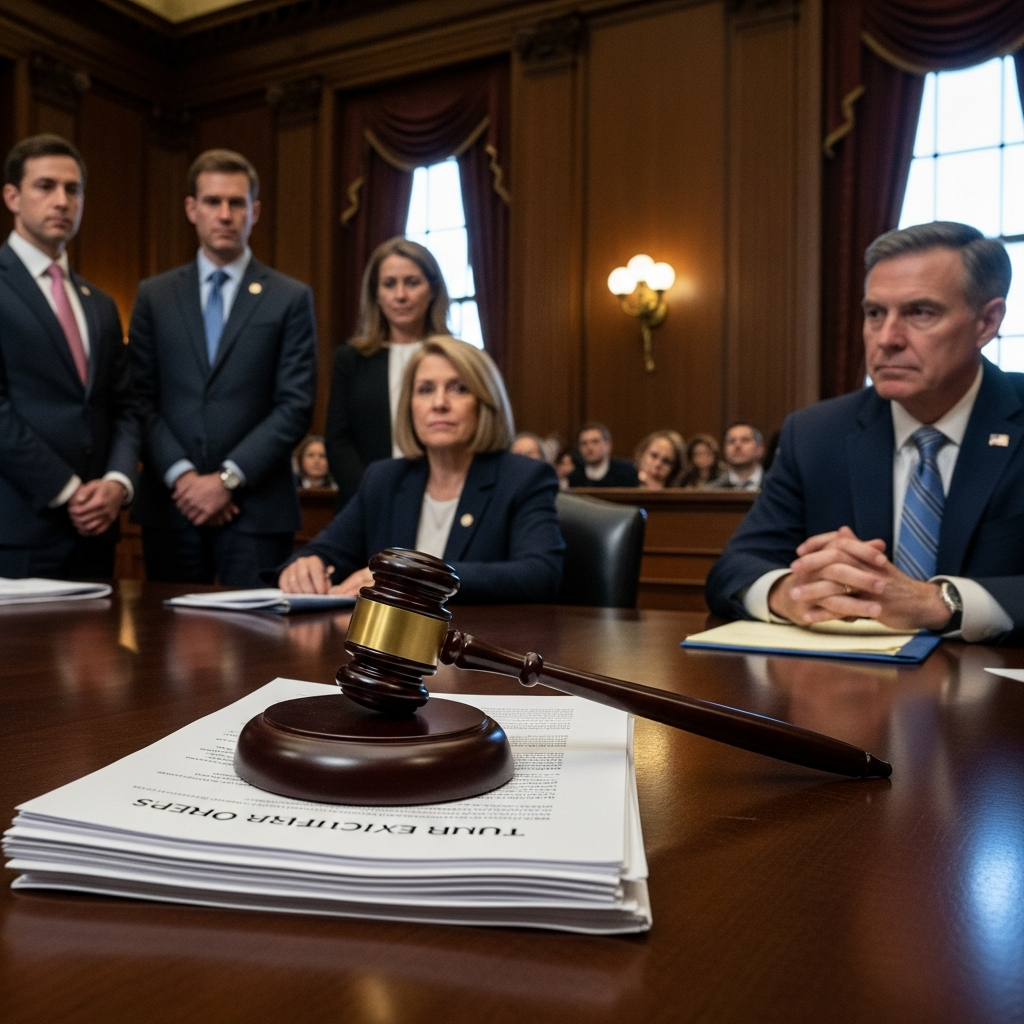
In a significant chapter for the American legal system, the Justice Department ultimately abandoned its defense of a series of executive orders issued by then-President Donald Trump, which had controversially targeted several prominent law firms. These directives, deemed unconstitutional by federal judges, sparked a crucial battle over presidential power, the rule of law, and the fundamental rights of legal representation. This comprehensive look explores the origins of these unprecedented orders, the firms that fought back, the Justice Department’s shifting stance, and the lasting implications for constitutional principles.
The Unprecedented Orders: Targeting the Legal Profession
During his presidency, Donald Trump issued executive orders that sought to penalize law firms based on their clientele and hiring practices. These actions represented an unusual move, aiming to exert presidential influence directly over the private legal sector. The underlying rationale, according to the administration, was rooted in the firms’ connections to individuals or entities perceived as opposing or investigating Trump.
Origins of the Directives
The executive orders, primarily signed in March and April of a prior year, were designed to impact the targeted firms significantly. They aimed to restrict access to federal buildings and officials, jeopardize security clearances held by employees, and even affect government contracts. None of these specific executive orders, however, ever fully took effect due to immediate legal challenges mounted by the affected firms. The very intent behind these directives raised immediate concerns about governmental overreach and potential violations of constitutional protections.
Who Was Targeted and Why?
Several high-profile law firms found themselves in the crosshairs of these presidential directives. Each targeting was rooted in specific legal work or hires perceived as adversarial to the Trump administration:
Perkins Coie: This firm faced scrutiny for its representation of Hillary Clinton during the 2016 presidential campaign. It also drew attention for hiring a research firm associated with Christopher Steele, who produced the controversial “Steele Dossier.”
WilmerHale and Jenner & Block: Both firms were singled out for employing lawyers who had worked on the Justice Department’s investigation into Russian interference in the 2016 election. Notably, WilmerHale had employed former special counsel Robert Mueller, while Jenner & Block had hired Andrew Weissmann, a key member of Mueller’s team.
Susman Godfrey: This firm represented Dominion Voting Systems in its defamation lawsuit against Fox News. This lawsuit arose from unsubstantiated claims made about the 2020 election, placing Susman Godfrey squarely in a politically charged environment.
Paul, Weiss: This firm faced measures that were later rescinded. The pressure stemmed from the work of Mark Pomerantz, a former partner, who oversaw an investigation into Trump’s finances. The firm reportedly pledged significant pro bono work for White House initiatives to resolve the issue.
These instances clearly demonstrated a pattern of utilizing executive power to influence or punish legal entities based on their involvement in politically sensitive cases.
A Legal Gauntlet: Firms Fight Back
The targeted law firms did not acquiesce. Instead, they mounted aggressive legal challenges against the administration’s directives, arguing that the orders were unconstitutional and threatened the very foundation of legal representation. Their courage to litigate against presidential authority became a pivotal aspect of this saga.
Unanimous Judicial Condemnation
Federal judges consistently sided with the law firms, issuing unanimous rulings against the executive orders. Across multiple cases, four different federal judges found that the measures violated several key amendments of the U.S. Constitution, including the First (freedom of speech), Fifth (due process), and Sixth (right to counsel) Amendments. U.S. District Judge Beryl Howell notably described the executive order against Perkins Coie as “an unprecedented attack” on the U.S. judicial system. Another judge, Loren AliKhan, ruled in favor of Susman Godfrey, concluding that the government “sought to use its immense power to dictate the positions that law firms may or may not take,” characterizing the order as a “personal vendetta.” Such strong judicial language underscored the gravity of the constitutional concerns.
Defending the Rule of Law
The firms’ legal battles were not just about their own interests; they were about defending foundational legal principles. WilmerHale, for instance, stated that their challenge to the “unlawful Executive Order was about defending our clients’ constitutional right to retain the counsel of their choosing and defending the rule of law.” Susman Godfrey declared the administration had “capitulated,” calling it an end to an attack on the firm and the rule of law. These statements highlight a collective resolve within the legal community to protect the independence of the bar and ensure equal access to justice, irrespective of political leanings. The consistent judicial backing solidified the argument that these Trump executive orders law firms faced were indeed beyond the bounds of presidential authority.
DOJ’s Shifting Stance: A Tumultuous Decision
The Justice Department’s position regarding the defense of these executive orders was not straightforward. It involved a period of initial wavering before a definitive resolution. This internal deliberation within the administration underscored the significant legal and ethical complexities surrounding the directives.
The Justice Department’s Initial Moves
Initially, the Trump administration, through the Justice Department, moved to voluntarily dismiss appeals of lower court decisions that had found the executive orders unconstitutional. This appeared to be a concession, acknowledging the legal challenges were insurmountable. However, a crucial update indicated that the Justice Department reversed course shortly after, stating its intent to defend these executive orders after all. This reversal created further uncertainty and prolonged the legal battle.
The Final Resolution and Vindication
Despite the initial vacillation, the Justice Department ultimately abandoned its legal efforts against the targeted firms. This decision, announced in early March, marked a clear concession by the administration to the unanimous rulings of federal judges. The final outcome vindicated the law firms that had challenged the orders, solidifying the federal judges’ earlier findings that these Trump executive orders law firms faced were unconstitutional. This episode serves as a powerful reminder of the checks and balances within the American legal system.
The Divide: Firms That Fought vs. Firms That Conceded
The saga of the Trump executive orders law firms also brought to light a significant division within the legal community. While some firms chose to vigorously fight the administration’s directives in court, others opted for a different path: making concessions to avoid the punitive measures.
Consequences of Acquiescence
Firms such as Paul Weiss and Skadden Arps reportedly made agreements with the administration. These concessions included undertaking tens of millions of dollars in pro bono work for causes favored by Trump and, controversially, dismantling their diversity, equity, and inclusion (DEI) policies. These actions drew significant criticism. A letter signed by Skadden alumni, for example, condemned their firm’s deal, highlighting the ethical concerns raised by such capitulation. This choice, while potentially avoiding immediate direct penalties, came at the cost of reputational damage and questions about adherence to legal principles.
Lessons in Ethical Courage
Vanita Gupta, a former high-ranking official at the Justice Department during the Biden administration, strongly criticized the firms that acquiesced. She argued that those firms “undermined the rule of law and the legal profession in this country.” Gupta emphasized a clear distinction between institutions that possessed the “ethical courage to uphold the Constitution and fight bullying and then won,” and those that “compromised their ethics and gained nothing.” This incident, therefore, offers crucial lessons for professional organizations, emphasizing the importance of standing firm against pressure when constitutional principles are at stake. Rep. Jamie Raskin of Maryland, a top Democrat on the House Judiciary Committee, praised the firms that fought back, stating they “forced Trump to back down and abandon his blatantly unconstitutional effort to punish lawyers, clients and causes because Trump disagrees with their speech.”
Broader Implications for Constitutional Rights & Legal Ethics
The episode involving the Trump executive orders law firms extends beyond the immediate legal battles. It highlights the critical importance of constitutional safeguards, particularly the First, Fifth, and Sixth Amendments, in protecting the integrity of the legal profession and the rights of citizens. The right to counsel, freedom of speech, and due process are cornerstones of American jurisprudence, and any attempt to undermine them, particularly from the executive branch, poses a severe threat to democratic institutions. This event demonstrated the resilience of the judiciary in upholding these principles against political pressure, reinforcing the system of checks and balances.
Moreover, it sparked important conversations about legal ethics and the responsibilities of law firms. The stark contrast between firms that chose to litigate and those that made concessions serves as a case study in professional courage and integrity. It underscores the vital role the legal profession plays as a guardian of the rule of law, even when facing significant political challenges.
Frequently Asked Questions
What were the key reasons federal judges found Trump’s executive orders against law firms unconstitutional?
Federal judges consistently ruled that President Trump’s executive orders violated the First, Fifth, and Sixth Amendments of the U.S. Constitution. They found that the orders unconstitutionally sought to punish law firms based on their clients or hiring practices, thereby infringing upon freedom of speech, due process rights, and the fundamental right to legal counsel. Judges described the orders as an “unprecedented attack” on the judicial system and an attempt to dictate legal representation based on a “personal vendetta,” which threatened the independence of the legal profession.
Which prominent law firms were specifically targeted by President Trump’s executive orders, and how did they respond?
Several prominent law firms were targeted, including Perkins Coie, WilmerHale, Susman Godfrey, and Jenner & Block, primarily for their involvement in politically sensitive cases or for hiring individuals who had investigated the Trump administration. These firms chose to actively challenge the executive orders in court. Their unified legal resistance led to federal judges consistently ruling in their favor, ultimately forcing the Justice Department to abandon its defense of the unconstitutional directives. Other firms, like Paul Weiss and Skadden Arps, made concessions, such as undertaking pro bono work or dismantling DEI policies, to avoid the orders.
What lessons can organizations and the legal community draw from the Justice Department’s actions regarding these executive orders?
The incident provides crucial lessons about upholding the rule of law and ethical courage. It demonstrated the judiciary’s role as a vital check on executive power, successfully defending constitutional rights against political pressure. For organizations and legal professionals, it highlighted the importance of resisting undue influence that compromises ethical standards or constitutional principles. Experts like Vanita Gupta stressed that firms which fought back successfully upheld the Constitution, while those that compromised “undermined the rule of law and the legal profession,” gaining nothing in the long term. This underscores the enduring value of integrity and resolute advocacy in protecting democratic institutions.
Conclusion
The confrontation over the Trump executive orders law firms faced stands as a testament to the enduring strength of the U.S. Constitution and the independence of its judiciary. While initially marked by confusion and a shifting stance from the Justice Department, the ultimate outcome reinforced foundational principles: the rule of law prevails, and no branch of government is above constitutional scrutiny. This episode underscored the critical role of a courageous and independent legal profession in safeguarding these liberties. It serves as a powerful reminder that defending constitutional rights against political pressure is not merely a legal obligation, but a cornerstone of a functional democracy.