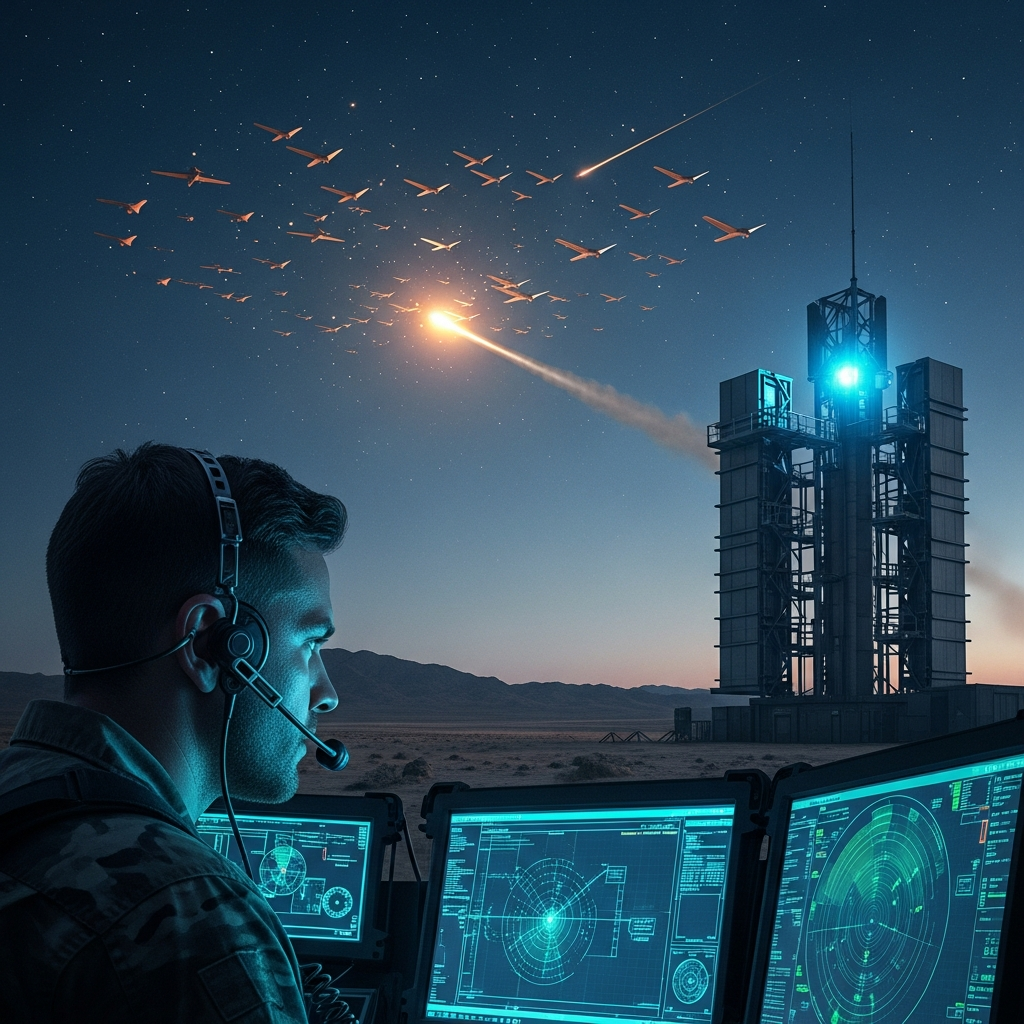
The geopolitical landscape is shifting dramatically, with inexpensive drones from Iran creating an unexpected catalyst for a critical transformation in US military strategy. These “attritable” weapons, primarily the Shahed drone, are exposing vulnerabilities in an expensive, traditional defense infrastructure, forcing the Pentagon to confront its industrial base and rapidly adapt to a new era of warfare. This unfolding conflict, dubbed “Operation Epic Fury,” isn’t just a military engagement; it’s a wake-up call demanding profound innovation.
For years, US defense strategy relied heavily on high-cost, sophisticated platforms and existing stockpiles. However, the sheer volume and low production cost of Iranian Shahed drones — estimated at just $20,000 to $50,000 per unit — present an economically unsustainable challenge. These drones, often built with fiberglass bodies, simple two-stroke engines, and commercial GPS, are easy to mass-produce. They are designed to overwhelm advanced Western defense systems, creating a critical cost-exchange imbalance where a multi-million dollar interceptor missile is fired at a relatively cheap drone.
The Drone Dilemma: Overwhelming Costly Defenses
The impact of Iran’s drones is undeniable. ABC News analysis reports that at least ten US and allied radar installations across five Middle Eastern countries have suffered damage. This damage resulted either from direct drone strikes or from ballistic missiles that exploited gaps in defenses created by swarming drones. The sheer scale of these attacks, sometimes involving thousands of drones and missiles, forces air defense operators to track numerous targets simultaneously, creating a “digital smokescreen” that can allow more advanced threats to penetrate.
The cost of this engagement is staggering. The first 100 hours of Operation Epic Fury alone were estimated by the Center for Strategic and International Security (CSIS) to cost approximately $3.7 billion. Air defense munitions account for a significant portion of this expenditure, ranging from $1.2 billion to $3.7 billion. Using high-cost fighter jets, like the F-35, to shoot down a $30,000 drone has been likened to “using a sledgehammer to crack a nut,” a tactic that is both expensive and inefficient.
A Forced Reckoning: Rebuilding America’s Defense Industrial Base
While the immediate impact of Iran’s drones poses a tactical and financial strain, it also serves as an inadvertent “favor” to the United States. This crisis is making it impossible to ignore the erosion of America’s defense industrial base. Experts like Shyam Sankar, Palantir’s Chief Technology Officer, and Madeline Hart argue in their book “Mobilize” that “mass production is like a muscle. If you don’t use it, it atrophies.” They contend that the US defense sector has developed a “sclerosis” due to rigid Pentagon bureaucracy and rules favoring insiders, stifling innovation and rapid production.
The ongoing conflict is compelling the US military to prioritize adaptability and scalable production over mere stockpiles of expensive hardware. This shift represents a fundamental rethinking of how the nation builds and procures its defense assets. It’s a move away from Cold War-era reliance on a few extremely sophisticated, slow-to-produce systems, towards an agile “arsenal of democracy” ready for long wars of attrition.
Trump’s Acquisition Reforms: A Step Towards Modernization
In response to these challenges, President Donald Trump’s April 2025 executive orders on defense acquisition reform are being lauded as a significant overhaul, perhaps the most serious since the Clinton era. These directives aim to streamline procurement by:
Prioritizing commercial off-the-shelf solutions: Leveraging existing, proven technologies from the private sector to accelerate deployment.
Imposing budget discipline: Threatening to cancel major programs exceeding budgets by more than 15%.
Fostering competition: Making it easier for startups and innovative smaller companies to compete with established defense giants.
These reforms are designed to inject dynamism into a system often criticized for its slowness and resistance to change. The goal is to cultivate an environment where defense production can be both innovative and cost-effective, ensuring the US can credibly regenerate its stockpiles and respond to diverse threats at scale.
Lessons from Ukraine: A Blueprint for Counter-Drone Warfare
The conflict in Ukraine has served as a brutal proving ground for modern drone warfare, offering invaluable lessons for the US. Russia’s extensive use of Shahed/Geran drones, with over 57,000 launches in four years, forced Ukraine to develop sophisticated and often low-cost counter-drone tactics. These include:
Mobile machine gun units: Rapidly deployable teams using conventional firearms against incoming drones.
Electronic jamming: Disrupting drone navigation and control signals.
Inexpensive interceptor drones: Developing their own cost-effective solutions, such as the “Sting” interceptor, which Ukraine reportedly offered to the US but was initially rebuffed.
This expertise is now being actively sought by the US. U.S. Central Command (CENTCOM) is reportedly shifting its approach, moving towards “shooting down hundred-thousand-dollar drones with $10,000-weapons” like the Advanced Precision Kill Weapon System II (APKWS). This precision-guided rocket, costing $25,000-$40,000, can be fitted to fourth-generation fighter jets, proving far more cost-effective than million-dollar missiles.
The Future of Defense: An Integrated System of Systems
The emerging reality, as highlighted by experts and demonstrated in current conflicts, points towards a “system of systems” approach to modern warfare. This means integrating diverse technologies across multiple domains:
Strategic Layer: High-end, stealth platforms (B-2 Spirit, F-22, F-35) for precision strikes and air superiority.
Attritable Layer: Mass-produced, inexpensive autonomous systems (like the US’s LUCAS or Anduril’s Ghost and Barracuda 500 platforms) to saturate defenses and conduct scouting and kinetic action.
Missiles & Saturation Warfare: Combined waves of drones and missiles to overwhelm layered defenses and impose an unfavorable cost exchange.
AI & Data: Rapidly processing vast amounts of intelligence, surveillance, and reconnaissance (ISR) data to accelerate the “sensor-to-shooter loop” and enable faster decision-making.
Cyber Operations: Disrupting enemy communications and supporting kinetic strikes, acting as a crucial force multiplier.
Layered Air Defense: Multi-tier architectures (e.g., Iron Dome, David’s Sling, Arrow family, naval Aegis systems) using sensor fusion to coordinate interceptions.
Companies like Anduril Industries are at the forefront of this shift, focusing on mass production of low-cost autonomous drones and AI-driven military systems. Their strategy emphasizes reducing the cost of engagement by building affordable, high-volume solutions tailored for tomorrow’s conflicts, not yesterday’s. This includes “hunter” drones for scouting and “killer” platforms for autonomous targeting, all leveraging advanced manufacturing techniques.
Towards a Resilient and Adaptive Defense Ecosystem
The explosions of Shahed drones in the Persian Gulf serve as an unequivocal message: the era of relying solely on exquisite, expensive weapons is over. The US military must embrace an ecosystem of diverse weapons at varying price points. This includes not only continued investment in cutting-edge, big-ticket items like nuclear submarines and stealth bombers, but also a dramatic expansion of the “cheap end of the arsenal.”
This involves developing:
Autonomous cruise missiles: Capable of operating independently.
Unmanned surface vessels: For naval reconnaissance and engagement.
- Directed-energy systems: Lasers and microwave weapons that can “fry” swarms of incoming drones efficiently and cost-effectively.
- www.foxbusiness.com
- www.npr.org
- telegrafi.com
- www.defenseone.com
- www.jpost.com
Companies such as Anduril, Saronic, and Epirus are already building these next-generation capabilities, poised to support a more resilient and adaptable defense posture. The depletion of existing stockpiles in Operation Epic Fury is forcing a necessary reckoning, pushing the US to reimagine its defense industrial capacity. The hope is that voices advocating for scalable production, cost-effectiveness, and rapid innovation will prevail, ensuring America is prepared for the complex and evolving challenges of modern warfare.
Frequently Asked Questions
How are Iran’s Shahed drones impacting US military operations?
Iran’s Shahed drones are significantly impacting US military operations by presenting a low-cost, high-volume threat that is financially unsustainable to counter with traditional, expensive interceptors. These drones have damaged US and allied radar installations across the Middle East, strained existing interceptor stockpiles, and increased the overall cost of military engagements like “Operation Epic Fury.” Their effectiveness lies in their ability to overwhelm defenses through sheer numbers, forcing a critical re-evaluation of US defense strategy and resource allocation.
What is the ‘cost exchange’ problem in modern drone warfare?
The ‘cost exchange’ problem refers to the significant financial disparity between inexpensive drones (like the Shahed, costing $20,000-$50,000) and the high-cost missiles or platforms used to intercept them (e.g., $1 million AIM-120 missiles or $4 million PAC-3 missiles). This imbalance allows adversaries to wage a relentless, low-cost war that quickly depletes an opponent’s expensive defensive assets, creating an economically unsustainable situation where the defender runs out of resources faster than the aggressor runs out of cheap drones.
Which emerging technologies are critical for countering cheap drone threats?
Countering cheap drone threats requires a multi-faceted approach leveraging emerging technologies. Critical solutions include developing and deploying low-cost autonomous systems, such as AI-driven hunter-killer drones and loitering munitions, capable of mass production. Directed-energy systems like lasers and high-power microwaves offer cost-effective interception of drone swarms. Additionally, integrating advanced sensor fusion, electronic jamming capabilities, and leveraging lessons from conflicts like Ukraine (e.g., mobile machine gun units, inexpensive interceptor drones like “Sting”) are vital for creating layered, resilient, and economically viable defenses.