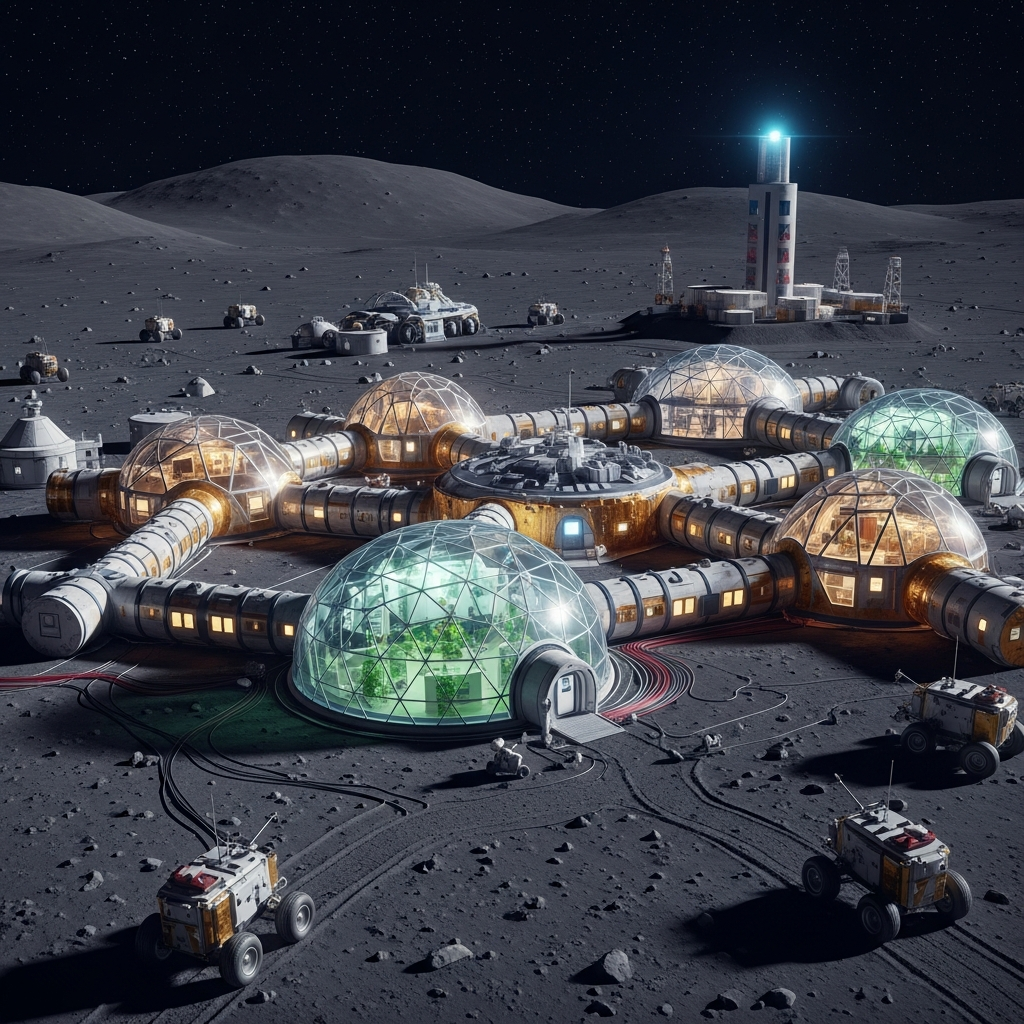
NASA has unveiled an ambitious, significantly revised, and urgent strategy to establish a permanent human presence near the lunar south pole. This groundbreaking $20 billion initiative, spanning the next seven years, aims to construct a full-fledged moon base complete with habitats, pressurized rovers, and cutting-edge nuclear power systems. The goal is clear: not merely to visit, but “to stay,” cementing American leadership in a rapidly intensifying global space race and paving the way for eventual human missions to Mars.
Led by NASA Administrator Jared Isaacman, this bold plan marks a pivotal shift in the agency’s approach to lunar exploration. It prioritizes direct surface operations over orbital infrastructure, emphasizing efficiency, competitive collaboration with commercial partners, and an unprecedented cadence of missions. This revised architecture signals a new era for space exploration, where sustained presence and scientific discovery are paramount.
A Strategic Pivot: From Gateway to Permanent Surface Settlement
A cornerstone of NASA’s reimagined lunar strategy is the strategic “pausing” of the Gateway lunar space station in its current form. Previously envisioned as an orbital outpost and transfer station for astronauts, components and resources initially earmarked for Gateway will now be repurposed directly for the lunar surface base. This shift streamlines operations, reduces complexity, and aligns with a focus on immediate, tangible infrastructure for sustained human presence on the Moon.
Administrator Isaacman articulated that this redirection ensures funds and efforts are concentrated on infrastructure directly supporting operations on the lunar surface. Instead of Orion crew ships transferring astronauts to landers via an orbital way station, they will now transfer directly to landers for descent. While Gateway is paused, officials emphasize this doesn’t preclude revisiting the concept in the future. The decision is a practical response to market realities and a commitment to accelerate the establishment of a lunar settlement.
Why the Lunar South Pole?
The lunar south pole is the prime target for NASA’s base due to its unique resources. This region is believed to contain significant reserves of water ice in permanently shadowed craters. This ice is vital for future missions, offering potential for drinking water, breathable air, and most critically, rocket fuel (hydrogen and oxygen). Access to these in-situ resources dramatically reduces the cost and complexity of sustained operations, making the moon base a self-sufficient hub.
The south pole also offers nearly continuous sunlight on some crater rims, ideal for solar power generation. This combination of potential water resources and consistent energy makes it an unparalleled location for long-term human habitation and scientific research, serving as a crucial proving ground for technologies needed for Mars missions.
The $20 Billion Vision: Building the Moon Base in Three Phases
NASA’s plan outlines a deliberate and achievable three-phase approach for constructing the moon base, leveraging an estimated $20 billion investment over the next seven years in collaboration with commercial and international partners.
Phase 1: Build, Test, Learn (Templated Approach)
The initial phase will transition from infrequent, bespoke missions to a “templated approach” designed for rapid learning and experimentation. This involves a dramatic expansion of lunar landings, primarily through the Commercial Lunar Payload Services (CLPS) program. Robotic landers will frequently deliver:
Rovers: For mobility and site scouting.
Instruments: To collect critical scientific data.
Technology Payloads: To test power systems, communications networks, navigation tools, and surface operations.
This phase aims to generate significant insights into operating on the lunar surface, preparing for more complex human missions. NASA plans an accelerated CLPS cadence, targeting up to 30 robotic landings starting in 2027.
Phase 2: Establish Early Infrastructure (Regular Astronaut Operations)
Building on the successes of Phase 1, Phase 2 will focus on establishing semi-habitable infrastructure and regular logistics. This includes the delivery of initial habitats and transportation assets, such as advanced pressurized rovers. This phase aims to support recurring astronaut operations on the surface, moving beyond short-duration visits. International partners like the Japan Aerospace Exploration Agency (JAXA) are expected to contribute, potentially with pressurized rovers, enhancing the base’s capabilities.
Phase 3: Enable Long-Duration Human Presence (Permanent Foothold)
The final phase will see the delivery of heavier infrastructure necessary to establish a continuous, long-duration human presence. This includes larger cargo-capable human landing systems (HLS) to transport substantial equipment. Contributions from partners like the Italian Space Agency (ASI) for multi-purpose habitats and the Canadian Space Agency (CSA) for lunar utility vehicles will be crucial. This phase will ultimately transition the moon base from a temporary outpost to a permanent, self-sustaining human settlement.
Accelerating Artemis: A New Cadence for Lunar Exploration
The revised Artemis program is central to this lunar strategy, outlining an aggressive schedule for returning humans to the Moon and establishing frequent missions.
Key Artemis Mission Updates:
Artemis II (Early April 2026): This mission will be the first crewed lunar flyby in over 50 years, sending three American astronauts and one Canadian around the Moon on a 10-day trip using the Space Launch System (SLS) rocket. It will test critical environmental control and life support systems.
Artemis III (2027): This mission will test the integrated operations of the Orion spacecraft with commercial lunar landers (from SpaceX or Blue Origin) in Earth orbit. It features a standardized SLS configuration and a redesigned Orion heat shield.
Artemis IV (2028): Targeted for no earlier than 2028, this mission represents the first crewed landing on the Moon since 1972, bringing humans back to the lunar surface.
Artemis V (Late 2028): Expected to launch in late 2028, further expanding lunar capabilities.
Beyond these initial missions, NASA aims for a dramatically increased cadence: at least one and possibly two moon landing missions in 2028, using privately developed landers. Following Artemis V, the agency intends to undertake crewed surface missions at least every six months, with potential to increase frequency as capabilities mature. This sustained presence is a stark contrast to previous “flags and footprints” missions.
Commercial Partners and Accountability
A significant aspect of this revised plan is NASA’s deepened reliance on commercial space companies for both launch services and lunar landers. The agency intends to work with no fewer than two commercial launch providers (e.g., SpaceX, Blue Origin) and open opportunities for new entrants, moving away from sole reliance on government-owned systems. For Human Landing Systems (HLS), both SpaceX and Blue Origin are collaborating, with a critical safety requirement: both providers must successfully complete an uncrewed landing prior to carrying any crew members. Administrator Isaacman has signaled a tough stance on accountability, warning of “uncomfortable action” if contractors underperform, underscoring the urgency driven by the ongoing “great-power competition.”
Powering the Future: Nuclear Energy for Moon & Mars
Integral to sustained presence on both the Moon and Mars is the development of robust nuclear power systems. These systems are crucial for providing warmth, electricity for habitats, equipment, and research, particularly during the harsh lunar night or Martian winters.
NASA is accelerating the development and deployment of these technologies:
Skyfall Mission to Mars (2028): This groundbreaking mission will feature the Space Reactor-1 Freedom (SR-1 Freedom), the first nuclear-powered interplanetary spacecraft. SR-1 will utilize a fission reactor to power a nuclear-electric propulsion system, efficiently transporting mass across deep space. It will deploy Ingenuity-class helicopters (the Skyfall payload) to Mars, surveying potential landing zones and establishing flight heritage for nuclear hardware.
Lunar Fission Power (by 2030): Findings from SR-1 Freedom will directly inform NASA’s plan to develop a fission reactor on the Moon’s surface by 2030. This system will be capable of powering the moon base continuously through both lunar day and night, ensuring consistent energy availability. Steven Sinacore, NASA’s program executive for Fission Surface Power, emphasizes public education on the safety of these technologies, noting reactors would only activate in space.
This investment in nuclear power represents a significant technological leap, enabling more ambitious and longer-duration missions than previously possible.
Commercializing Low-Earth Orbit (LEO) & Beyond
While focusing intensely on the Moon and Mars, NASA also remains committed to fostering a robust commercial space ecosystem in Low-Earth Orbit (LEO). With the International Space Station (ISS) projected for retirement in the 2030s, NASA aims to transition to commercially developed and operated space stations.
Acknowledging that past efforts to stimulate private sector interest haven’t fully met expectations, NASA is exploring new strategies:
Government-Owned Core Module: Proposing to procure a core module that could initially attach to the ISS, validating commercial modules before they detach for free flight.
Private Astronaut Missions & Commander Slots: Allowing more privately financed non-astronauts to conduct research on the ISS and “selling” commander slots to qualified individuals.
ISS as Staging Base: Utilizing the ISS for assembling private-sector modules that could later operate independently, stimulating an orbital economy.
NASA envisions becoming one of many customers purchasing services on commercial stations, thereby fostering a thriving LEO economy that reduces government costs and expands access to space.
Leadership & Accountability: Isaacman’s Urgent Mandate
Administrator Jared Isaacman’s leadership style signals a major shift in NASA’s operational philosophy. He has repeatedly stressed the urgency of these initiatives, driven by a “great-power competition” and the need to reassert American leadership in space. He has made it clear that “success or failure will be measured in months, not years.”
Isaacman’s mandate emphasizes efficiency, accountability, and avoiding the program changes and delays that have plagued past lunar efforts. He stated, “Expect uncomfortable action” if schedules slip or budgets are exceeded, highlighting his readiness to take decisive measures. The revised architecture, he believes, can be afforded within NASA’s existing budget by trimming bureaucratic waste and repurposing hardware. This proactive approach aims to unleash NASA’s potential and ensure America’s swift and permanent return to the Moon, leveraging over $100 billion of public investment.
Frequently Asked Questions
Why is NASA focusing on the lunar south pole for its moon base?
NASA is targeting the lunar south pole primarily because it’s believed to harbor significant reserves of water ice in permanently shadowed craters. This ice is crucial for sustained human presence, providing potential sources for drinking water, breathable air, and rocket propellant. Additionally, certain elevated regions near the south pole experience almost continuous sunlight, offering excellent opportunities for solar power generation. These combined factors make it the most strategically valuable location for establishing a self-sufficient, long-term moon base.
How will NASA ensure frequent crewed missions to the moon?
To ensure frequent crewed missions, NASA is dramatically increasing its mission cadence and shifting its operational model. After the Artemis V mission, the agency aims for crewed lunar landings at least every six months. This will be achieved by moving away from reliance on a single government-owned launch system, instead working with at least two commercial launch providers and opening opportunities for new entrants. The plan also involves utilizing commercially developed lunar landers (like those from SpaceX and Blue Origin) and standardizing mission approaches to make them more repeatable and efficient.
What role will commercial companies play in NASA’s new moon base strategy?
Commercial companies are central to NASA’s new moon base strategy. They are vital partners for developing human landing systems (HLS) like those from SpaceX and Blue Origin, and for providing launch services to transport astronauts and cargo. Through programs like Commercial Lunar Payload Services (CLPS), private companies will deliver rovers, instruments, and technology payloads to the lunar surface. Furthermore, commercial entities are expected to play a key role in developing future orbital space stations in Low-Earth Orbit, ultimately taking over services currently provided by the International Space Station. NASA aims to be a customer, not solely an operator, fostering a robust commercial space economy.
Conclusion
NASA’s ambitious $20 billion plan for an ultimate moon base at the lunar south pole signifies a monumental shift in space exploration. This isn’t just about revisiting the Moon; it’s about establishing a permanent human presence, a proving ground for Mars missions, and a platform for unprecedented scientific discovery. Through strategic partnerships, an accelerated Artemis program, and a relentless focus on efficiency and innovation, NASA under Administrator Isaacman is poised to lead humanity into a new era of sustained space habitation. The vision is clear: America is committed to staying on the Moon, securing its leadership in the cosmos for generations to come.