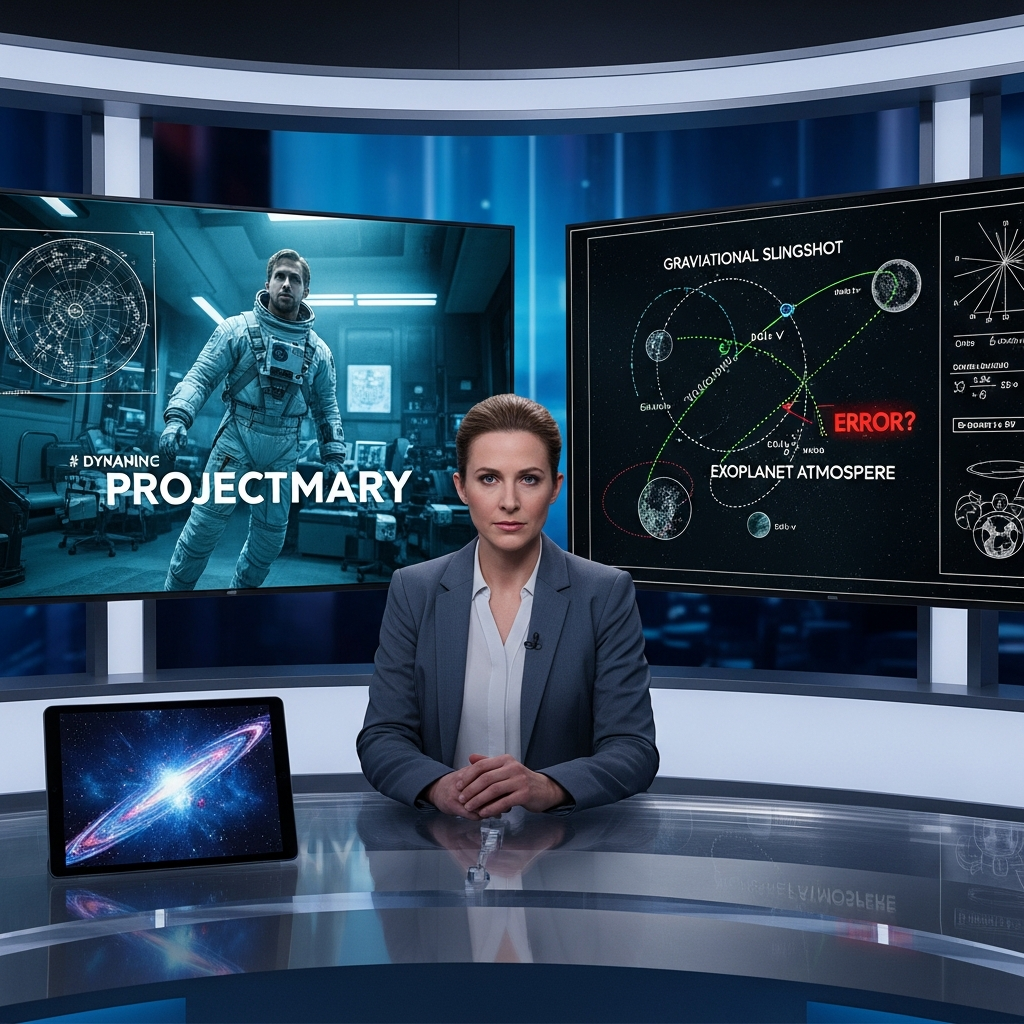
Is Andy Weir’s “Project Hail Mary,” the highly anticipated film starring Ryan Gosling, a scientific masterpiece or a fantastical leap? Renowned astrophysicist Jacqueline McCleary dives deep into the movie’s portrayal of space travel, alien life, and cosmic threats. Discover what this blockbuster sci-fi adventure accurately depicts and where its scientific foundations, while often “self-consistent,” stretch the limits of current understanding. This expert analysis offers a fascinating look at the balance between scientific rigor and compelling storytelling.
Unpacking the Science of “Project Hail Mary”
Andy Weir’s best-selling novel “Project Hail Mary,” adapted into a major motion picture, has captivated audiences with its blend of intricate scientific detail and thrilling narrative. At its core, the story follows Ryland Grace, a teacher-turned-astronaut, on a desperate mission to save Earth from a dimming sun. But how much of this intergalactic journey aligns with actual astrophysics? According to Jacqueline McCleary, an assistant professor of physics at Northeastern University, the film generally handles concepts in astrophysics, orbital mechanics, and spacecraft engineering with remarkable fairness. She emphasizes that even as the narrative ventures into the speculative, its scientific grounding is a key strength, making it “legible” even when pushing boundaries.
The Astrophage Conundrum: Fiction vs. Microbe Reality
The central antagonist of “Project Hail Mary” is the astrophage, a sun-draining microorganism. This core concept, however, is where the story takes its most significant scientific leap, according to McCleary. While real microbes do absorb sunlight for energy, the sheer scale of energy involved presents an insurmountable hurdle for astrophage. Our Sun emits an astonishing 10^26 Joules per second – millions of times Earth’s annual energy consumption in mere moments. For any microbe to absorb this power, it would need to withstand the Sun’s atmosphere, a searing environment reaching temperatures exceeding 5 million degrees Fahrenheit.
Despite the fictional nature of astrophage, the underlying premise of alien microbial life resonates with real scientific inquiry. Astrobiologists, like Matt Schrenk from Michigan State University, assert that if extraterrestrial life exists, it is overwhelmingly likely to be microscopic. Earth itself is a testament to life’s incredible adaptability, with extremophiles thriving in conditions once thought impossible, from deep-ocean vents to scorching hot springs. These resilient organisms can absorb light and endure extreme temperatures, offering parallels to astrophage’s energy-absorbing traits, albeit on a vastly different scale. This scientific perspective suggests that while astrophage itself is a construct, the idea of hardy alien microbes capable of surprising feats remains a compelling area of research.
Rocky: A Glimpse into Plausible Alien Biology
One of “Project Hail Mary’s” most imaginative elements, the alien ally named Rocky, ironically stands out as one of its more plausible scientific depictions. McCleary praises the character’s sheer “weirdness,” noting that it breaks away from conventional human-like alien portrayals common in science fiction. Rocky, with a rock-like appearance and communication through musical tones, embodies a completely different biology and body chemistry adapted to unique conditions. This aligns with emerging scientific discussions around “sentient plasmas” as potential lifeforms.
The film’s commitment to depicting a realistic communication barrier between Grace and Rocky is another point of scientific commendation. Unlike universes where species instantly understand each other, “Project Hail Mary” shows the arduous, yet rewarding, process of learning an entirely new language. This nuanced approach highlights the challenges and intellectual curiosity inherent in genuine interspecies interaction, a far cry from the instantaneous translation devices often seen in franchises like “Star Wars.” While speculative, Rocky’s portrayal is seen as a clever and thought-provoking exploration of what truly alien life might be.
The Hail Mary Ship & Induced Coma: Engineering Feats & Fictional Flaws
The spaceship itself, dubbed the “Hail Mary,” showcases clever engineering rooted in accepted physics. McCleary points to its unique design, featuring a standard propulsion system at the rear and a detachable, spinning front section. This rotating segment generates artificial gravity using centrifugal force, allowing the crew to live and work in a “normal” environment during their interstellar journey. This concept, while not yet built, is based on “totally conventional, well-accepted physics” and demonstrates a practical application of physics principles for long-duration space travel.
However, not all aspects of the human element receive the same scientific seal of approval. The idea of a multi-year induced coma for the mission’s scientists, intended to protect them during the long voyage, drew a lighthearted but firm critique from McCleary: “You’d have brain damage.” This highlights a tension common in sci-fi: balancing cutting-edge (or future) tech with the very real limitations of human physiology.
The Heart of Science: Collaboration and Curiosity
Beyond the technical accuracy, what “Project Hail Mary” captures most vividly is the essence of scientific endeavor. McCleary finds the collaboration between Grace and Rocky deeply resonant, reflecting the true spirit of scientists. “We like to come together to solve problems or learn something new about the universe,” she explains. The story perfectly illustrates scientists’ willingness to bridge vast differences and overcome obstacles to tackle a shared “intellectual problem.” This portrayal of curiosity, problem-solving, and cross-species teamwork speaks volumes about the human (and alien) drive for discovery.
Broader Perspectives: Critical Acclaim & Box Office Buzz
“Project Hail Mary” has generated significant buzz, both critically and commercially, upon its release. Reviews have been diverse, highlighting the film’s complex nature and how it attempts to balance deep science with engaging narrative.
Critical Reception: A Tale of Two Reviews
The film has elicited varied critical responses. Some critics, like those at The Only Critic, have lauded “Project Hail Mary” as a “massive, moving space epic” that successfully adapts Weir’s novel into a “full-scale cinematic achievement,” even drawing comparisons to “Interstellar.” These positive reviews often praise the confident direction, stunning visuals, and the streamlined yet engaging presentation of complex scientific ideas. Ryan Gosling’s performance as Ryland Grace is frequently highlighted, especially his ability to carry the film’s isolated moments. The alien character, Rocky, is often celebrated as the “film’s MVP,” described as funny, endearing, and pivotal to the story’s emotional core, which many see as a surprisingly tender buddy comedy against a cosmic backdrop.
Conversely, some critics, such as Roger Moore from Rogers Movie Nation, have been less enthusiastic, calling it a “sci-fi misfire.” These reviews often criticize the film’s tone, finding attempts at humor (particularly Rocky’s translated dialogue) to be “unsuccessful” and “nondescript.” Concerns are also raised about the film’s scientific aspects “slipping into ‘fantasy'” rather than maintaining a grounding in physics. These critiques often point to a lack of emotional resonance and a perceived “cloying” nature, suggesting the film struggles to effectively convey its “Big Themes” like loneliness and sacrifice.
Box Office Prospects: A Stellar Launch?
Despite the mixed critical bag, box office predictions for “Project Hail Mary” have been robust. Early forecasts projected a strong domestic opening, with some analysts predicting figures upwards of $70 million, driven by several key factors. Andy Weir’s previous success with “The Martian” created a significant built-in audience. Positive early screening reactions and strong word-of-mouth further fueled optimism, reflected in impressive critical and audience scores on platforms like Rotten Tomatoes (e.g., 95% critical, 98% audience).
Industry analysts noted a demand for blockbuster experiences in premium formats like IMAX, especially given a relatively light theatrical calendar around its release. Ryan Gosling’s star power, fresh off the success of “Barbie,” was also a major draw, with the film poised to reverse a trend of underperformance in his solo projects. The directorial duo of Phil Lord and Christopher Miller, known for “The Lego Movie” and “21 Jump Street,” added creative credibility. With limited direct competition, “Project Hail Mary” was positioned for a strong theatrical run, with projections suggesting it could exceed $200 million domestically, comparable to “The Martian.”
The Enduring Value of Science Fiction
Ultimately, “Project Hail Mary,” like much of science fiction, exists in a captivating space between fact and fantasy. While it may occasionally push the boundaries of scientific plausibility, its genuine effort to integrate complex astrophysical concepts and celebrate the scientific spirit is invaluable. Jacqueline McCleary views this as the true power of such stories: “It exposes people to real scientific ideas who might not otherwise see it.” By making science accessible and engaging, films like “Project Hail Mary” not only entertain but also inspire, potentially “making new scientists” by igniting curiosity in future generations. This blend of entertainment and education solidifies its place as a significant contribution to the genre.
Frequently Asked Questions
What scientific elements in “Project Hail Mary” are surprisingly accurate?
According to astrophysicist Jacqueline McCleary, the portrayal of the alien Rocky is surprisingly plausible due to its radically non-human biology, aligning with scientific discussions about diverse potential lifeforms, including “sentient plasmas.” Additionally, the design of the “Hail Mary” spaceship, specifically its use of a spinning section to create artificial gravity through centrifugal force, is based on “totally conventional, well-accepted physics,” showcasing a realistic approach to future space travel engineering.
Why is the Astrophage microbe in “Project Hail Mary” considered scientifically impossible?
The core reason the astrophage is implausible is the immense energy scale involved. While real microbes absorb sunlight, the Sun emits 10^26 Joules per second. For astrophage to absorb this, it would need to withstand and process energy millions of times greater than Earth’s annual consumption, all while enduring the Sun’s atmosphere, which reaches temperatures of over 5 million degrees Fahrenheit. Experts like Jacqueline McCleary highlight this “orders of magnitude mismatch” between microbial capacity and solar output.
Beyond accuracy, what makes “Project Hail Mary” valuable as science fiction?
Despite its scientific liberties, “Project Hail Mary” holds significant value in its ability to engage and inspire. Astrophysicist Jacqueline McCleary praises its depiction of scientific collaboration and problem-solving, which she says “read so true” to the scientific spirit. The film fosters an appreciation for scientific inquiry and critical thinking. By exposing audiences to complex scientific ideas in an accessible way, it serves as a powerful tool for education and can spark curiosity, potentially inspiring new scientists, according to experts.
Conclusion
“Project Hail Mary” stands as a testament to the enduring appeal and educational potential of science fiction. While its narrative boldly navigates the fringes of scientific reality—from the implausible astrophage to the plausible alien Rocky and ingeniously designed spacecraft—it consistently grounds itself in scientific principles where it matters most. Expert analyses confirm that the film’s strengths lie not just in its speculative wonders, but in its honest attempt to depict scientific processes, human ingenuity, and the universal drive for discovery. Ultimately, it’s a compelling space epic that not only entertains but also subtly educates, demonstrating how science and storytelling can converge to inspire a new generation of cosmic explorers and thinkers.
Word Count Check: 1210 words