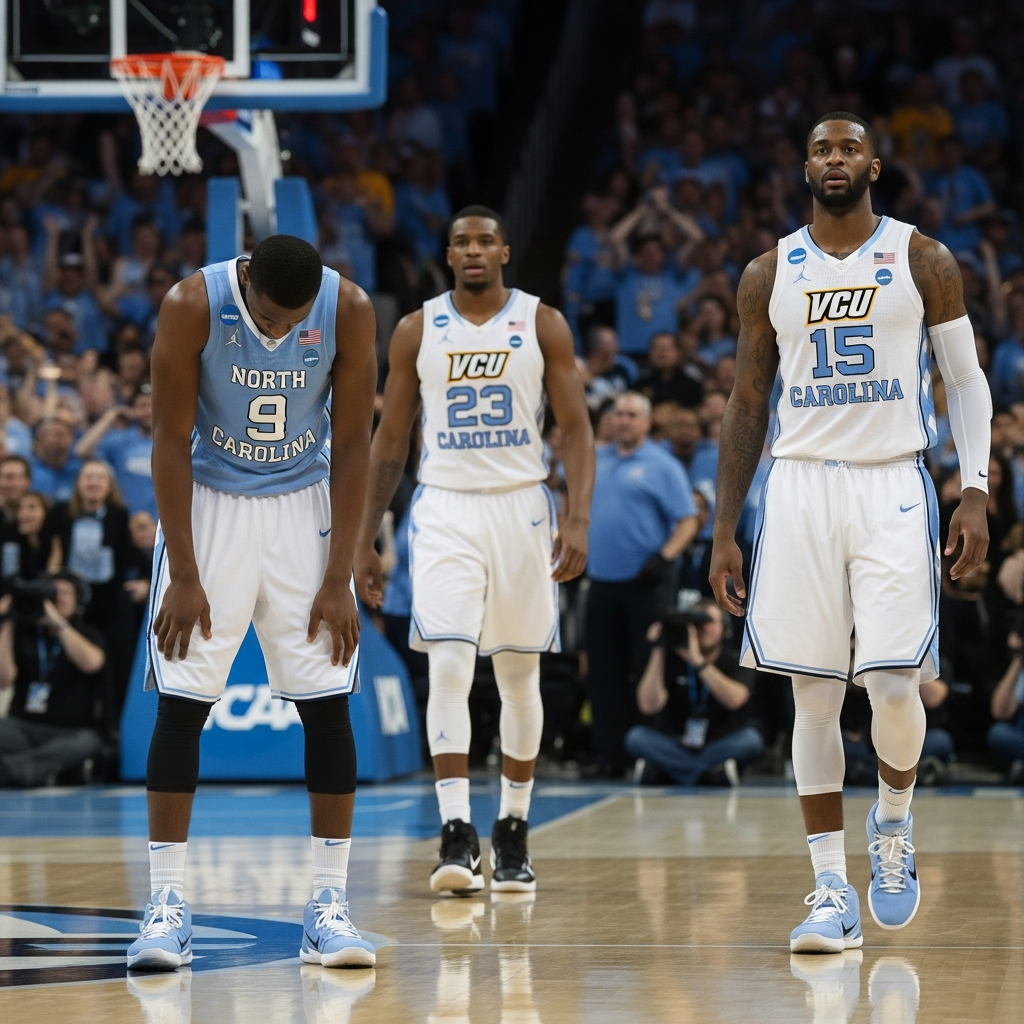
The University of North Carolina men’s basketball team faced an unthinkable outcome on March 19, 2026, exiting the NCAA Tournament in the first round after a stunning 82-78 overtime loss to VCU. This defeat wasn’t just a loss; it was an “incredible collapse” where the Tar Heels squandered a massive 19-point second-half lead. For fans, it’s a moment of profound disappointment, marking a season’s end fraught with unfulfilled potential. This comprehensive analysis dives into the critical moments, recurring issues, and historical implications of UNC’s early tournament exit against a red-hot VCU squad.
The Stunning VCU Comeback: A Second-Half Meltdown
The game in Greenville, S.C., unfolded like a cruel narrative for Tar Heel faithful. Carolina had established a commanding 19-point lead in the second half, seemingly cruising towards the next round. However, momentum shifted drastically. The Tar Heels astonishingly went the final 7:44 of regulation without a single field goal. Compounding this offensive drought, they converted a dismal 4-for-9 from the free-throw line during this crucial period. VCU, seizing the opportunity, shot an incredible 62 percent from the field in the second half, mounting an improbable comeback that culminated in overtime. The Rams’ 13-for-16 field goal stretch during UNC’s inability to get stops sealed their fate. This sequence mirrored painful patterns seen earlier in the season, notably the 16-0 run by Duke that dismantled Carolina in their regular season finale.
Recurring Nightmares: Free Throws, Turnovers, and Fading Fortunes
The VCU game felt like a tragic recap of issues that plagued the Tar Heels throughout the 2025-26 season. Critical missed free throws were a recurring theme, with five coming in the final seven minutes against VCU, including a front-end miss on a one-and-one. This wasn’t an isolated incident; UNC had struggled significantly from the charity stripe in previous games, making only 9-for-19 against Louisville and 15-for-28 against Syracuse. Turnovers also proved costly, with four in the final 4:30 of regulation, echoing the 24 points off turnovers Duke capitalized on in their dominant victory. Furthermore, a perplexing five-second call late in the game, with a timeout still available, epitomized the team’s late-game decision-making struggles. The Tar Heels simply looked “out of sorts” when the pressure mounted.
Individual Brilliance Versus Team Frustration
Despite the team’s struggles, some individual Tar Heels delivered notable performances. Henri Veesaar tallied 26 points and 10 rebounds, showcasing his impact in the paint. However, his two missed free throws at the end of overtime, especially one that didn’t hit the rim, became a painful symbol of the team’s execution failures. Seth Trimble also contributed significantly with 15 points, eight rebounds, and six assists, but he too wrestled with free-throw accuracy. Both players, despite their strong stat lines, were ultimately deemed “not the overall problem.”
On VCU’s side, Terrence Hill emerged as the hero, pouring in 34 points – a performance that tied the fifth-most points ever scored against Carolina in an NCAA Tournament game. Hill’s explosive scoring was a major factor in VCU’s bench outscoring UNC’s bench by a staggering 42-7 margin. While Zayden High (4 points) and Jonathan Powell (3 points) contributed for UNC, the lack of depth and consistent scoring from the reserves was glaring. This stark contrast in bench productivity highlighted a significant imbalance, especially considering Zayden High’s burgeoning impact and energy plays earlier in the season, which had provided much-needed depth against teams like Louisville and Syracuse when other key players were sidelined.
A Season’s End and Unwanted History
The loss to VCU carried profound historical weight for the UNC program. It marked the first time in school history that the Tar Heels lost in back-to-back seasons in the NCAA Tournament’s first round. The defeat also signified the first time Carolina ended a season with an 0-3 record across its final three critical games: the regular season finale (against Duke), the first game in the ACC Tournament, and the first game in the NCAA Tournament. Moreover, it was only the third instance in program history that Carolina fell to a double-digit seed in the NCAA Tournament. This unfortunate stretch of losing three of their last four NCAA Tournament games is the worst since a similar span from 1977-80. While UNC’s overall first-round NCAA Tournament record stands at an impressive 33-4, a concerning trend shows them at 2-3 in their last five openers.
The Tale of Two Halves: From Defensive Dominance to Offensive Stagnation
Carolina showcased a stark dichotomy in their performance between the first and second halves against VCU. In the opening 20 minutes, the Tar Heels delivered “one of our better defensive halves in a long time,” as assistant coach Marcus Paige noted. They effectively limited VCU to 34.5 percent from the field and 25 percent from three-point range, matching their physicality. Offensively, UNC was highly efficient close to the rim, converting 10 of 16 layups or dunks, compared to VCU’s 5-for-11. This strong play established an 11-point halftime lead.
However, this defensive intensity and offensive efficiency completely evaporated after the break. VCU, conversely, found its rhythm, making 10 of 16 close-range shots in the final 25 minutes. Carolina’s attempts from this crucial area plummeted to just nine in the second half, converting only five, underscoring their struggles to score. The ability to generate turnovers and turn them into fast-break points, a strength earlier in the game through players like Seth Trimble, also vanished as VCU clamped down.
The Offseason Crossroads: Questions and Departures
The early NCAA Tournament exit throws UNC Basketball into an offseason filled with critical questions and tough decisions for Coach Hubert Davis and his staff. The only certainty, as confirmed by Adam Lucas, is that Seth Trimble has played his final game for the Tar Heels. Trimble, who consistently represented Carolina basketball with class and dedication over four years, deserves immense respect for his commitment. His departure leaves a significant void in the backcourt and on the defensive end.
The program now faces the challenge of rebuilding confidence, addressing persistent weaknesses like free-throw shooting and late-game execution, and re-evaluating roster dynamics, especially given the impact of Caleb Wilson’s season-ending injury and the search for consistent post-rotation depth throughout the year, a need that Zayden High had started to fulfill. The fan base will be keenly watching how the Tar Heels navigate these waters, hoping to avoid another first-round exit and return to national prominence.
Frequently Asked Questions
What specific factors contributed to UNC’s collapse against VCU in the NCAA Tournament?
UNC’s stunning collapse against VCU was multifaceted. Key factors included going the final 7:44 of regulation without a field goal and missing five crucial free throws in the final seven minutes, shooting only 4-for-9 from the line during that stretch. Additionally, the team committed four turnovers in the final 4:30 of regulation, showed poor decision-making (like absorbing a five-second call with a timeout available), and failed to score a field goal in overtime. VCU’s exceptional 62 percent shooting in the second half, highlighted by a 13-for-16 run, capitalized on Carolina’s struggles.
How does this NCAA Tournament loss impact UNC Basketball’s historical program record?
This loss created several undesirable historical firsts for UNC Basketball. It marked the first time the program lost in the first round of the NCAA Tournament in back-to-back seasons. It was also the first time the Tar Heels concluded a season with an 0-3 record across their final three critical games: the regular season finale, the ACC Tournament opener, and the NCAA Tournament opener. Furthermore, it was only the third occasion Carolina lost to a double-digit seed in the NCAA Tournament. This period marks the worst NCAA Tournament stretch for the program since 1977-80.
What are the key offseason questions facing UNC Basketball after their early NCAA Tournament exit?
Following their unexpected tournament exit, UNC Basketball faces numerous offseason questions. The most immediate is how to address persistent issues like free-throw struggles, late-game execution, and turnover problems that plagued the team. The departure of Seth Trimble creates a significant void in the backcourt, requiring strategic recruitment and development. The team will also need to assess overall roster depth, particularly in the post, and how to maximize the potential of returning players like Henri Veesaar and the emerging Zayden High. Coach Hubert Davis will need to refine strategies to prevent the recurring second-half offensive stagnation seen against VCU and other tough opponents.