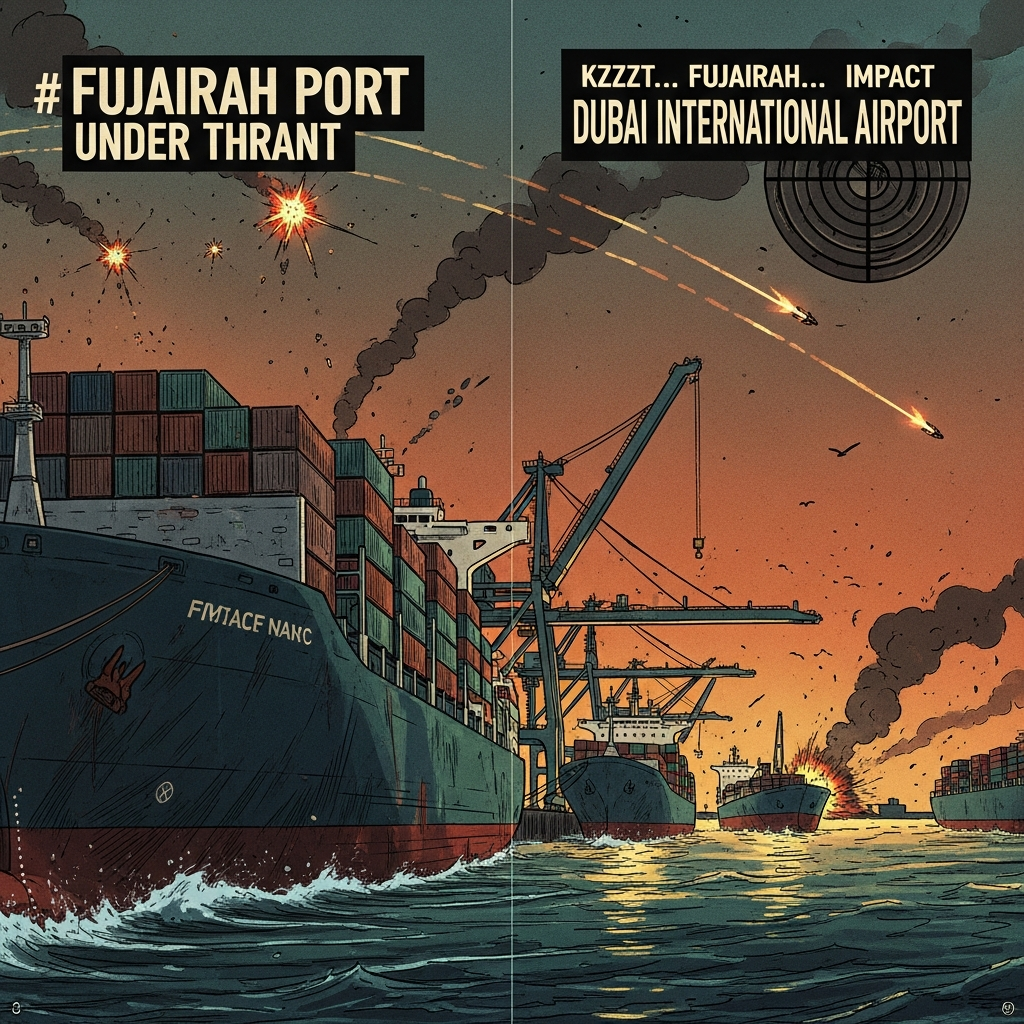
Recent drone and missile attacks attributed to Iran have severely impacted critical infrastructure across the United Arab Emirates (UAE), specifically targeting the strategic Fujairah port and the bustling Dubai International Airport. These escalating incidents underscore heightened geopolitical tensions in the Middle East, challenging regional stability and sending ripples through global energy markets. This detailed analysis delves into the specifics of these Iran UAE attacks, their immediate consequences, and the broader implications for international trade and security.
Escalating Attacks Rock Key UAE Hubs
The UAE recently faced a barrage of drone and rocket assaults, marking a significant escalation in the ongoing conflict. On a recent Monday, flights at Dubai International Airport, recognized as the world’s busiest for international passengers, were temporarily grounded. A “drone-related incident” sparked a fire near the airport, marking the third such event in the vicinity since the broader conflict involving the US, Israel, and Iran began. This disruption caused widespread flight delays and cancellations, subtly eroding the UAE’s carefully cultivated image of safety and stability.
Concurrently, the strategically vital Fujairah port and industrial zone, a behemoth among the region’s oil storage facilities, also fell victim to a drone attack, which ignited a substantial fire. Oil loading operations at the port were temporarily halted as damage assessments commenced. Further compounding the instability, a rocket strike on the outskirts of Abu Dhabi, in the Al Bahia area, tragically resulted in the death of a Palestinian national. The UAE Defence Ministry confirmed the interception of six ballistic missiles and 21 drones on that same Monday, highlighting the intense aerial threats. Since the conflict’s inception, Iran has reportedly launched over 1,900 missiles and drones at the UAE, signifying a persistent campaign targeting Gulf transport and oil infrastructure. Earlier attacks included a drone strike on an oil storage tanker on Saturday and another on oil facilities on Monday, both causing fires.
Fujairah: A Lifeline Bypassing the Strait of Hormuz
The port of Fujairah holds immense strategic importance, particularly in the context of Middle East stability and global oil supplies. Uniquely positioned on the UAE’s eastern coast, it faces the Gulf of Oman rather than the Persian Gulf. This geographical advantage means vessels can access Fujairah without navigating the Strait of Hormuz, a narrow and critical chokepoint often vulnerable to geopolitical disruptions.
Justin Harper, editor of CEO Middle East, emphasizes Fujairah’s “crucial” role in “helping keep global supplies moving” should the Strait of Hormuz be blocked. He notes, “If tensions with Iran disrupt the chokepoint, the UAE can still export oil through Fujairah via pipelines from the oilfields in Abu Dhabi.” Matt Stanley, an oil analyst with Kpler, further explains that Fujairah is “ideally placed to bypass the Strait of Hormuz,” serving as a hub where the UAE’s state oil company, Adnoc, houses tankers carrying crude grade oil highly sought after by Asian buyers.
Beyond oil, Fujairah’s role in global maritime security is expansive. Stanley describes it as the “first stop out of the Middle East on the way to Singapore and China,” and a vital bunkering station. It provides essential services – fuel, food, and water – for container ships navigating the historic “old Silk Road” maritime route. Likening it to a “huge vending machine” for ships, Stanley underscores its comprehensive logistical support. These direct attacks on Fujairah’s oil storage and facilities, according to Stanley, “shows the vulnerability of Gulf infrastructure,” clearly demonstrating Iran’s strategic intent to “disrupt the flow of energy.”
Broader Geopolitical Context and International Reactions
The Iran UAE attacks are deeply embedded within a wider regional conflict that has seen significant international friction. Iran has openly accused the US of utilizing UAE ports and facilities, specifically mentioning Ras Al-Khaimah and an area “very close to Dubai,” to launch strikes against Iran’s Kharg Island, its primary oil export terminal. Iran’s foreign minister, Abbas Araghchi, warned non-US assets in the UAE, advising residents to evacuate areas housing American forces. While no direct attacks on major ports like Jebel Ali were confirmed, intercepted drone debris at Fujairah port led to a fire. The UAE, through a presidential adviser, affirmed its right to self-defense while prioritizing “reason and logic” and exercising restraint.
The closure of the Strait of Hormuz by Iran, utilizing drones and naval mines, has become a focal point of international concern. This strait typically facilitates the passage of approximately 20% of the world’s oil and liquefied natural gas. Despite its closure, the region witnessed an unexpected dip in oil prices below $100 US a barrel, and stock markets rallied after the US Treasury Secretary indicated a willingness to allow some Iranian fuel vessels through the Strait.
US President Donald Trump expressed significant frustration over key allies, including Germany, Spain, and Italy, refusing his call to deploy warships to escort tankers through the Strait of Hormuz. These allies cited a lack of international mandate and non-consultation on the initial conflict. Trump had “obliterated” military sites on Kharg Island, warning that Iran’s oil infrastructure could be next if shipping interference continued. Iran’s parliamentary speaker, however, vowed “new levels of retaliation” if its oil facilities were targeted, with Araghchi declaring the Strait closed only to “those who are attacking us and their allies.” This complex interplay of threats and counter-threats highlights the precarious nature of regional security.
Regional Instability and Military Buildup
The ripple effects of the conflict extend across the Middle East. In Iraq, a missile struck a helipad within the US Embassy compound in Baghdad, a frequent target of Iran-aligned militias, prompting an urgent warning from the US State Department for citizens to leave Iraq. Lebanon is simultaneously grappling with a severe humanitarian crisis, with hundreds killed and hundreds of thousands displaced due due to Israeli strikes against Iran-backed Hezbollah militants.
In response to the escalating situation, the US has significantly bolstered its military presence in the Middle East, deploying 2,500 Marines and the amphibious assault ship USS Tripoli, adding to a substantial buildup that includes 12 Navy ships and the aircraft carrier USS Abraham Lincoln in the Arabian Sea. These reinforcements underscore global anxieties about the potential for broader regional conflict.
UAE’s Resilience Amidst Adversity
Despite the ongoing Iran UAE attacks and the significant disruptions, the sentiment within the UAE projects a strong message of resilience. Justin Harper observes that Dubai’s business community remains “resilient,” noting that malls are still busy and restaurants offer deals to attract customers. He suggests that observers often “underestimate Dubai and its ability to survive a downturn.”
This view is echoed by Lana Nusseibeh, the UAE’s Minister of State. In a BBC interview, she vowed that her country would “bounce back” from the conflict, firmly asserting the “resilience” of its economy. This steadfast outlook reflects the nation’s determination to maintain its economic vitality and perceived stability even under sustained pressure.
Frequently Asked Questions
What is the strategic importance of Fujairah port to global oil supplies during these attacks?
Fujairah port is strategically vital because of its unique location on the UAE’s eastern coast, facing the Gulf of Oman. This positioning allows oil tankers to bypass the Strait of Hormuz, a critical chokepoint in the Persian Gulf that is often subject to geopolitical tensions and has been partially closed by Iran. If the Strait of Hormuz becomes impassable, Fujairah serves as a crucial alternative route for the UAE to export oil from its Abu Dhabi oilfields via pipelines, ensuring global oil supplies can continue to move. It also acts as a major bunkering station and logistical hub for maritime trade with Asia.
How have the recent Iranian attacks impacted international travel through Dubai International Airport?
The recent drone attacks attributed to Iran have significantly impacted international travel through Dubai International Airport, one of the world’s busiest air hubs. Flights were temporarily suspended following a “drone-related incident” that caused a fire near the airport. This incident, the third of its kind since the conflict began, led to widespread flight delays and cancellations. While the airport has demonstrated operational resilience, these disruptions have cast a shadow over the UAE’s image of safety and stability, potentially influencing traveler confidence and highlighting the vulnerability of key civilian infrastructure to regional conflicts.
What are the broader economic and geopolitical implications of these attacks in the UAE?
The Iran UAE attacks carry significant economic and geopolitical implications. Economically, targeting key oil infrastructure like Fujairah port highlights the vulnerability of Gulf energy supplies, threatening to disrupt global oil flows and potentially driving up prices, although there was an unexpected dip in oil prices recently. Geopolitically, these assaults escalate tensions in an already volatile region, underscoring the ongoing conflict involving Iran, the US, and Israel. They challenge international efforts to maintain Middle East stability, complicate global maritime security, and test the diplomatic resolve of international powers, particularly as allies have been reluctant to commit military support for securing the Strait of Hormuz. The UAE’s demonstrated economic resilience, however, suggests an effort to mitigate long-term impacts.
Conclusion
The recent wave of Iran UAE attacks represents a critical juncture in the ongoing Middle East conflict. The targeting of vital infrastructure like Dubai International Airport and the strategic Fujairah port not only disrupts daily life and economic activity but also spotlights the intricate vulnerabilities of global energy and trade networks. While the UAE has emphasized its resilience and commitment to stability, the persistent drone and missile barrages, coupled with explicit threats and a significant US military buildup, paint a complex picture of regional volatility. Understanding these dynamics is crucial for grasping the broader implications for international security, oil supplies, and diplomatic efforts to de-escalate tensions in this pivotal region.