The vastness of space holds countless mysteries, but humanity just took a monumental step in demonstrating its ability to actively safeguard our home planet. In a groundbreaking first, NASA’s Double Asteroid Redirection Test (DART) mission successfully altered the orbital path of an asteroid system around the Sun. This landmark achievement, detailed in new research published in Science Advances, confirms the kinetic impact technique as a viable strategy for planetary defense. Dive into how this human-made intervention changed a celestial body’s trajectory and what it means for protecting Earth from future asteroid threats.
DART’s Dual Impact: A Groundbreaking First for Humanity
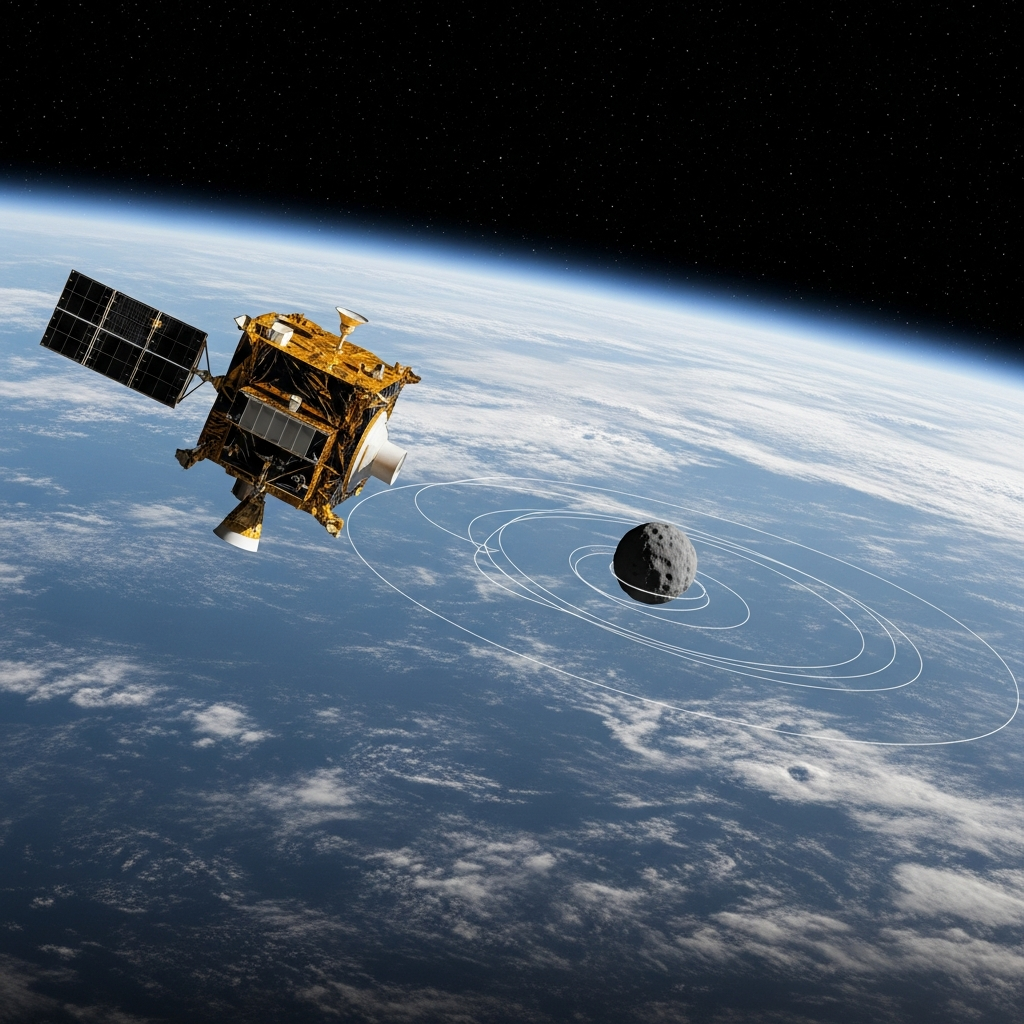
In September 2022, the DART spacecraft intentionally collided with Dimorphos, a small asteroid moonlet orbiting a larger asteroid named Didymos. The primary goal was to test the “kinetic impactor” method: smashing a spacecraft into an asteroid to alter its course. Initial observations quickly confirmed the mission’s immediate success, showing a significant change in Dimorphos’s orbit around its companion, Didymos. Specifically, Dimorphos’s 12-hour orbital period around Didymos was shortened by a remarkable 33 minutes.
Now, a more profound revelation has emerged. Beyond this initial change, scientists have confirmed that the DART impact also measurably shifted the orbit of the entire Didymos-Dimorphos binary system around the Sun. This marks an unprecedented milestone: the first time a human-made object has demonstrably changed the path of a celestial body in its solar orbit. This wasn’t just a bump; it was a cosmic nudge with long-term implications.
Unpacking the Orbital Shift: The Numbers Behind the Success
While the change seems subtle, its significance is immense. The DART mission’s impact reduced the binary system’s 770-day orbital period around the Sun by 0.15 seconds. This translates to an incredibly precise change in orbital speed of approximately 11.7 microns per second, or about 1.7 inches per hour. Over the system’s 300-million-mile (480-million-kilometer) solar orbit, this seemingly tiny deceleration is projected to shrink its orbital radius by roughly 2,360 feet (720 meters).
Rahil Makadia, lead author of the paper from the University of Illinois Urbana-Champaign, emphasized the importance of these figures. He stated that even a minute deflection, “given enough time, can grow to a significant deflection.” This “real-time slowdown” validates the core principle of kinetic impacts: a small shove delivered far enough in advance can mean the difference between an asteroid hitting or missing Earth.
The Science of Deflection: Momentum, Ejecta, and “Double the Punch”
The DART mission’s success wasn’t solely due to the direct impact of the spacecraft. A crucial factor in the orbital alteration was the vast amount of rocky debris ejected from Dimorphos’s surface upon collision. When DART struck the 560-foot (170-meter) wide asteroid, it flung a massive cloud of material into space. This expelled debris carried its own momentum away, providing an additional “explosive thrust” to Dimorphos.
Scientists refer to this phenomenon as the momentum enhancement factor. For DART’s impact, this factor was determined to be approximately two. This means the momentum transferred by the ejected material effectively doubled the impact’s “punch” compared to the spacecraft alone. Previous estimates suggested that 35 million pounds (16 million kilograms) of rock and dust were ejected, significantly contributing to the overall orbital alteration. This added force amplified the effectiveness of the kinetic impactor method.
Why a “Tiny Shove” Matters for Planetary Defense
The Didymos-Dimorphos system posed no threat to Earth, either before or after the DART impact. However, the mission served as a vital real-world test for planetary defense strategies. The ability to precisely measure and confirm even a small change in a celestial body’s solar orbit demonstrates a proven capability. Thomas Statler, lead scientist for Solar System small bodies at NASA Headquarters, highlighted that while tiny, such a change, accumulating over decades, could lead to a substantial deflection. This validates the kinetic impact technique, especially for binary asteroid systems where impacting just one member can alter the entire system.
This concept underscores the importance of early detection. The key to successful planetary defense isn’t a last-minute, massive push. Instead, it’s about delivering a “tiny shove many years in advance” to gently nudge a potentially hazardous object off a collision course. DART provides the crucial data point needed for predicting the outcomes of any future asteroid deflection missions.
Precision Tracking: How Scientists Measured the Change
Measuring such subtle changes in an asteroid’s heliocentric orbit required extreme accuracy and innovative techniques. Researchers employed a sophisticated combination of radar and ground-based observations. A critical method involved tracking stellar occultations. This is when the asteroid system passes directly in front of a distant star, causing its light to briefly blink out.
These observations provide exceptionally precise data on the asteroid’s speed, shape, and position. This challenging method relied heavily on a global network of dedicated volunteer astronomers. They meticulously recorded 22 stellar occultations between October 2022 and March 2025. These collective efforts, combined with years of existing ground-based data, were instrumental in calculating the minute yet significant change in Didymos’s solar orbit. Steve Chesley, a study co-lead at JPL, praised these volunteer efforts for providing highly precise measurements.
Beyond the Orbit: Unveiling Asteroid Secrets
The extensive study of Didymos’s motion offered more than just orbital data. It allowed researchers to calculate the densities of both Didymos and Dimorphos. The findings revealed that Dimorphos is slightly less dense than previously assumed. This supports the “rubble pile” theory of asteroid formation. This theory posits that Dimorphos likely formed from rocky debris shed by a rapidly spinning Didymos, with the loose material eventually clumping together under gravity. This insight into asteroid composition is invaluable for understanding how these celestial bodies behave and how they might respond to future impacts.
Looking Ahead: The Future of Planetary Defense
The DART mission unequivocally demonstrates the effectiveness of the kinetic impactor method. However, the ultimate success of planetary defense hinges on detecting potentially hazardous objects (PHOs) far enough in advance. To address this critical initial step, NASA is developing the Near-Earth Object (NEO) Surveyor mission. This next-generation space survey telescope, managed by the Jet Propulsion Laboratory, is specifically designed to identify hard-to-find NEOs, including dark asteroids and comets that are difficult to detect with traditional methods.
Further insights into DART’s aftermath are also anticipated. The European Space Agency’s Hera spacecraft is currently en route to the Didymos system. Expected to arrive in November, Hera will conduct months of detailed surveying, including deploying a pair of small experimental probes to land on the asteroids. Its observations will provide additional data, helping refine our understanding of asteroid dynamics and planetary defense strategies.
Frequently Asked Questions
What was the primary goal of the DART mission and what did it achieve?
The DART (Double Asteroid Redirection Test) mission’s primary goal was to test the kinetic impactor method as a viable strategy for planetary defense. On September 26, 2022, DART successfully impacted the asteroid moonlet Dimorphos. This not only shortened Dimorphos’s orbit around its companion Didymos by 33 minutes, but crucially, it also altered the entire Didymos-Dimorphos binary system’s orbit around the Sun. This marks the first time humanity has deliberately changed a celestial body’s heliocentric path.
How was the DART mission’s success verified by scientists?
Scientists verified DART’s success through a combination of radar and ground-based observations, including a sophisticated technique called stellar occultations. This involved tracking the asteroid system as it passed in front of distant stars, causing their light to briefly dim. A global network of volunteer astronomers contributed to recording 22 such occultations between October 2022 and March 2025. These precise measurements, combined with existing data, allowed researchers to confirm the subtle orbital shifts and the change in orbital speed.
What does the DART mission mean for Earth’s future planetary defense against asteroids?
The DART mission provides crucial validation for the kinetic impactor method, proving that a human-made object can effectively alter an asteroid’s trajectory. This offers a tangible strategy for planetary defense against potentially hazardous objects (PHOs). It demonstrates that even a “tiny shove” applied many years in advance can lead to a significant orbital change, potentially diverting a hazardous asteroid from a collision course with Earth. The mission also highlights the importance of early detection, underscored by NASA’s ongoing NEO Surveyor mission.
A New Era of Planetary Defense
The DART mission stands as a monumental testament to human ingenuity and our evolving capacity to protect our planet. By intentionally altering an asteroid’s orbit around the Sun, NASA has not only achieved a groundbreaking scientific feat but also laid a critical foundation for future planetary defense efforts. This successful test confirms that we possess a viable tool to defend Earth from cosmic threats, ushering in a new era of proactive space stewardship. As we continue to monitor the Didymos system and develop advanced detection capabilities, humanity is better equipped than ever to safeguard our home among the stars.