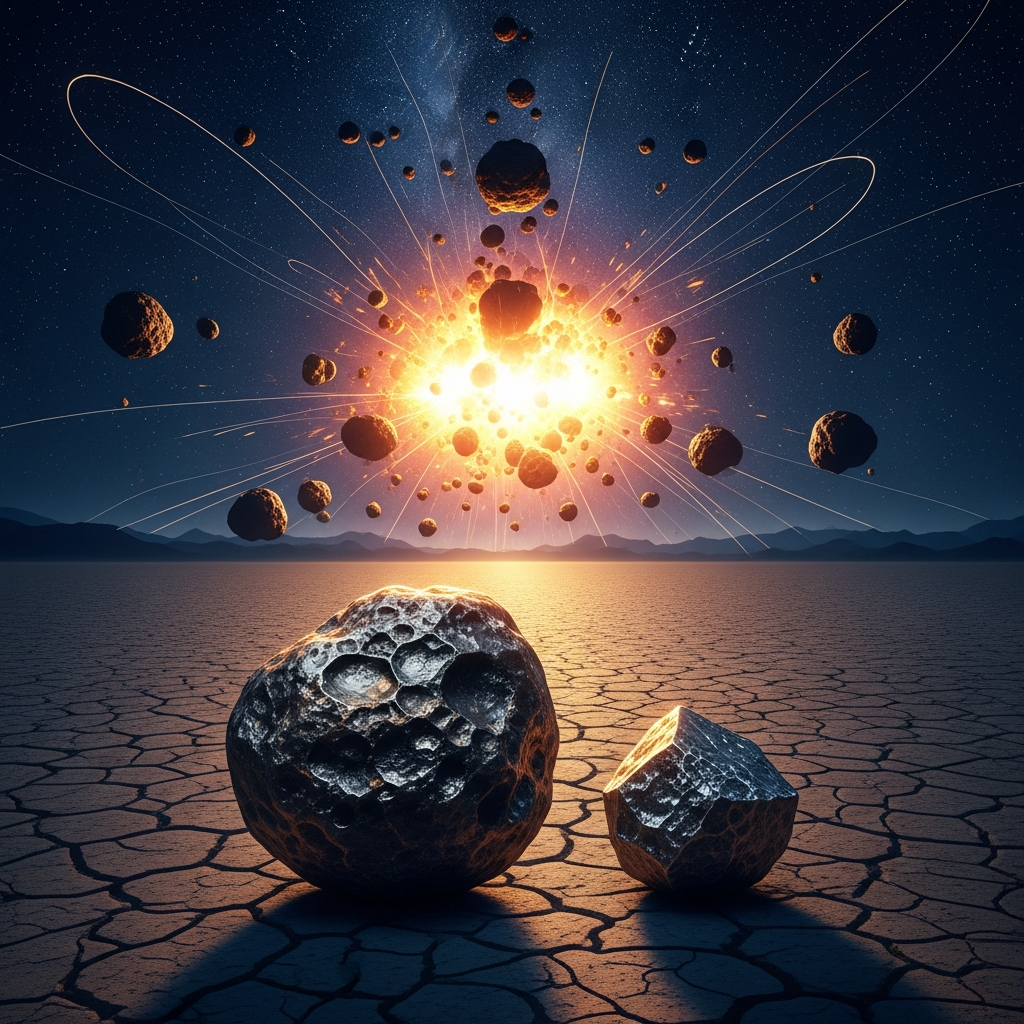
Imagine a cosmic ballet spanning billions of years, culminating in an astonishing celestial reunion right here on Earth. Against nearly impossible odds, two meteorite fragments, born from the same ancient planetary collision, landed mere dozens of miles apart in Arizona. This captivating saga offers unparalleled insights into the violent birth of our solar system and the incredible journey of space debris. It’s a story of deep time, planetary evolution, and the enduring human fascination with objects falling from the sky.
This article delves into the extraordinary narrative of these meteorite twins, tracing their origins back nearly 4.6 billion years to a fledgling planetesimal, through cataclysmic impacts, to their dramatic arrivals on Earth, observed by both ancient peoples and modern scientists.
The Violent Genesis of a Protoplanet
Our story begins in the early chaos of the inner solar system, approximately 4.6 billion years ago. A vast molecular cloud collapsed, forming a spinning disk of gas and dust. Within this swirling nebula, a young protostar, our Sun, began to ignite. Simultaneously, dust particles aggregated into protoplanetary nuggets, the very first geological structures of our solar system. These small bodies swiftly grew into planetesimals.
One such celestial body, about 300 miles (500 kilometers) across – roughly the size of Arizona – emerged from this primordial dust. This planetesimal was a primordial mixture of rock, iron-rich metal, and sulfide. Its composition mirrored that of the most primitive meteorites discovered on Earth today, reflecting the elemental proportions found in our Sun. This young world, however, was not static.
Shaped by Fire and Fury
Radioactive elements, remnants of exploding stars, heated the planetesimal from within. This internal warmth made it exceptionally susceptible to melting during the frequent, violent collisions characteristic of the early solar system. Some impacts were so devastating they spewed vast quantities of rock, metal, and sulfide into space, never to return.
These early planetary collisions left an indelible mark on our protagonist. Its surface became heavily pockmarked with impact craters and was repeatedly fractured. This intense bombardment generated overlapping fields of planetary rubble and fragmented rock extending deep beneath its surface. Scientists have studied meteoritic relics of this ancient rock found on Earth. Radiometric dating reveals evidence of two particularly immense impacts occurring 3.5 million and 5 million years after the solar system’s formation. The earlier event was so powerful it excavated a crater spanning one-third to one-half of the planetesimal’s entire diameter.
The immense energy unleashed by this collision created pressures that extensively metamorphosed and melted significant portions of the planetesimal. A vast pool of molten rock and metal, tens of miles across, formed within the newly excavated crater. This crater lake was subsequently blanketed by a layer of rock, both from collapsed crater walls and ejected debris falling back onto the asteroid. This silicate-rich rock layer acted as an insulator, allowing the molten material to cool at an exceptionally slow rate.
A World Divided: The Birth of Unique Meteorites
As the molten lake cooled, denser metal and sulfide components began to sink, forming a substantial molten metal mass at the crater’s floor. This dense, off-centered “slug” of metal exerted torque on the planetesimal, causing it to gyrate as it spun through space. Insulated by 20 to 40 miles (30 to 60 km) of overlying material, this metallic core cooled incredibly slowly – only 20 to 40 degrees Fahrenheit (10 to 20 degrees Celsius) per million years. This protracted cooling process took 50 million to 100 million years for complete crystallization.
These slow cooling rates were crucial. They allowed metallic crystals to grow remarkably large, initially up to 20 inches (50 centimeters) and, with further cooling, to millimeter-to-centimeter dimensions visible to the naked eye. This process created the iconic Widmanstätten texture, a distinctive pattern of intergrown iron-nickel crystals found in some coarse-grained iron meteorites. These geological specimens are far older than any rock formed on Earth, serving as ancient messengers of the earliest processes that shaped our solar system.
Two Distinct Legacies
While the crater floor produced these spectacular silver-colored metal specimens, the overlying silicate-rich portion of the molten lake, significantly larger in volume, solidified separately. As it crystallized, it primarily formed pyroxene and olivine minerals. Interspersed were plagioclase feldspar crystals, along with residual metal and sulfide that had not completely separated, plus a suite of other minor minerals. This resulted in a vibrant, colorful mixture. When viewed under a petrographic microscope using polarized light, the rock reveals a stained-glass-like vision of that 4.5-billion-year-old world. Such meteorites, now classified as winonaites, represent some of the oldest planetary samples known to science.
The collision that reshaped the ancient planetesimal thus produced two distinct layers: a crystalline rock layer atop a denser metal alloy. As the metal sank, it entrapped some of the rock material, creating jewel-like inclusions. These embedded rocks, resembling winonaites, are still found today in certain iron meteorites, specifically those chemically classified as IAB meteorites. These inclusions offer tangible physical evidence of the common origin shared by these two meteorite types.
The Long Journey to Earth
The planetesimal endured continued bombardment for another 200 million years. This further fractured its crust, mixed it with other rock, and recrystallized portions, leading to increasingly complex textures found in some meteorites. The body might even have been disrupted and reassembled during this tumultuous period. However, this was merely a prelude to a far more impactful event that occurred approximately 4 billion years later.
Studies of winonaites, IAB iron meteorites, and other meteorite types indicate that collisions became far less frequent after the first billion years of solar system history. Therefore, the solidified metal-rich material within the planetesimal lay buried kilometers beneath its surface for nearly four billion years. A catastrophic collision with another planetesimal roughly 500 million years ago finally jettisoned this debris, including the metal slug, exposing it to cosmic radiation. This liberating impact was incredibly violent and likely disrupted a large body, around 200 miles (300 km) wide, about 470 million years ago. This event produced meteorites belonging to a common class known as L-chondrites and is considered a pivotal disruption in solar system history.
When these two planetesimals collided, powerful shock waves rippled through both bodies. Rock was crushed and compressed, with molten material surging through fractures before both worlds were ultimately shattered. Fragments of all sizes launched from the collision point, silently cartwheeling through space and scattering rock and metal flotsam across the ecliptic plane.
Two Stars Fall in Arizona
Some of this cosmic debris eventually entered Earth-crossing trajectories. These early arrivals deposited L-chondritic meteorites and a winonaite, later identified in ocean sediments. More significantly, Earth experienced a surge in asteroid impacts, forming numerous craters. While linking specific craters to asteroid types is often challenging, two craters from this period show a faint chemical signature of L-chondrites, and another bears the signature of an iron asteroid. These ancient impacts struck a flourishing Ordovician world, impacting land covered with moss and liverworts, and splashing into seas teeming with life: graptolites, brachiopods, trilobites, and early vertebrates called conodonts.
However, the specific block of metal that forms one of our meteorite twins took a much longer route to Earth. It remained firmly embedded within the asteroid belt for half a billion years before its dramatic arrival 50,000 to 60,000 years ago. At that time, northern Arizona was uninhabited by humans, but Ice Age giants like mammoths and mastodons might have witnessed the asteroid streaking across the Grand Canyon sky. Envision a dawn scene: a sun-bright bolide, trailing a plume of smoke, making a blistering dive toward the Arizona desert. The massive iron body struck with a multimegaton blast, instantly reshaping the ecosystem for miles around. A shockwave raced across a sage and woodland steppe, followed by a supersonic air blast, as the impact explosion excavated 175 million metric tons of rock, carving the iconic Meteor Crater from the Colorado Plateau.
This marked the fall of the first “star” in our incredible tale. Iron-rich material, formed within an impact crater on a primordial planetesimal over 4.5 billion years ago, had completed its cosmic journey to Earth. In a grand act of cosmic recycling, it produced yet another impact crater.
The Second Descent: The Winona Meteorite
Other debris from the planetesimal’s collisional evolution continued to lurk in space. Notably, a fragment of the silicate-rich material that had pooled and crystallized above the metal continued its orbit around the Sun. This fragment eventually collided with another asteroid approximately 50 million years ago, exposing previously buried material to cosmic radiation.
This newly exposed material continued its solar orbit until it collided with Earth roughly 900 years ago near what is now Winona, Arizona. This event produced the Winona meteorite, which landed an astonishingly close 25 miles (40 km) from Meteor Crater. It seems improbable, yet two fragments from a single impact crater on a nearly 4.6-billion-year-old planetesimal, liberated by subsequent impact events, orbited the Sun for billions of years before finally colliding with our planet and falling within sight of each other.
This was the fall of the second “star.” And unlike its predecessor, this falling star was observed by the ancestors of the modern-day Hopi people.
Ancient Stargazers and Modern Discoveries
Today, the Hopi occupy three mesas east of where the Winona meteorite was found and northeast of Meteor Crater. Their ancestors left extensive archaeological evidence across the region, including petroglyphs, pit houses, pueblos, ceramics, and tools. Among these artifacts was the Winona meteorite itself, discovered buried in a basaltic stone cist – a stone-lined enclosure – near a vacated pueblo.
The discovery site is nestled among volcanic cinder cones and surrounded by ash-rich soils. Around the same time the Winona meteorite fell, the Sunset volcanic crater erupted approximately 10 miles (16 km) away. This eruption forced migrations to areas like Winona, where the land became fertile for cultivating corn, squash, and beans.
Ancestral Puebloans were renowned stargazers, integrating their celestial observations into their architecture and recording features in petroglyphs. The Milky Way, which the Hopi call Soongwupa, held particular prominence. Hopi artist Gerald Dawavendewa noted in his 2021 book, Codex Taawa: Exploring the Cosmos of the Hopi, that Soongwupa “holds prayer feathers, promises of life with blessings.”
We cannot definitively say if the Winona meteorite fell during daylight or at night. However, its careful collection and preservation strongly suggest that Hopi ancestors witnessed the event. Imagine a family outside their pueblo at dusk, startled by a brilliant meteor, followed by thunderous noises. The next morning, on their way to a nearby streambed, they might have connected these events to the large, black-surfaced stone lying in their path. Regardless of the exact circumstances, the ancestral Hopi collected and preserved the specimen, burying it in a cist where it lay undisturbed for 900 years.
Echoes at Meteor Crater
Ancestral Hopi also visited the site where the first “star” fell – Meteor Crater, known as Yuvukpu. Dawavendewa wrote that “even Hoopoq’yaqam [ancient people] did not know how it came to be,” as the crater formed long before their arrival. Yet, centuries later, they constructed structures on its rim and the surrounding plain.
When the massive iron meteorite struck, most of it was obliterated. However, fragments of unshocked material were scattered across the plain, and shock-metamorphosed pieces, some containing diamonds, were distributed along the crater rim. Hopi ancestors regarded these fragments with similar reverence to the Winona meteorite. Dawavendewa documented that they “found parts of the star, which were different from all other stones. The sacred stars were taken to a rock-lined cist and placed into the Earth wrapped in a turkey-feather blanket.”
One Meteor Crater meteorite was found in a vacated pueblo near Camp Verde, Arizona. Ancestral Hopi also collected a piece of graphite from Meteor Crater, intricately veined with silver-colored metal, reminiscent of lightning across a night sky. This particular specimen was buried in Elden Pueblo (Pasiwvi) at the base of the San Francisco Peaks (Nuvatukya’ovi), near modern-day Flagstaff.
Unlocking the Cosmos with Meteorite Twins
The improbable story of these meteorite twins – material from a primordial planetesimal, melted and segregated within an impact crater during the first few million years of solar system formation, then separated further by subsequent collisions in the asteroid belt, lost from each other for perhaps half a billion years, only to cross paths with Earth within a blink of cosmic time – is truly exceptional. One fell 50,000 to 60,000 years ago, creating a massive crater; the other, a fragment of the same body, arrived within the last millennium.
Their near-identical landing sites provide scientists with a unique opportunity to “reassemble” the original ancient planetesimal. This allows us to piece together its geological history and understand the very first processes that shaped planetary bodies in our solar system. The “magic” of this scientific discovery is amplified by the respect and care shown by those who first encountered these celestial visitors. Whether 900 years ago or in the last century, these meteoritic samples were curated, allowing oral traditions, illustrations, and scientific writings to enrich our understanding of the cosmos.
Frequently Asked Questions
What makes the Canyon Diablo and Winona meteorites “cosmic twins”?
The Canyon Diablo and Winona meteorites are considered “cosmic twins” because they both originated from the same ancient planetesimal. This primordial body formed in the early solar system. A massive impact event on this planetesimal billions of years ago created distinct layers of rock and metal. Over eons, fragments from these different layers were liberated by subsequent collisions, eventually traveling separate paths through space before both falling to Earth in Arizona, remarkably close to each other.
How do scientists determine the shared origin of these meteorites?
Scientists trace the shared origin of the Canyon Diablo (an iron meteorite) and Winona (a stony meteorite, specifically a winonaite) through their unique geological and chemical signatures. The iron meteorites contain inclusions of rock that chemically resemble winonaites, indicating they were once part of the same molten lake within the planetesimal. Radiometric dating and analysis of features like the Widmanstätten texture in the iron meteorites provide further evidence of their formation within a slowly cooling body in the early solar system.
What is the significance of the ancestral Hopi’s interaction with the Winona meteorite?
The ancestral Hopi people’s interaction with the Winona meteorite holds immense cultural and scientific significance. Their careful collection and preservation of the Winona meteorite, burying it in a stone cist, suggests they witnessed its fall and recognized its unique nature. This provides invaluable human observation of a meteoritic event from centuries ago and highlights the deep historical connection between indigenous peoples and celestial phenomena. Their stewardship allowed the meteorite to be preserved for modern scientific study, enriching our understanding of both space and human history.
This incredible saga underscores the vastness of cosmic timescales and the power of celestial mechanics. It is a powerful reminder that every fragment of rock from space tells a story, connecting us to the universe’s earliest moments.