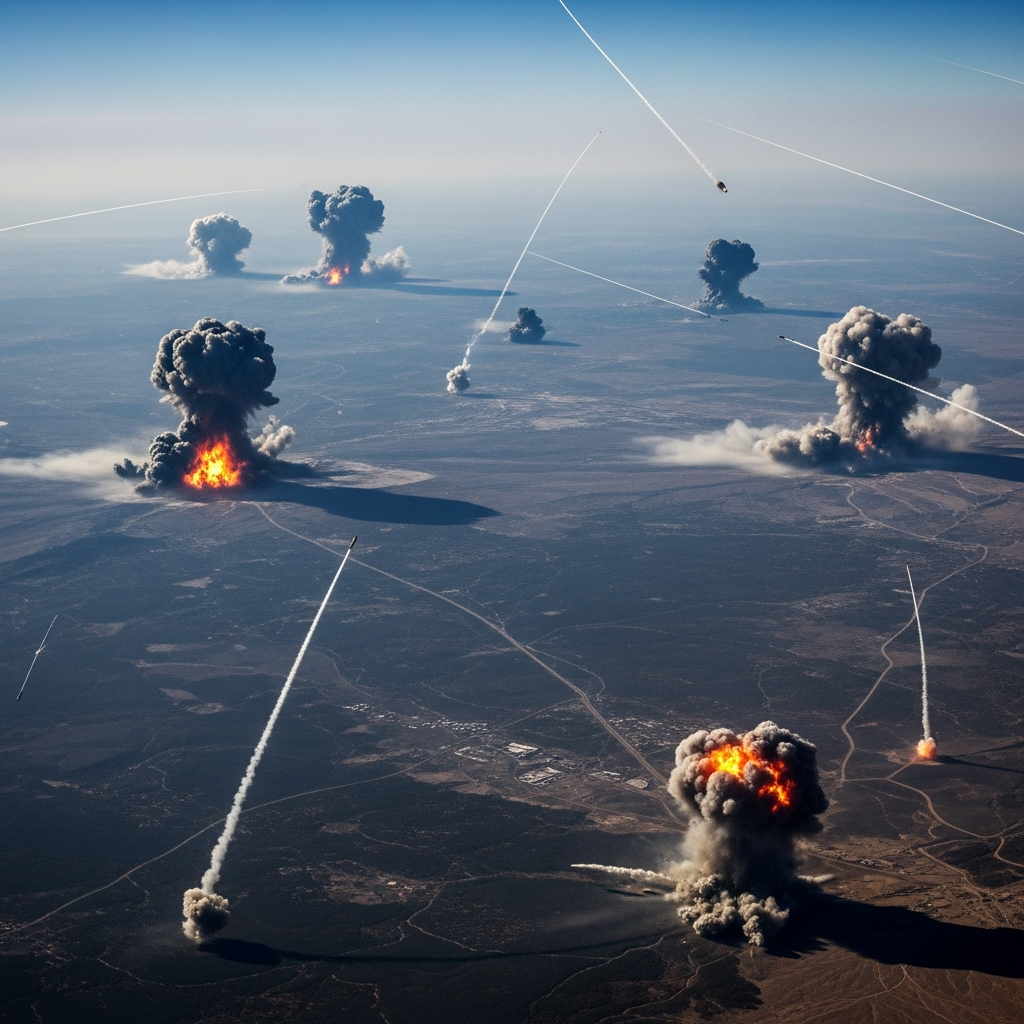
The Middle East is gripped by an intensifying conflict, now in its second week, featuring unprecedented military actions by the United States and Israel against Iran, met with significant Iranian retaliation across the region. This multi-faceted confrontation, ignited on February 28, 2026, has already caused extensive destruction, numerous casualties, and triggered widespread global concern over geopolitical stability and economic repercussions. Initial US-Israeli strikes targeted Iran’s leadership and critical infrastructure, while Iran launched a swift, expansive wave of counter-attacks, escalating tensions further.
Unprecedented Strikes Ignite Regional Warfare
The current Middle East conflict commenced with a coordinated US-Israeli military assault on Iran. This offensive, dubbed “Operation Roaring Lion” by Israel, aimed to dismantle Iran’s regime and reshape the region. Reports indicate a pivotal Israeli strike on a Tehran bunker killed Iran’s Supreme Leader Ayatollah Ali Khamenei, its defense minister, and several top Islamic Revolutionary Guard Corps (IRGC) generals. US President Donald Trump announced Khamenei’s death via social media, affirming the campaign’s focus on Iranian leadership. This initial attack was described as the largest aerial assault ever conducted by the Israeli Air Force.
US and Israeli forces executed thousands of strikes across Iran. Targets included Iran’s political command, military infrastructure, and missile sites. Satellite imagery confirmed damage to the Natanz nuclear facility, three missile sites, and aircraft at Tehran’s Mehrabad airport. Naval bases at Konarak and Bandar Abbas also suffered significant damage, with at least 11 Iranian naval vessels reportedly destroyed or damaged. US Central Command (CENTCOM) claimed over 5,000 targets struck in Iran within 10 days, including more than 50 naval vessels, air defense systems, and ballistic missile facilities.
Iran’s Swift and Broad Retaliation
In response to these initial assaults, Iran launched what its President, Masoud Pezeshkian, called “legal acts of self-defense.” This involved an unprecedented wave of missile and drone attacks. These retaliatory strikes extended across the Middle East, targeting US military bases and civilian infrastructure in several Gulf nations. Saudi Arabia, Kuwait, Bahrain, and the United Arab Emirates (UAE) all reported interceptions of Iranian projectiles.
Bahrain, in particular, suffered a drone attack that injured 32 civilians and ignited a fire at its largest oil refinery. The UAE reported intercepting 16 missiles and numerous drones, with officials confirming 238 missiles and 1,422 drones detected in a single week. Kuwait downed eight drones, and Saudi Arabia’s defense ministry confirmed destroying five drones targeting its Shaybah oil field. A projectile also hit a container ship off the UAE coast in the crucial Strait of Hormuz. Oman, Qatar, and Iraq also faced attacks, with a drone striking a major US diplomatic facility near Baghdad airport.
Mounting Casualties and Humanitarian Crisis
The human cost of this escalating Iran war is rapidly climbing. The US-based Human Rights Activists News Agency (HRANA) reported 1,245 civilian deaths, including at least 194 children, since the conflict began. Lebanon’s health ministry confirmed 486 deaths due to Israel’s offensive there.
Tragically, a primary school in Minab, Iran, was hit on February 28, resulting in at least 168 fatalities, mostly schoolchildren. Independent analysis suggested a US Tomahawk missile might have been responsible, raising significant humanitarian concerns. Six US Democratic senators voiced horror, criticizing the “cavalier approach” to rules of engagement. President Trump, however, without evidence, attributed the school strike to Iranian “inaccuracy.”
On the Israeli front, two soldiers were killed in southern Lebanon in combat with Hezbollah, while Iran-backed missile strikes killed two people and injured 27 in Beit Shemesh. Ten Israeli civilians also died, and over 2,142 were injured in wider Iranian retaliation. The US Department of Defense confirmed seven US service members have been killed, with nine MQ-9 Reaper drones lost, costing over $270 million. The US State Department has assisted over 32,000 American citizens in returning from the Middle East.
Economic and Geopolitical Fallout
The Middle East conflict has significantly disrupted global energy markets. Iranian attacks on oil infrastructure, including setting Bahrain’s sole oil refinery ablaze and hitting fuel tanks at Kuwait International Airport, have caused major supply concerns. Bahrain’s state oil company, Bapco, declared force majeure on foreign shipments. Fires also broke out at an oil facility in Fujairah, UAE.
These disruptions, alongside Iranian actions to choke off oil and gas shipments through the Strait of Hormuz, a critical chokepoint for one-fifth of the world’s exported oil, sent global oil prices soaring. Brent crude surpassed $100 per barrel, reaching nearly four-year highs, and US gas prices hit their highest since August 2024. French President Emmanuel Macron announced a “defensive” mission to reopen the Strait of Hormuz, deploying a significant naval force to the Eastern Mediterranean. However, Iran’s Ali Larijani warned that “insecurity will persist” in the Strait.
International Response and Shifting Dynamics
The international community has reacted with varied concerns. French President Macron urged Iran to halt strikes and guarantee freedom of navigation. Swiss Defense Minister Martin Pfister stated that both US/Israeli and Iranian actions likely violate international law. Omani Foreign Minister Badr Albusaidi called for restraint and diplomacy. Pope Leo XIV appealed for an end to the violence, fearing wider spread.
Germany’s Chancellor Friedrich Merz placed sole responsibility for ending the war on Iran’s leadership, labeling the regime “the center of international terrorism.” China, a major Iranian ally and the world’s largest energy importer, condemned the war, recognizing its reliance on Gulf oil. The British Foreign Office advised against all travel to Israel and Palestine. The Pentagon confirmed a US submarine sank an Iranian warship off Sri Lanka, killing over 80 people, highlighting the conflict’s global reach. Azerbaijan also accused Iran of drone attacks, and a UK airbase in Cyprus was hit by a Hezbollah drone.
Leadership and Political Maneuvers
In Iran, Mojtaba Khamenei, the late Supreme Leader’s second son, has been officially named Iran’s new Supreme Leader. Despite lacking elected office experience, he holds significant sway within the IRGC. US President Trump publicly expressed disapproval of this succession, reiterating his demand for Iran’s “unconditional surrender.” Israel’s Ambassador Michael Leiter outlined a vision for a “transitional government” in Iran under US-Israeli guidance, aiming for a democratic process. President Trump stated the war was “very complete” and would “end soon,” aiming to prevent Iran from “taking over the Middle East.”
Frequently Asked Questions
What are the main triggers and initial actions of the current Middle East conflict?
The conflict began on February 28, 2026, with a joint US-Israeli military assault on Iran. These initial strikes, including Israel’s “Operation Roaring Lion,” primarily targeted Iran’s political leadership and military infrastructure. A key event was an Israeli strike in Tehran that reportedly killed Iran’s Supreme Leader Ayatollah Ali Khamenei and other high-ranking officials. Iran swiftly retaliated with extensive missile and drone attacks across the region.
How has the conflict impacted key global economic points like the Strait of Hormuz?
The conflict has severely impacted global energy markets, particularly through disruptions to oil and gas shipments via the Strait of Hormuz. Iranian attacks on oil infrastructure in Gulf states and actions to choke off the Strait have led to significant oil price surges, with Brent crude exceeding $100 per barrel. This prompted French President Emmanuel Macron to announce a “defensive” mission to reopen the critical waterway, highlighting its strategic global importance.
What are the humanitarian costs and broader international reactions to this war?
The war has resulted in a substantial humanitarian crisis, with over 1,200 civilian deaths reported by HRANA, including nearly 200 children, and hundreds more in Lebanon. Tragic incidents include a strike on an Iranian girls’ school that killed over 160. Internationally, reactions vary: while the US and Israel maintain a stance of “unconditional surrender” from Iran, many nations, including France, Switzerland, Oman, and the Pope, have called for de-escalation, diplomacy, and adherence to international law, expressing grave concerns about regional instability and the conflict’s global spillover effects.
Conclusion
The ongoing Middle East conflict represents a dramatic escalation of long-standing regional tensions, transforming into an open and destructive war. With major powers engaged in extensive military operations, a high human toll, and significant economic fallout, the situation remains volatile and unpredictable. The strategic importance of the region, particularly the flow of global energy, ensures that international focus will remain sharply on these developments. As military actions continue and diplomatic efforts struggle, the long-term implications for global security and stability are profound.