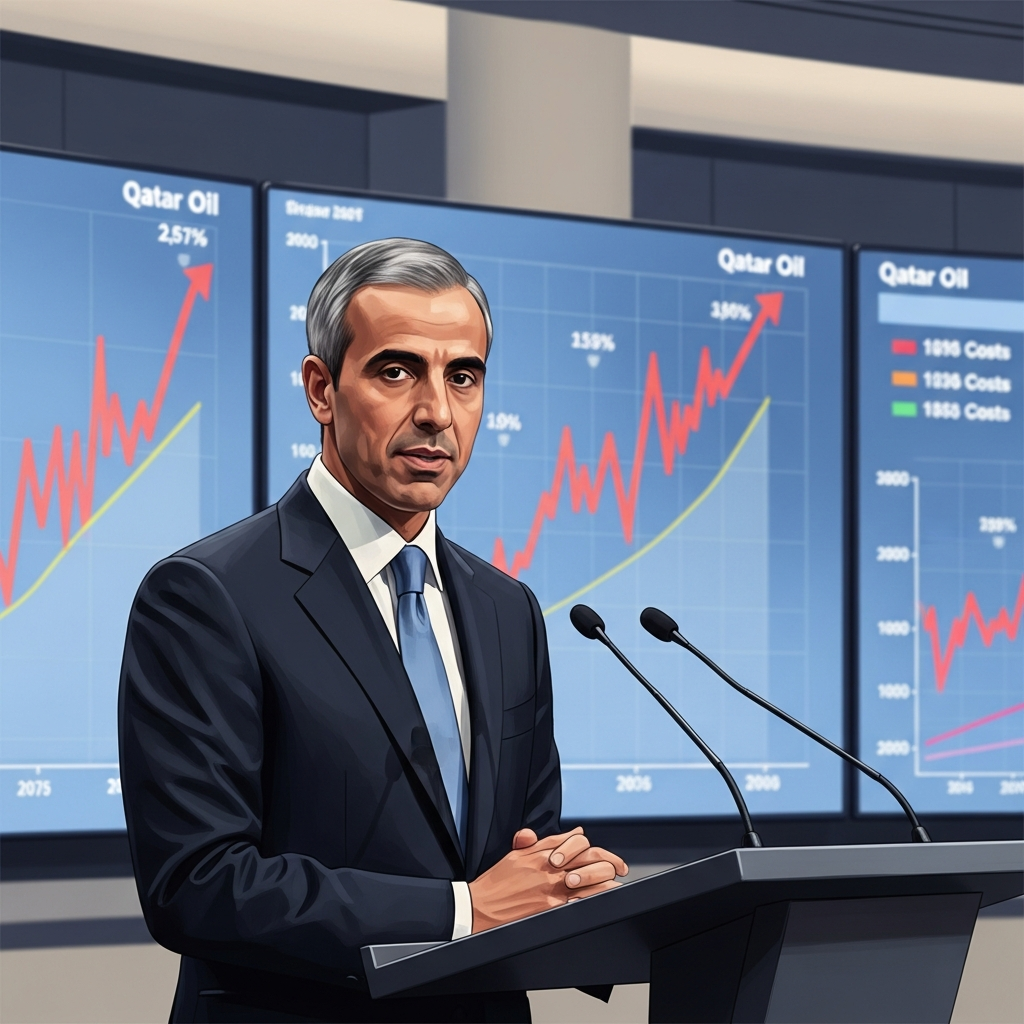
The global energy landscape is teetering on the brink of an unprecedented crisis. Oil prices have surged to a two-year high, fueled by a dire warning from Qatar’s energy minister, Saad al-Kaabi. He anticipates a complete shutdown of all Gulf oil and gas production within days if the escalating Middle East conflict persists. This stark pronouncement has sent shockwaves through international markets, signaling potential “massive economic and energy crisis” that could destabilize economies worldwide. Consumers are already feeling the pinch at the pump, with broader inflationary pressures now a significant concern for major global economies.
Escalating Tensions Trigger Historic Oil Price Surge
The conflict in the Middle East, a region pivotal for global energy supplies and critical shipping routes, has propelled Brent crude oil prices above $93 a barrel, marking their highest level since autumn 2023. This rapid escalation saw Brent crude jump over 9% on Friday alone, reaching $94 and even touching $100 per barrel in some analyses. The US benchmark West Texas Intermediate (WTI) also soared to $91 per barrel, reflecting intense investor anxiety over imminent supply disruptions.
Saad al-Kaabi, who also serves as chief executive of QatarEnergy, warned the Financial Times that a prolonged conflict could push crude oil to $150 a barrel. Such a scenario would severely impact global GDP growth, drive up energy costs universally, trigger product shortages, and create a cascading effect of factory disruptions. The economic ramifications are not merely accidental; some analysts suggest they are an intrinsic aspect of the conflict, with deliberate attacks on Gulf oil facilities hinting at a strategy to escalate economic pressure.
The Threat to Global Energy Supplies: A De Facto Blockade
Qatar, a significant producer and exporter of oil and liquefied natural gas (LNG), has already seen QatarEnergy halt LNG production following “military attacks” on its facilities, declaring “force majeure.” Kaabi expects other regional energy exporters to follow suit if the war continues, highlighting that even if hostilities ceased immediately, resuming normal output could take “weeks to months.”
A critical chokepoint, the Strait of Hormuz, typically facilitates the passage of about a fifth of the world’s daily oil supply. Traffic through this narrow waterway has virtually halted since the recent US-Israel conflict with Iran began. While Iran has not formally closed the strait, soaring insurance costs and safety concerns have effectively ceased normal shipping operations. A sustained blockage would globally inflate the cost of goods and services, severely impacting major crude oil importers like China, India, and Japan. Although the UAE and Saudi Arabia possess pipelines to bypass the Strait, analysts warn that persistent threats to shipping will inevitably lead to higher oil prices and increased shipping costs. Rystad Energy analyst Jorge Leon emphasized that if Gulf countries cannot export oil, they must store it, leading to production halts once storage capacities are exhausted – a point potentially reached within days or weeks.
Economic Fallout: Inflation and Global Slowdown
The surge in oil and gas prices is poised to ignite inflation in major global economies such as the UK and US, where it had recently been on a downward trend. In the UK, consumers are already experiencing significant increases, with petrol up by 3.7p and diesel by 6p since Saturday, reaching a 16-month high. Household energy bills could also rise, though the impact might not be felt until July due to existing regulatory price caps.
The economic ramifications extend beyond crude oil to vital derivative petrochemical products like jet fuel and urea, which are crucial for various industries. These too are experiencing price spikes due to their reliance on free passage through the Gulf. The Bank of England, for instance, is now widely expected to delay anticipated interest rate cuts as inflation proves “sticky,” impacting the mortgage market as banks reprice home loans. Official economic forecasts, like those from the Office for Budget Responsibility, have swiftly become obsolete due to the rapid shifts in energy prices. Canada, too, is seeing gas prices increase by about 10 cents a litre, along with strained global supply chains and rising freight costs.
Widespread Impact on Consumers and Industries
Rising oil prices have wide-reaching effects, impacting not only the cost of filling up vehicles but also the cost of some heating, food, and imported goods. Industries such as airlines, shipping, and transportation face significantly increased operating costs, which are then passed on to consumers as higher prices for goods and services across the entire economy. A prolonged halt to all Gulf oil and gas production, though an “extreme scenario,” could disproportionately affect energy prices rather than causing a broad inflationary shock in certain sectors, such as UK food imports, which are less reliant on Gulf shipping routes.
The broader economic risk stems from persistently higher energy costs, which can significantly impede global growth. Governments worldwide are closely monitoring the situation. They may respond by releasing strategic oil reserves, as seen after Russia’s invasion of Ukraine, but the long-term direction of prices hinges on the geopolitical evolution in the Middle East.
International Response and Humanitarian Concerns
The escalating conflict is prompting international action and concern. Canada, for instance, is organizing flights and buses for its citizens in the Middle East, with thousands requesting evacuation assistance. The conflict has also spurred a rapidly growing humanitarian crisis, displacing tens of thousands and freezing humanitarian aid operations in crucial hubs like Dubai. Children are particularly vulnerable, experiencing profound fear and compounding vulnerabilities, as noted by World Vision’s Amanda Muñoz de Toro.
Global powers are navigating complex dynamics. The US and Israel report significant degradation of Iran’s military capabilities, while Russia is allegedly sharing intelligence with Iran. Gulf states, including Kuwait, the UAE, Qatar, and Saudi Arabia, have intercepted numerous missile and drone attacks, expressing anger over inadequate notice about joint war plans. The sporting world is also affected, with event cancellations being considered in Bahrain and Saudi Arabia. This situation underscores the world’s heavy dependence on Middle Eastern oil, despite diversification efforts, and the profound vulnerability of global markets to geopolitical instability.
Frequently Asked Questions
What caused the recent surge in oil prices to a two-year high?
The recent surge in oil prices is primarily due to escalating conflict in the Middle East. Qatar’s energy minister, Saad al-Kaabi, issued a stark warning that all Gulf oil and gas production could cease within days if the conflict persists. This threat, coupled with the effective closure of the crucial Strait of Hormuz due to heightened insurance costs and safety concerns, has triggered fears of a severe global supply shock, driving benchmark crude oil prices over $93 a barrel.
What are the main areas of concern regarding potential disruptions to global energy supply?
The primary concerns revolve around the Strait of Hormuz, a vital shipping lane through which about one-fifth of the world’s oil supply typically passes. Its effective closure significantly impacts global trade. Additionally, the explicit warning from Qatar’s energy minister about a potential complete halt in oil and gas production from all Gulf exporters, including QatarEnergy’s declared “force majeure” on LNG output, highlights the immediate threat to supply from major producing nations.
How might this oil crisis impact everyday consumers and global economies?
This oil crisis could lead to significant global inflation, particularly affecting energy, fuel, food, and imported goods prices. Consumers may face higher costs for petrol, diesel, and heating, while businesses in transport and manufacturing will see increased operating expenses, potentially passed on to consumers. Globally, analysts warn of a “real risk to the global economy,” with potential impacts on GDP growth, product shortages, factory disruptions, and central banks delaying interest rate cuts.
Conclusion
The current situation in the Middle East poses an immediate and profound threat to global economic stability. Qatar’s urgent warning about a potential complete halt in Gulf oil and gas production, coupled with the effective closure of the Strait of Hormuz, has pushed oil prices to historic highs. The ripple effects are already evident in rising fuel costs and inflationary pressures across major economies. While governments may deploy strategic reserves to mitigate immediate shocks, the long-term trajectory of global energy markets hinges on the de-escalation of this critical geopolitical conflict. The coming weeks will be crucial in determining whether the world faces a short-term energy disruption or a more prolonged and severe global economic crisis.