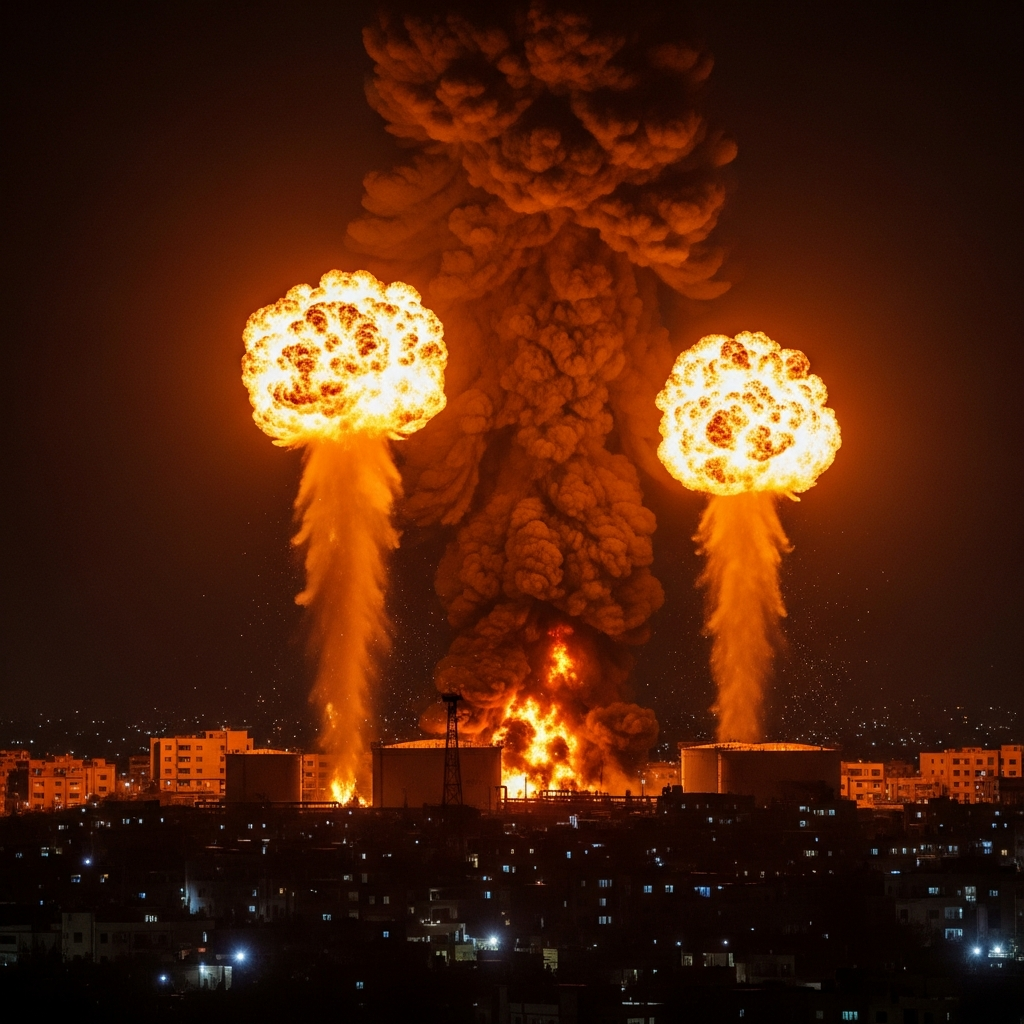
The Middle East finds itself plunged into an unprecedented phase of conflict. Recent Israeli airstrikes have reportedly targeted an oil storage facility in Tehran. This marks a critical escalation, with civil industrial infrastructure now squarely in the crosshairs. Pillars of flame and smoke dramatically lit the night sky over Iran’s capital. The attack signals a significant shift in the region’s week-old hostilities.
This direct strike on Iran’s energy infrastructure has immediate, far-reaching consequences. It underscores the intensifying geopolitical crisis in the Middle East. Beyond military targets, the conflict now threatens vital civilian resources and global energy supplies.
Unprecedented Strikes on Civilian Industrial Facilities
Late Saturday, Tehran’s skyline became a canvas of fire. Israeli airstrikes struck an oil storage facility, sending enormous plumes of flame and smoke skyward. This event was confirmed by Israel’s military. Iranian state media, however, attributed the attack to “the U.S. and the Zionist regime.” Fars news agency reported four tanker drivers tragically lost their lives in the assault. This incident appears to be the first time a civil industrial facility has been directly targeted in this escalating war. It highlights a perilous new phase where economic lifelines are under direct attack.
Broader Targeting of Critical Infrastructure
The Tehran incident is not isolated. The conflict has seen other vital civilian and industrial sites targeted. In Bahrain, a desalination plant sustained “material damage” from an Iranian drone attack. This marks a concerning first for an Arab nation. Additionally, Iran claimed retaliatory strikes hit a major refinery in Saudi Arabia and a liquefied natural gas (LNG) facility in Qatar. The attack on Qatar’s LNG facility alone took about 20% of the world’s LNG supply offline. These strikes demonstrate a widening scope of targets. They threaten essential services and economic stability across the entire region. Such actions significantly escalate the potential for widespread civilian impact.
Widespread Regional Repercussions and Humanitarian Toll
The conflict’s reach extends far beyond Iran and Israel. Numerous Gulf nations have experienced direct attacks. Kuwait reported two border guards killed by a “swarm of missiles and drones.” Bahrain’s capital, Manama, also saw attacks. Missile fragments wounded three people and caused damage at a university in Muharraq city. Saudi Arabia shot down a drone east of Riyadh. Even Dubai, UAE, experienced a missile alert and drone debris. One Pakistani man was killed in Dubai. These incidents underscore the volatile and interconnected nature of security in the Persian Gulf.
Mounting Casualties and Diplomatic Pressure
The human cost of this escalation is severe. Reports indicate at least 1,230 deaths in Iran and over 300 in Lebanon. Around a dozen deaths have occurred in Israel. The U.S. has also mourned six soldiers killed in the conflict. Civilian casualties in Iran include over 1,000 deaths and 5,400 injuries, with 181 children among the dead. In Lebanon, nearly 60,000 people have been displaced, including 18,000 children. These staggering figures highlight the urgent humanitarian crisis unfolding. Egypt’s Foreign Minister Badr Abdelatty called for de-escalation. He warned that the region stands “at a critical juncture,” facing profound instability.
Economic Fallout: Global Energy Market in Crisis
The attacks on energy infrastructure and the broader conflict have triggered a global energy crisis. The economic impact is profound and immediate. Global oil and gas prices have surged rapidly. This directly threatens global economic stability.
The Strait of Hormuz Under Perilous Threat
A primary cause of this price hike is the precarious state of the Strait of Hormuz. This critical choke point, bordered by Iran, sees approximately 20 million barrels of oil transit daily. Many ships are now stranded, unable to safely pass through the strait. Iran has declared the Strait of Hormuz closed to all vessels. This has led to attacks on commercial ships and a near halt in shipping traffic. Counterterrorism concerns, including drone speedboats and weapon-carrying drones, make passage extremely risky. The effective closure of this vital artery chokes a fifth of the world’s oil and gas supply. This creates an “extreme deficit” in global supply.
Soaring Oil and Gas Prices Impact Consumers
Consumers worldwide are already feeling the pinch. Oil prices have soared dramatically. American crude settled at $90.90 a barrel, a 36% jump in a single week. Brent crude, the international benchmark, climbed 27% to $92.69. At the pump, U.S. regular gasoline rose to $3.41 a gallon (up 43 cents). Diesel hit $4.51 a gallon (up 75 cents). The shocks are even more severe in Europe and Asia. These regions heavily rely on Middle Eastern energy. Europe has seen diesel prices double. Jet fuel prices in Asia have increased by nearly 200%. The widespread damage to key oil and gas facilities exacerbates the crisis. Some producers, like Kuwait, have proactively reduced output. Qatar has suspended its LNG production, citing Force Majeure.
Internal Iranian Dynamics and Broader Geopolitics
The crisis reveals complex internal political dynamics within Iran. It also highlights the broader geopolitical stakes. The conflict is not just about immediate strikes but long-term strategic objectives.
Contradictory Statements from Iranian Leadership
Iranian President Masoud Pezeshkian initially offered an apology for attacks on “neighboring countries.” This conciliatory tone was quickly challenged by hard-liners. They insisted that Tehran’s war strategy would remain unchanged. By Sunday, Pezeshkian had shifted his rhetoric. He threatened stronger responses to U.S. and Israeli air campaigns. He also accused the U.S. of trying to divide the region. Yet, Ali Larijani, Secretary of the Supreme National Security Council, publicly stressed the unity of Iranian leaders in “fighting Israel and the United States.” These mixed messages reflect internal tensions regarding the conflict’s direction.
US and Israeli Objectives and Military Actions
The U.S. and Israel have clearly stated their objectives. The operations, codenamed “Roaring Lion and Epic Fury,” explicitly aim at “creating conditions for regime change” in Iran. Israeli Prime Minister Benjamin Netanyahu claims Israel has “nearly achieved total control of Iranian airspace.” He stated operations are coordinated with the U.S. The IDF reported destroying 75% of Iranian missile launchers. Defense Secretary Pete Hegseth declared the U.S. is “accelerating, not decelerating.” He confirmed the sinking of the Iranian warship IRIS Dena, calling it the “first sinking of an enemy ship by a torpedo since World War II.” U.S. forces have reportedly destroyed over 20 Iranian naval vessels.
Furthermore, a major Israeli aerial attack allegedly killed Ayatollah Ali Khamenei, Iran’s Supreme Leader, alongside Iran’s defense minister and several IRGC generals. Israel also claimed to have struck Iran’s F-14 fighter jets at Isfahan Airport and its detection and air defense systems. Israeli President Isaac Herzog cited intelligence about Iran’s potential to enrich uranium to 90% (weapons-grade) within two weeks. This raises acute concerns about Iran’s nuclear ambitions. The strategic targeting and explicit declarations signal a full-spectrum military and political campaign.
Frequently Asked Questions
What prompted the recent Israeli airstrikes on Iran’s oil storage facilities?
The recent Israeli airstrikes on Iran’s oil storage facilities in Tehran are part of a broader, escalating conflict in the Middle East, particularly intensified since late February 2026. Israel’s military confirmed these strikes, framing them as actions within ongoing hostilities. Iranian state media, however, blamed the U.S. and Israel for the attack. The targeting of an oil facility marks a significant escalation, as it appears to be the first time a civil industrial facility has been directly hit in this particular conflict. This strategic move aims to impact Iran’s economic and infrastructural capabilities amidst the wider war.
How has the escalating conflict impacted global oil and gas prices?
The escalating conflict has severely disrupted global energy markets, causing rapid and significant surges in oil and gas prices. The effective closure of the Strait of Hormuz, a vital shipping lane, has stranded approximately 20 million barrels of oil daily. Attacks on key facilities, including Iran’s oil storage, Saudi refineries, and Qatar’s LNG plant, have taken millions of barrels of oil and about 20% of global LNG supply offline. Consequently, American crude prices jumped 36% in a week, and Brent crude climbed 27%. Consumers are experiencing higher prices at the pump, with U.S. gasoline and diesel prices rising sharply, and even steeper increases in Europe and Asia.
Which other Middle Eastern countries have been affected by the escalating conflict?
The conflict has had widespread regional repercussions, impacting numerous Middle Eastern countries beyond Iran and Israel. Kuwait reported two border guards killed by missiles and drones. Bahrain sustained “material damage” from Iranian drone attacks, including a desalination plant and a university building. The UAE, including Dubai, experienced missile alerts and drone debris. Saudi Arabia intercepted drones. Iraq’s national power grid shut down due to gas supply issues, and oil production halted near Basra. Iranian drone attacks also hit Azerbaijan, injuring civilians, and a ballistic missile was fired at Turkey. These incidents underscore the broad geographic spread and destabilizing effect of the ongoing hostilities across the Gulf.
Conclusion: A Region on the Brink
The recent Israeli strike on Tehran’s oil storage facility signals a dangerous escalation in the Middle East conflict. The targeting of civilian industrial infrastructure, coupled with the effective closure of the Strait of Hormuz, has dire economic consequences globally. Oil and gas prices are soaring, threatening a worldwide energy crisis. The human toll is also mounting, with thousands of casualties and displaced persons across multiple nations. As internal Iranian political dynamics clash and U.S. and Israeli objectives of “regime change” become explicit, the region stands at a critical juncture. The uncertain duration of this conflict promises continued volatility and widespread implications for international stability and global markets.