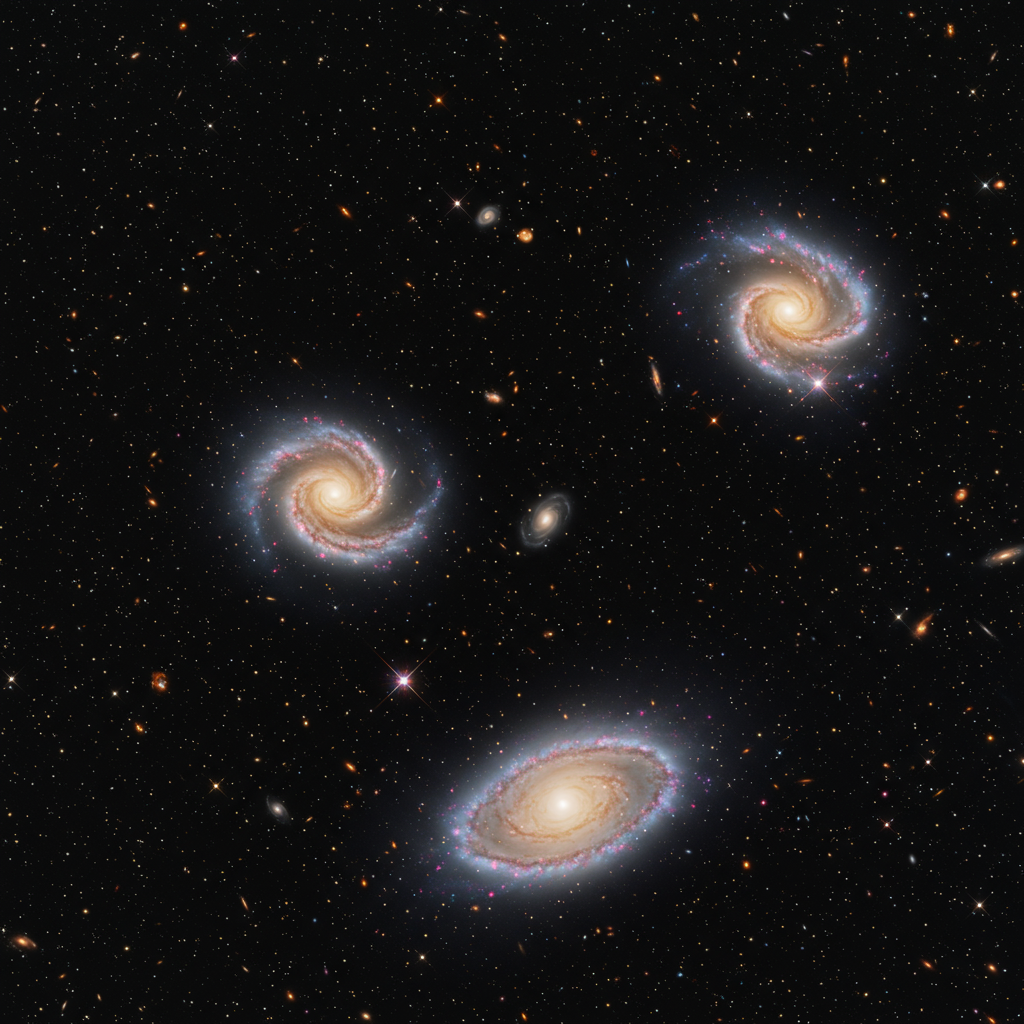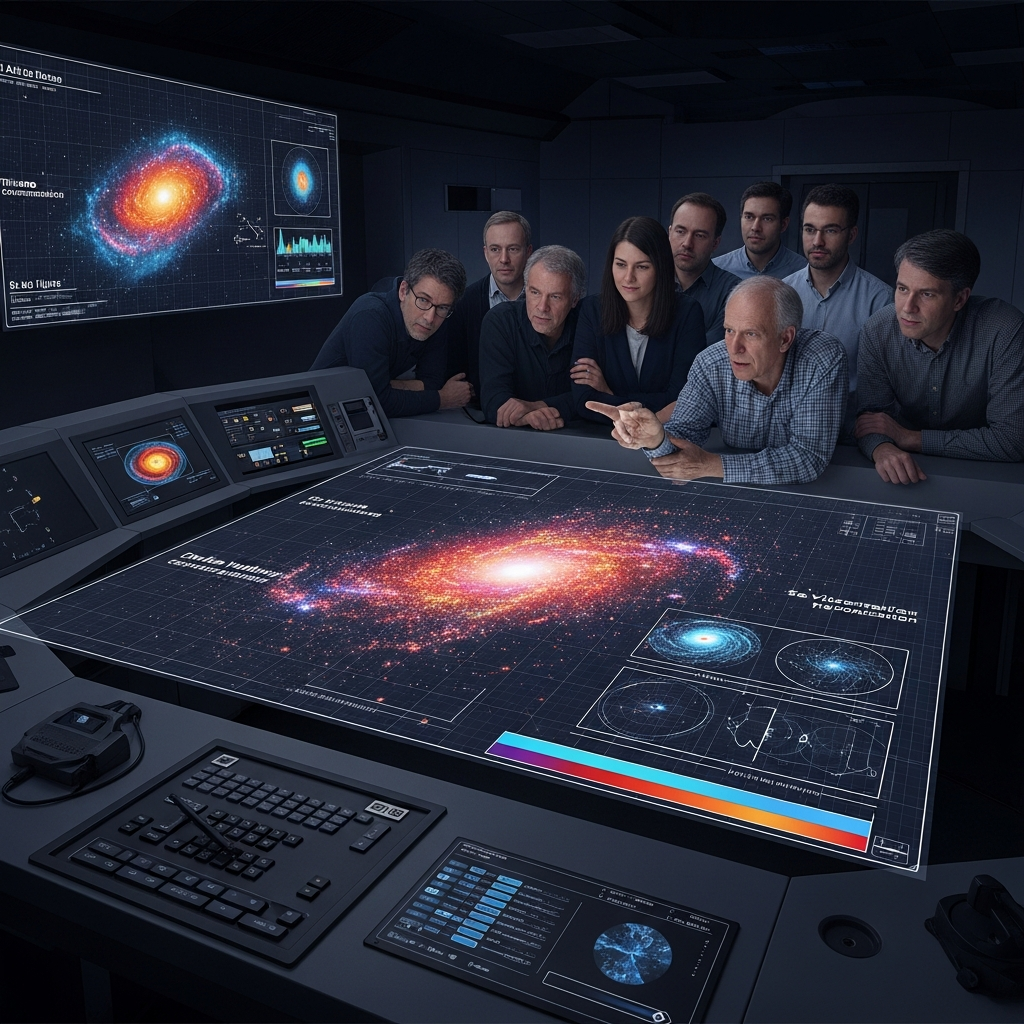
Astronomers have achieved a monumental feat, crafting one of the most precise and extensive 3D maps of the universe ever created. This groundbreaking cosmic map reveals a stunning “sea of light” that permeated the early cosmos, offering an unprecedented glimpse into the universe’s formative years. Developed through the Hobby-Eberly Telescope Dark Energy Experiment (HETDEX), this 3D map of the universe is fundamentally changing our understanding of how gravity and the mysterious force of dark energy sculpted the cosmos.
Unveiling the Universe’s Luminous Past
Imagine peering back in time, 9 to 11 billion years ago, to an era known as the “cosmic dawn.” This was a period of intense star formation, where the universe was bursting with newfound brilliance. Researchers have now captured this vigorous activity, not by observing individual galaxies, but by detecting the collective glow of excited hydrogen, the universe’s most abundant element. This integrated light paints a vivid picture of a “sea of light” illuminating the vast expanse of space.
Unlike previous cosmic surveys, this extraordinary early universe map focuses on a specific wavelength: Lyman-alpha light. This ultraviolet emission occurs when hydrogen atoms are energized by the radiation from nearby stars. By measuring these signature emissions across an immense stretch of sky, scientists could essentially trace the distribution of matter and light when the universe was only a fraction of its current age.
The HETDEX Project: A New Lens on Cosmic Evolution
This pioneering research is a core component of the Hobby-Eberly Telescope Dark Energy Experiment (HETDEX). This ambitious sky survey aims to unravel the roles of dark energy and gravity in shaping the very structure of the cosmos. The data, collected using the powerful Hobby-Eberly Telescope at the McDonald Observatory in Texas, allows researchers to rigorously compare their cosmological simulations against actual observations. This critical comparison helps validate or refine our theoretical models of the universe.
Study co-author Julian Muñoz, a theoretical cosmologist at The University of Texas at Austin, likens traditional galaxy surveys to “mapping the brightest cities only.” This approach misses the broader context—the “suburbs and small towns” of fainter galactic structures and immense interstellar gas clouds. The HETDEX survey adopts a different philosophy: “zooming out.” Instead of focusing on discrete objects, it captures the combined light from every entity within a designated cosmic region.
This integrated approach enables astronomers to gather comprehensive data from countless galaxies and intergalactic gas clouds simultaneously. The HETDEX project has accumulated an astounding dataset, encompassing over 600 million spectra across an area equivalent to more than 2,000 full moons. This vast collection of information provides an unparalleled resource for charting over a million bright galaxies and understanding the intricate web of cosmic structures.
Line-Intensity Mapping: Charting the Invisible
The key to revealing this ancient “sea of light” lies in an innovative technique called line-intensity mapping. Traditionally, massive, bright galaxies are relatively easy to spot. However, the universe also contains numerous fainter galactic structures and colossal interstellar gas clouds that serve as stellar nurseries. These have largely remained undetected by conventional methods—until now.
Line-intensity mapping revolutionizes cosmic observation by focusing on the characteristic spectral emissions, or telltale wavelengths, produced by specific elements like hydrogen. By identifying these unique “signatures,” astronomers can chart the concentration and distribution of these elements throughout the cosmos. This allows them to effectively map the luminous galaxies and glowing gas clouds, all lit up by excited hydrogen atoms. Muñoz’s analogy of viewing a scene through a “smudged plane window” perfectly illustrates this. While the picture might be blurrier, it captures all the light, not just the brightest spots, offering a complete census of cosmic luminosity.
Illuminating Dark Energy and Gravity’s Influence
This new 3D map of the universe is not just a pretty picture; it’s a powerful tool for fundamental physics. As co-author Karl Gebhardt, a professor of astrophysics at The University of Texas at Austin, explains, these maps allow scientists to study how galaxies cluster together. Gravity is the primary force responsible for pulling galaxies into these clusters. Therefore, by meticulously analyzing these clustering patterns, researchers can gain profound insights into the properties of gravity and the total mass distribution within the universe.
Observing galactic structures collectively is invaluable for measuring large-scale density fluctuations across the cosmos. These fluctuations are directly linked to the influence of dark energy—the enigmatic force driving the universe’s accelerating expansion. By refining our understanding of how mass is distributed and how galaxies interact, this cosmic map helps us constrain models of dark energy, bringing us closer to understanding its mysterious nature.
However, the endeavor is fraught with challenges. Detecting the faint signals from ancient galaxies is difficult enough. But, as co-author Robin Ciardullo, a professor of astronomy and astrophysics at Penn State, highlights, meticulously excluding unwanted signals is even harder. This includes faint foreground galaxies, detector noise, analysis artifacts, scattered light from sources like the moon, and even weak atmospheric absorption. The next crucial step for the HETDEX team involves refining noise-reduction techniques to isolate the desired cosmic signals from these myriad contaminants. Ultimately, this will enable them to use fainter and lower-mass objects as more robust tracers of cosmic evolution, further strengthening gravity models.
Why This Early Universe Map Matters for Galaxy Evolution
The “sea of light” revealed in this early universe map offers a foundational understanding of the conditions that fostered galaxy formation. The vigorous star formation during the cosmic dawn laid the groundwork for the complex galactic structures we observe today. For instance, while this map captures the collective glow, other research delves into the specifics of galaxy evolution. Programs like the Virgo Environment Traced in CO survey (VERTICO), led by McMaster University researchers, are mapping extreme galaxy environments like the Virgo Cluster. These studies aim to understand how galactic environments influence the cessation of star formation, a process crucial to the “life and death” of galaxies. The early universe map provides the initial state—a universe brimming with star-forming potential—against which later evolutionary processes can be understood.
Furthermore, the early universe was home to incredibly active galaxies. The most luminous galaxy ever discovered, W2246-0526, shines 350 trillion times brighter than our Sun. This extreme luminosity is fueled by galactic cannibalism, where a central supermassive black hole devours smaller neighboring galaxies. The new cosmic map helps contextually understand the dense, vibrant environments where such hyper-luminous galaxies, which contributed significantly to the “sea of light,” could thrive and interact, driving the evolution of the largest structures.
Visualizing the Vastness: A Logarithmic Perspective
Grasping the immense scale captured by this 3D map of the universe requires a shift in perspective. As theoretical astrophysicist Ethan Siegel notes, linear scales are insufficient for comprehending cosmic distances. While Earth is a mere 12,742 km across, the observable universe spans an astonishing 46.1 billion light-years. When we observe light from 9 to 11 billion years ago, we are literally looking into the past, witnessing cosmic events as they unfolded billions of years before Earth even formed.
A logarithmic scale, where each mark represents a multiplicative factor of 10, provides a far more intuitive way to visualize these disparate distances. This allows a single image to span nearly 20 orders of magnitude, from Earth-sized scales to the cosmic horizon. The HETDEX map, by capturing light from such distant epochs, essentially creates a snapshot across a significant logarithmic slice of cosmic history. This perspective underscores the incredible achievement of mapping a region that spans such vast stretches of space and time.
A Golden Age for Cosmic Mapping
The success of the HETDEX project signals a vibrant era for astronomy. As Julian Muñoz optimistically states, with pioneering instruments like the Hobby-Eberly Telescope and the arrival of complementary tools, “we’re entering a golden age for mapping the cosmos.” Indeed, recent discoveries across various scientific fields, from the James Webb Space Telescope’s deep-field observations to new analyses of global warming, underscore a period of rapid scientific advancement. This unprecedented early universe map is a testament to human ingenuity and our relentless quest to understand our place in the universe. It pushes the boundaries of observational astronomy, promising exciting new insights into the fundamental forces that govern our existence.
Frequently Asked Questions
What is line-intensity mapping and how does it help create a 3D map of the early universe?
Line-intensity mapping is a novel astronomical technique that measures the collective light, or “intensity,” from specific atomic or molecular emissions across vast regions of space, rather than focusing on individual bright objects. For this 3D map of the universe, researchers targeted Lyman-alpha light emitted by excited hydrogen atoms. By charting the distribution of this light across different cosmic distances—which correspond to different times due to light travel—they could reconstruct a three-dimensional view of the universe’s structure and luminosity as it existed billions of years ago during an epoch of vigorous star formation.
Which scientific collaborations and observatories are behind the new universe map?
The groundbreaking universe map is the result of the Hobby-Eberly Telescope Dark Energy Experiment (HETDEX), an international collaboration. The primary instrument used for data collection is the Hobby-Eberly Telescope, located at the McDonald Observatory in Texas. Scientists from various institutions, including The University of Texas at Austin and Penn State, have been instrumental in leading this extensive sky survey. Their combined efforts have produced an immense dataset vital for understanding cosmic evolution.
Why is understanding the “sea of light” crucial for studying dark energy and gravity?
The “sea of light” observed in this early universe map provides a unique census of matter distribution and star formation activity during a critical period of cosmic evolution. By analyzing how galaxies and gas clouds clustered together in this early luminous state, scientists can deduce the underlying gravitational forces at play. This, in turn, allows them to measure large-scale density fluctuations across the cosmos. These measurements are essential for evaluating and refining cosmological models that aim to explain the influence of dark energy, the mysterious force causing the universe’s accelerating expansion, and to precisely characterize the properties of gravity itself.
Conclusion
The creation of this enormous 3D map of the universe marks a profound leap in our understanding of cosmic history. By revealing a brilliant “sea of light” near the cosmic dawn, astronomers have provided an unparalleled window into an era of vigorous star formation and the intricate dance of gravity and dark energy. This innovative use of line-intensity mapping, spearheaded by the HETDEX project, is not merely an observational triumph; it’s a foundational step towards unlocking the universe’s deepest secrets. As new instruments and analytical techniques emerge, we stand on the precipice of a golden age in cosmology, poised to map the cosmos with unprecedented detail and deepen our appreciation for its incredible complexity and beauty.