The celestial dance around our home planet often sparks both wonder and, at times, concern. For years, the near-Earth asteroid 2024 YR4 had been on NASA’s watchlist, raising a notable, albeit small, possibility of a lunar impact in December 2032. However, a major announcement from NASA’s experts brings definitive reassurance: thanks to cutting-edge observations from the James Webb Space Telescope (JWST), we can now confirm that asteroid 2024 YR4 will safely pass by the Moon, posing no collision risk. This breakthrough underscores the vital role of advanced space technology in safeguarding Earth and its natural satellite from potential cosmic threats.
Unveiling the Truth: Webb Telescope’s Definitive Stance
The uncertainty surrounding asteroid 2024 YR4’s trajectory culminated in a 4.3% probability of lunar impact on December 22, 2032, according to previous analyses. This seemingly small percentage was enough for scientists to remain vigilant, intensifying monitoring efforts. The challenge, however, grew significantly after spring 2025. Asteroid 2024 YR4 became too faint and distant to be observed by most Earth-based and even other space-based observatories. It was effectively “lost” to conventional tracking methods.
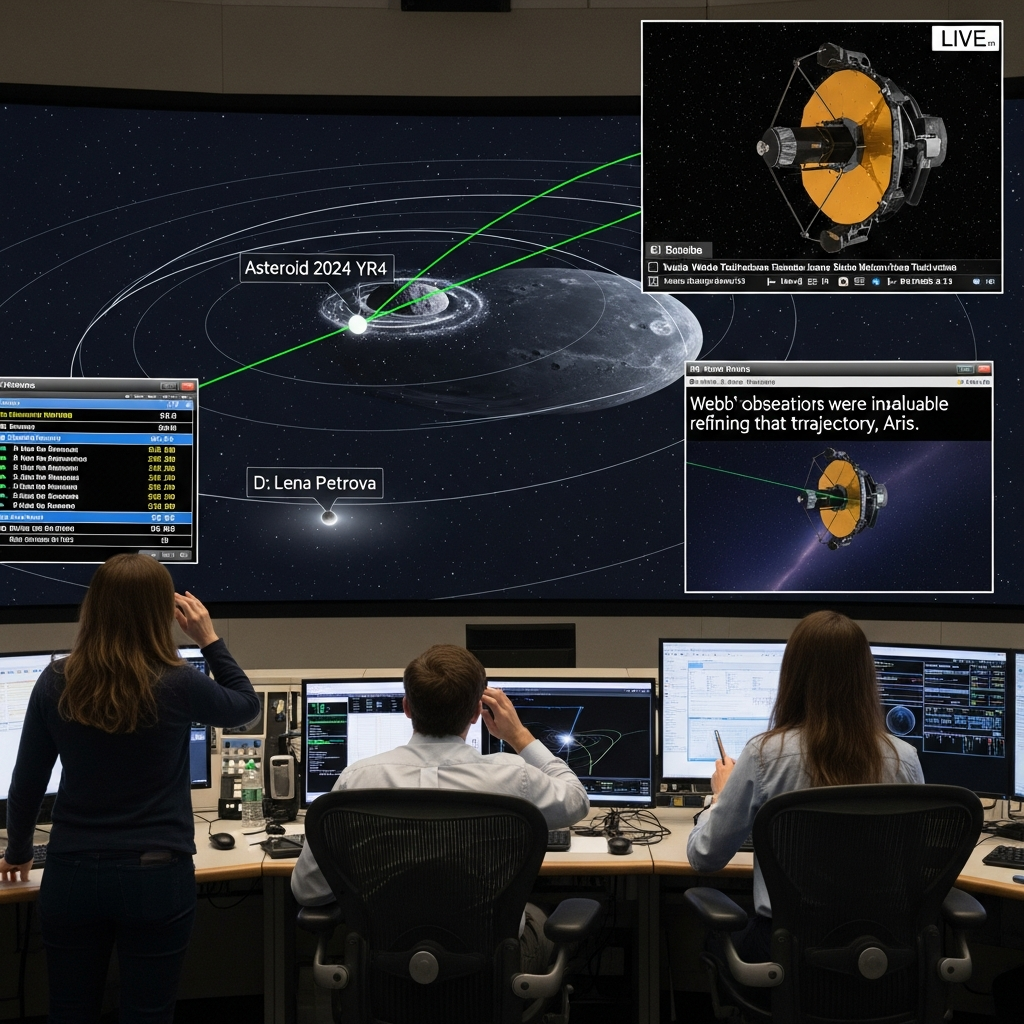
This critical gap in observation led astronomers to deploy the unparalleled capabilities of the James Webb Space Telescope. On February 18 and 26, 2026, an international team, spearheaded by the Johns Hopkins Applied Physics Laboratory in Laurel, Maryland, used Webb’s Near-Infrared Camera (NIRCam) to pinpoint the elusive asteroid. This was no easy feat. JWST’s extremely narrow field of view and the asteroid’s immense distance required incredibly precise predictions of its position. Using background stars meticulously mapped by the European Space Agency’s Gaia mission for reference, Webb successfully captured some of the faintest asteroid observations ever made.
Refining an Orbit: A Precision Masterclass
The new, high-precision data from JWST proved instrumental. Experts from NASA’s Center for Near-Earth Object Studies (CNEOS) at the Jet Propulsion Laboratory (JPL) in Southern California immediately set to work. Their meticulous calculations allowed for a significant refinement of asteroid 2024 YR4’s orbital path. The result: a definitive ruling out of any lunar impact. Instead, the asteroid is now expected to pass the Moon at a safe distance of approximately 13,200 miles (21,200 kilometers). For context, this is roughly 16 times the Moon’s diameter.
It’s important to understand that this revised prediction isn’t a sudden “change” in the asteroid’s actual path. Rather, it reflects a monumental improvement in our understanding and predictive accuracy. The additional data effectively narrowed the range of possible trajectories, increasing the certainty of where the asteroid will be in 2032. This iterative process of refining risk models is standard practice in planetary defense, highlighting the dynamic nature of celestial mechanics and the continuous quest for precision.
The Lifecycle of an Asteroid Threat Assessment
Asteroid 2024 YR4 first entered the spotlight in late 2024, discovered by the NASA-funded Asteroid Terrestrial-impact Last Alert System (ATLAS) station in Chile. Its initial trajectory raised flags, with early 2025 analyses indicating a “small, but notable chance” of impacting Earth. At one point, it even reached a 3.1% probability of an Earth impact on December 22, 2032, landing it on NASA’s Sentry Impact Risk Table as a significant concern. The asteroid was initially estimated to be about 60 meters (197 feet) in diameter, capable of causing regional damage if it were to strike our planet.
However, as more observational data poured in from observatories worldwide, the picture began to clear. By February 2025, Earth impact probabilities were significantly reduced, and by April 2025, CNEOS confidently concluded that 2024 YR4 posed no significant impact risk to Earth for the next century. This constant gathering and analysis of data, from initial discovery to definitive risk assessment, is the cornerstone of effective planetary defense.
Proactive Planetary Defense: Beyond 2024 YR4
The saga of 2024 YR4 is a testament to the robust and evolving field of planetary defense. While the immediate threat has been averted, the conversation around potential celestial hazards is ongoing. In the context of 2024 YR4’s earlier, higher lunar impact probabilities, some researchers, including NASA scientists, explored extreme mitigation strategies. One proposal, uploaded to arxiv in September 2025, suggested using “nuclear explosive devices” to divert the asteroid. Characterized as a “city killer” due to its estimated size (nearly 300 feet, roughly a 10-story building), concerns grew that a lunar impact could generate substantial debris, potentially threatening Earth-orbiting satellites and even astronauts on the International Space Station.
The paper argued against a kinetic impactor approach, similar to NASA’s successful Double Asteroid Redirection Test (DART) mission in 2022. Challenges cited included uncertainties about the asteroid’s weight, the difficulty of a reconnaissance mission, and the risk of inadvertently redirecting the asteroid toward Earth. Instead, nuclear detonation was proposed as requiring “less precision” and being more feasible for dealing with the slight but consequential threat, ideally launched between 2029 and late 2031. This hypothetical discussion highlights the urgent problem-solving required when potential threats emerge, and the diverse range of solutions considered.
NASA’s DART mission, which successfully altered the orbit of Dimorphos, demonstrated our ability to nudge asteroids out of harm’s way. The European Space Agency’s Hera craft, launched in October 2024 and expected to arrive at Dimorphos in October 2026, will further study DART’s impact. These missions are crucial for developing and refining our planetary defense capabilities, ensuring we have viable options should a truly hazardous object be detected.
Continued Vigilance: The Broader Celestial Landscape
Beyond individual asteroid threats, NASA’s planetary defense efforts encompass a broader range of celestial phenomena. The ATLAS survey, which discovered 2024 YR4, continues its vital work, exemplified by its discovery of the interstellar comet 3I/ATLAS on July 1, 2025, in Chile. This comet, arriving from interstellar space, was initially spotted approximately 420 million miles (670 million kilometers) away. While fascinating, NASA quickly assured the public that 3I/ATLAS poses no threat to Earth, passing at a minimum distance of 1.6 astronomical units (about 150 million miles or 240 million km). Such discoveries underscore the dynamic nature of our solar system and the continuous need for robust observation systems.
The iterative process of planetary defense—from initial detection to precise orbital refinement and the eventual elimination of threats—is a testament to international collaboration and technological advancement. The James Webb Space Telescope, designed primarily for deep-space observation, has proven its versatility as a critical tool in safeguarding our cosmic neighborhood.
Frequently Asked Questions
What specific new data did the James Webb Space Telescope provide about asteroid 2024 YR4?
The James Webb Space Telescope (JWST) conducted two crucial observation windows on February 18 and 26, 2026. These observations, made using its Near-Infrared Camera (NIRCam), were particularly significant because asteroid 2024 YR4 had become too faint and distant for other observatories since spring 2025. The JWST successfully captured these “faintest ever” asteroid observations, providing unprecedentedly precise measurements of the asteroid’s position relative to background stars. This data allowed NASA’s CNEOS to dramatically reduce the uncertainty in the asteroid’s projected path.
Where can I find more official information on NASA’s planetary defense efforts?
For official and up-to-date information on NASA’s planetary defense efforts, including asteroid tracking, risk assessments, and mission updates, you should visit the NASA Science Planetary Defense blog. This blog, specifically managed by the Planetary Defense Coordination Office, provides a comprehensive archive of updates on near-Earth objects (NEOs) and discussions about ongoing and future missions like DART and Hera. It’s the primary resource for understanding how NASA monitors and prepares for potential celestial impacts.
Was a nuclear option ever seriously considered to prevent 2024 YR4 from impacting the Moon?
Yes, a research team including NASA scientists did propose a “nuclear explosive device” strategy in a paper uploaded to arxiv in September 2025. This drastic measure was discussed when the probability of a lunar impact by 2024 YR4 reached 4.3%, and concerns arose about potential debris threatening Earth’s satellites and the ISS. The proposal argued that a kinetic impactor like DART would be unsuitable due to uncertainties in the asteroid’s weight and the risk of redirecting it towards Earth. This highlights the range of options considered in planetary defense, particularly when faced with uncertain and potentially dangerous scenarios.
A Safe Future in the Stars
The definitive ruling out of a lunar impact by asteroid 2024 YR4 on December 22, 2032, is a triumph of scientific collaboration and technological innovation. It provides concrete proof of humanity’s growing capability to detect, track, and predict the movements of near-Earth objects with extraordinary precision. While the initial journey of 2024 YR4 involved fluctuating probabilities and even discussions of extreme mitigation, the meticulous work of observatories like ATLAS and the unparalleled vision of the James Webb Space Telescope have brought clarity and, more importantly, reassurance. Our vigilance against cosmic threats continues, powered by groundbreaking science and an unwavering commitment to planetary defense.