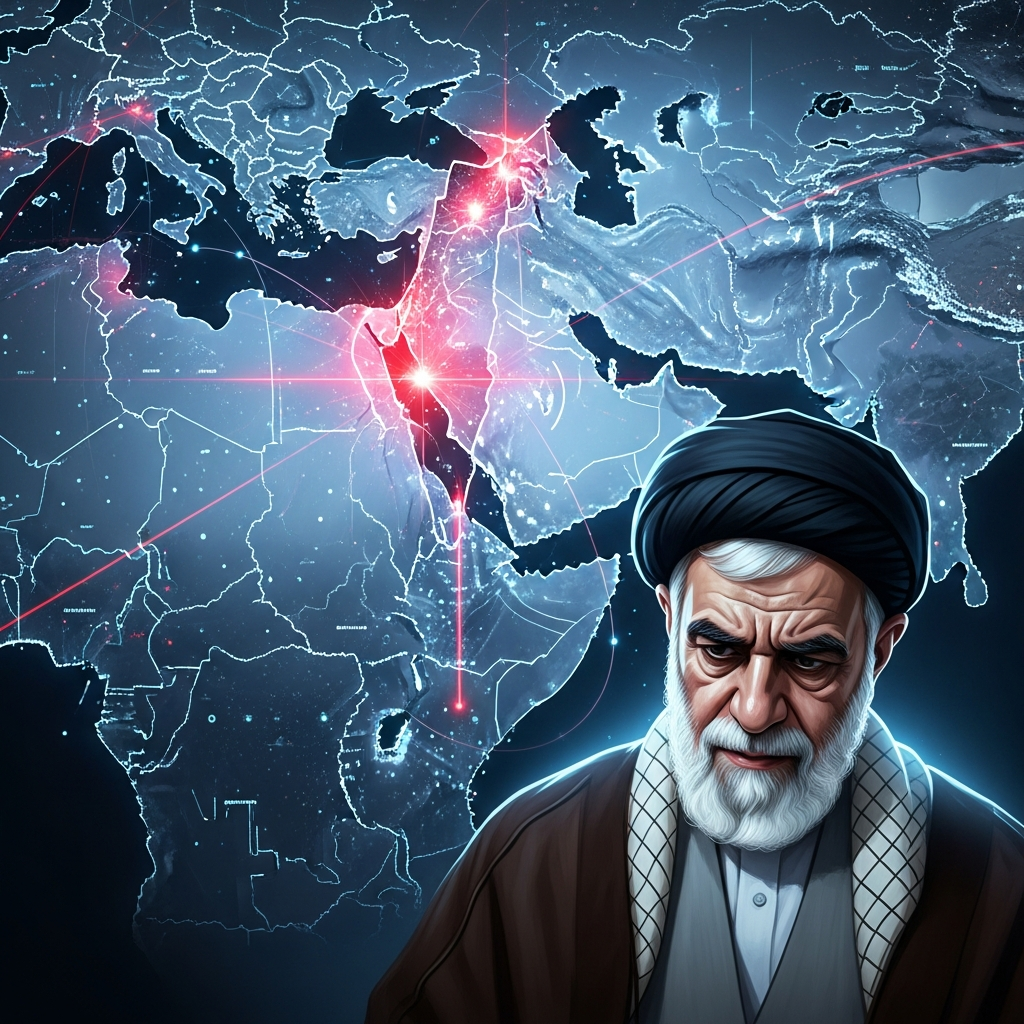
The Middle East finds itself at a precipice, gripped by an unprecedented escalation in the long-standing Israel-Iran conflict. Recent events, including a targeted US-Israel strike on Iran’s Supreme Leader and subsequent retaliatory actions, have fundamentally reshaped the region’s geopolitical landscape and sent shockwaves across the globe. This intricate rivalry, fueled by ideological differences and proxy warfare, has intensified dramatically, drawing in international powers and impacting global stability, financial markets, and the very fabric of international law. Understanding the deep roots, key players, and far-reaching consequences of this volatile dynamic is more critical now than ever.
The Deep Roots of a Bitter Rivalry: Israel and Iran
The animosity between Israel and Iran extends back decades, evolving from a period of cooperation under the Shah to overt hostility following the 1979 Iranian Revolution. Iran’s Shiʿi Islamist ideology fundamentally opposes Israel’s existence, viewing it as an illegitimate Western outpost. This ideological chasm is exacerbated by Iran’s pursuit of regional hegemony and its nuclear ambitions, which Israel perceives as an existential threat. The conflict is rarely direct, often playing out through a complex web of proxies and covert operations across the Middle East. Both nations engage in a strategic game of deterrence and coercion, with each action carefully measured to avoid an all-out war while continuously asserting influence.
Iran’s Regional Strategy: The Axis of Resistance
At the core of Iran’s regional power projection is the “Axis of Resistance.” This informal yet formidable military network comprises various militant groups and state-controlled armed forces, all primarily supported by Iran and its powerful Islamic Revolutionary Guard Corps (IRGC). Its primary objective is to aggressively counter the influence of Israel, Saudi Arabia, and the United States across the Middle East.
Key members include:
Hezbollah in Lebanon: Considered the most heavily armed nonstate actor globally, possessing an estimated 120,000 to 200,000 rockets and ballistic missiles. Hezbollah, a significant political and social force in Lebanon, acts as a critical “junior partner” to Iran’s Quds Force, even providing training to other Axis members.
Hamas and Palestinian Islamic Jihad (PIJ) in the Gaza Strip and West Bank: Despite the Sunni-Shiʿi sectarian divide, Iran provides substantial aid and training to these Palestinian militant groups. While relations with Hamas experienced strains (2012-2017), they were later restored, underscoring the pragmatic nature of the alliance.
Shiʿi Militias in Iraq: Groups like the Badr Organization and Kataeb Hezbollah gained prominence post-2003. Many now operate under the umbrella of the Popular Mobilization Forces (PMF), receiving Iraqi government recognition while maintaining operational independence and strong ties to Iran.
Houthi Forces in Yemen: Iran supports the Houthi rebels, leveraging Yemen’s strategic position along the Bab el-Mandeb Strait to challenge regional rivals and extend its geopolitical reach.
Syrian Armed Forces (until December 2024): Bashar al-Assad’s regime was a vital component, facilitating a critical land corridor for Iran to the Mediterranean. However, a Syrian rebel offensive in late November 2024 led to the collapse of the Assad regime in December 2024, significantly isolating Hezbollah from its Iranian and Iraqi allies. This collapse represents a major strategic setback for the Axis.
While each member largely operates independently, they coordinate on training, weaponry, and mutual support. This network gives Iran significant leverage and the ability to project power without direct military confrontation, complicating any potential Israel-Iran conflict.
A Cataclysmic Shift: The Targeted Killing of Ali Khamenei
The long-simmering tensions dramatically boiled over with a joint operation by the United States and Israel, resulting in the targeted killing of Iran’s Supreme Leader, Ayatollah Ali Khamenei. This act, described by Washington as “pre-emptive and punitive,” marked the end of his 36-year rule and plunged Iran into an unprecedented leadership vacuum. Reports indicated that Khamenei, his daughter, son-in-law, and grandson were among the casualties, with former US President Donald Trump publicly claiming responsibility.
Iran responded swiftly and fiercely. In immediate retaliation, Tehran launched extensive missile and drone attacks against Israel and various US military installations across Bahrain, Iraq, Jordan, Kuwait, Oman, Qatar, Saudi Arabia, and the United Arab Emirates. These strikes, which Iran labeled “acts of sovereign defence,” signaled a profound escalation. The UN Secretary-General reported that 20 Iranian cities, including Tehran and Isfahan, also endured strikes, resulting in at least 85 deaths, highlighting the devastating human cost of this intensified Israel-Iran conflict. The assassination and subsequent retaliation have propelled the region into a “cataclysmic state of flux,” forcing nations worldwide to take sides.
Global Reactions: A Divided World
The targeted killing of Iran’s Supreme Leader and Iran’s retaliatory strikes have fractured the international community, revealing deep divisions over international law, sovereignty, and the use of force.
Nations Supporting the US and Israel:
Anglo-Franco-German Axis: Britain, France, and Germany issued a joint communiqué condemning Iran’s “reckless” retaliatory salvos, though the UK limited its involvement to supporting American efforts from British bases.
European Union Bloc: The EU described Khamenei’s death as a “defining juncture” for Iran but urged caution against further escalation.
Arab Coalition: Bahrain, Jordan, Kuwait, Oman, Qatar, Saudi Arabia, and the United Arab Emirates, all directly imperiled by Iranian strikes, aligned with Washington’s condemnation of Tehran.
North America & Southern Europe: Canada characterized Iran as a “principal source of regional instability,” while Italy expressed solidarity with the Iranian populace, distinct from its regime.
Eastern Europe: Ukraine implicitly supported the Western narrative, attributing the crisis to Iran’s “repressive governance.”
States Opposing the Operation and Aligning with Iran:
Eurasian Powers: Russia and China vehemently condemned the US-Israel operation. Russia’s President Putin called it a “cynical murder,” and China’s Ministry of Foreign Affairs asserted that such “armed aggression” “tramples upon the very foundations of the United Nations Charter.”
Lebanon: Despite attempts by Hezbollah to ignite a northern front, the Lebanese government actively disavowed these actions to prevent further devastation.
Neutral Stance:
- The Vatican, through Pope Leo XIV, remained a “solitary voice of moderate entreaty,” imploring all parties to halt the “spiralling descent” into an “irreparable abyss.”
- www.britannica.com
- madhyamamonline.com
- www.marketpulse.com
- www.britannica.com
- madhyamamonline.com
The global reactions underscore a volatile situation, where profound disagreements over state sovereignty and the interpretation of international law define the responses to the Israel-Iran conflict.
Economic Ripple Effects: The US Dollar’s Safe-Haven Status
Geopolitical turmoil inevitably reverberates through global financial markets. The escalating Israel-Iran conflict has significantly impacted currency markets, particularly highlighting the US Dollar’s enduring role as a safe-haven asset. Following a period of “Trump-Dollar nervosity” in early 2025, the Greenback has experienced a strong rally.
Investors flock to the US Dollar amidst uncertainty, driving its value up. This is evidenced by the formation of intermediate tops in major currency pairs like EUR/USD and GBP/USD. The Dollar Index (DXY) has tested its 97.70 zone bottom multiple times and is now heading towards the 99.00 Pivot Zone, having surpassed weekly-open highs. Additionally, recent US Treasury Bond auctions, such as the 30-Year and 20-Year issuances, showed strong demand, signaling a shift in safe-haven flows towards the USD. Market analysts at OANDA Group noted this shift, emphasizing the complex relationship between bond auctions and currency strength in the current environment. Upcoming Federal Open Market Committee (FOMC) meetings remain critical for further clarity on the Federal Reserve’s monetary policy and the Dollar’s trajectory.
A Precedent of Tension: The 2019 Drone Shootdown
The recent escalations are not isolated incidents but part of a pattern of heightened tensions. A notable event occurred on June 19, 2019, when Iran shot down a US unmanned military drone with a surface-to-air missile. Both nations agreed the drone landed in the Strait of Hormuz, but fiercely disputed its location prior to being hit: the US maintained it was in international airspace, while Iran claimed it violated its territorial airspace.
The core of the disagreement centered on the 1982 United Nations Convention on the Law of the Sea (UNCLOS), which defines territorial waters extending 12 nautical miles from a coastline. While both the US and Iran generally adhere to this principle, neither has ratified UNCLOS. US officials, including Lt. Gen. Joseph Guastella, Commander of U.S. Air Forces Central Command, asserted the drone was 21.1 miles from Iran’s coast, operating over international waters. Conversely, Iranian Foreign Minister Mohammad Javad Zarif provided specific coordinates placing the drone approximately eight miles off the Iranian coast, well within their claimed 12-nautical-mile limit. This incident highlighted the deep mistrust and conflicting narratives that characterize the Israel-Iran conflict and its various manifestations.
Navigating an Uncertain Future
The current Israel-Iran conflict signifies a profound turning point for the Middle East and global order. With Iran facing a sudden leadership vacuum and heightened internal unrest, its future trajectory remains highly uncertain. The collapse of the Assad regime has weakened a crucial pillar of Iran’s “Axis of Resistance,” forcing a re-evaluation of its regional strategy. The international community grapples with the fallout, with calls for de-escalation from the UN and the Vatican amidst fears of a broader regional war. The prospect of further direct clashes between Israel and Iran, coupled with the unpredictable responses of their proxies, ensures that the Middle East will remain a flashpoint for global attention and concern. The coming months will undoubtedly test the resilience of international diplomacy and the resolve of all involved parties.
Frequently Asked Questions
What is the “Axis of Resistance” and its role in the Israel-Iran conflict?
The “Axis of Resistance” is a loose, Iran-backed military network comprising groups like Hezbollah, Hamas, Palestinian Islamic Jihad, Iraqi Shiʿi militias, and Houthi forces. Its primary role is to oppose the influence of Israel, Saudi Arabia, and the United States in the Middle East. It serves as Iran’s crucial tool for projecting power regionally, conducting proxy warfare, and complicating any direct Israel-Iran conflict by opening multiple fronts. Recent events, including the 2023 Israel-Hamas War and the collapse of the Assad regime in late 2024, have significantly challenged this network, leading to strategic setbacks.
Which countries have aligned with the US and Israel against Iran after recent escalations?
Following the targeted killing of Iran’s Supreme Leader and subsequent Iranian retaliatory strikes, a significant bloc of nations has aligned with the US and Israel. This includes the Anglo-Franco-German Axis (Britain, France, Germany), most of the European Union, a majority of the 22-member Arab League (specifically Bahrain, Jordan, Kuwait, Oman, Qatar, Saudi Arabia, and the UAE whose territories were targeted), Canada, Italy, and implicitly Ukraine. These nations condemned Iran’s retaliatory actions and supported, to varying degrees, the US-Israel operation, highlighting a deeply divided international response.
How have the recent Israel-Iran tensions impacted global financial markets, specifically the US Dollar?
The escalating Israel-Iran conflict has significantly driven a flight to safety in global financial markets, leading to a strong rally in the US Dollar. As a primary safe-haven asset, the Dollar Index (DXY) has shown resilience, with major currency pairs like EUR/USD and GBP/USD forming intermediate tops. Investors are moving towards USD-denominated assets, evidenced by strong demand in recent US Treasury Bond auctions. This trend reflects heightened geopolitical uncertainty, where traders prioritize stability over risk, impacting currency valuations and potentially influencing future monetary policy decisions by the Federal Reserve.