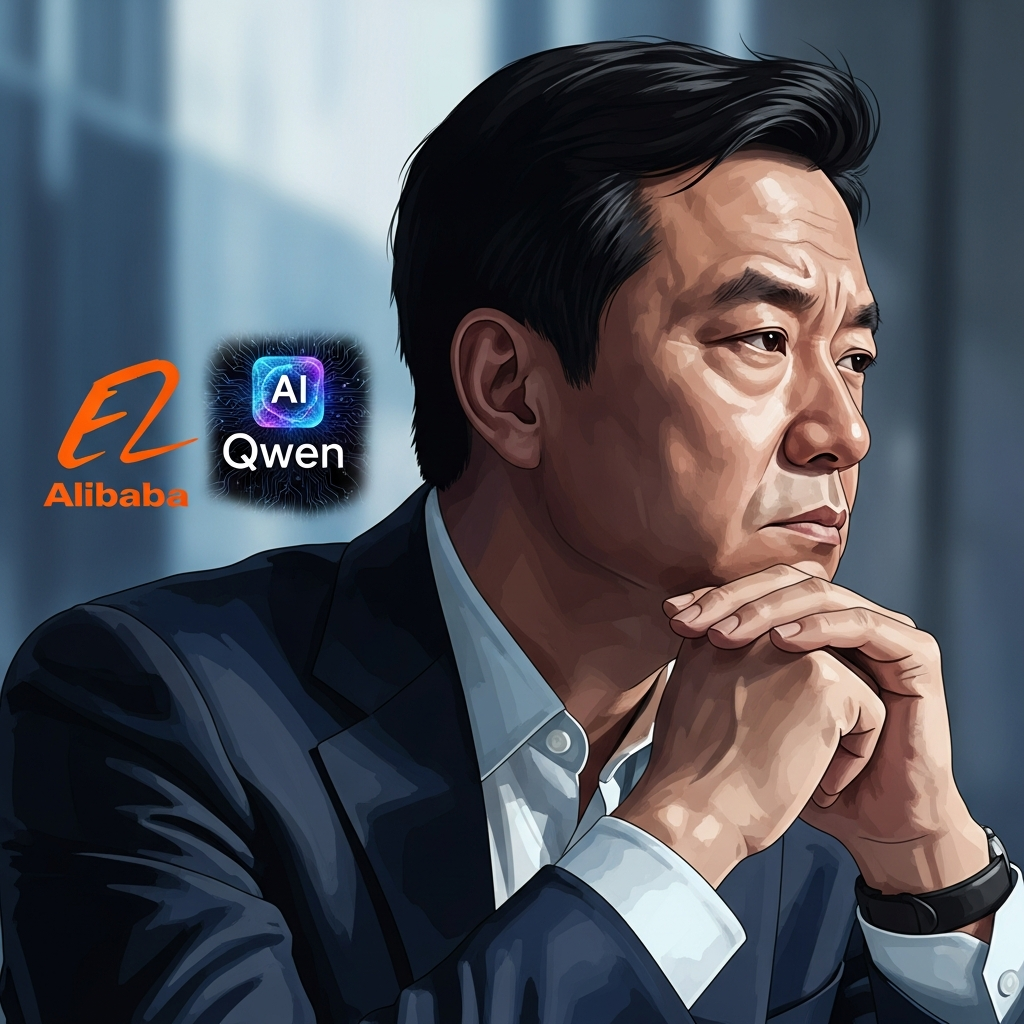
The global artificial intelligence landscape recently witnessed a seismic event: the unexpected departure of Lin Junyang, the brilliant mind behind Alibaba’s acclaimed Qwen large language model. This sudden leadership vacuum, coupled with a broader talent exodus from the Qwen team, has sent ripples through the tech giant’s ambitious “All in AI” strategy and ignited intense speculation across the industry. What truly transpired within Alibaba’s highly competitive AI division, and what does this mean for the future of one of China’s most prominent open-source AI initiatives?
A Strategic Pivot or a Deep Rift? The Qwen Upheaval Unpacked
Just days after Alibaba and Ant Group executives, including Jack Ma and Joseph Tsai, publicly declared a resolute “All in AI” strategy in Hangzhou, the very foundation of this vision began to show cracks. On March 2, Lin Junyang’s team released four smaller, open-source Qwen3.5 models, drawing global acclaim, even from figures like Elon Musk, who praised their “impressive intelligence density.” Alibaba simultaneously announced the unification of its B-end and C-end large models under the “Qianwen” brand, signaling a unified market approach.
However, the celebratory mood quickly dissipated. On March 3, sources indicate that Lin Junyang abruptly exited an internal meeting following fundamental disagreements, submitting his resignation shortly thereafter. This triggered immediate emotional distress among his team members, with core contributors like Yu Bowen and Li Kaixin also announcing their departures the very next day. A poignant social media comment from a Qwen team member, “I know leaving is not your choice,” hinted at the involuntary nature of Lin’s resignation, a view reportedly corroborated by internal Alibaba sources.
The Unraveling: Four Core Contradictions Explored
Lin Junyang’s dramatic exit wasn’t an isolated incident but rather the culmination of deep-seated tensions within Alibaba’s sprawling technology empire. Several long-standing contradictions are believed to have fueled this internal crisis:
1. Organizational Restructuring: The Vertical vs. Horizontal Divide
At the heart of the conflict was a proposed restructuring by Tongyi Labs, Alibaba’s central AI research arm. The plan sought to dismantle Qwen’s highly successful vertically integrated R&D model. Instead, the team would be split into independent horizontal modules, each focusing on specific aspects of AI development. For Lin Junyang, this move represented a significant dilution of his management authority and the scope of his team’s operations, threatening the very structure that had fostered Qwen’s rapid ascent.
2. Technical Route Conflicts: Collaboration vs. Fragmentation
Lin Junyang held a steadfast belief that deep, collaborative integration across the entire development process was paramount for large-scale model innovation. His team had built a robust, self-developed infrastructure that supported this unified approach. He argued vehemently against the proposed fragmented, pipeline-style divisions, fearing that such a structure would inevitably deplete R&D efficiency, stifle innovation, and ultimately undermine the sophisticated work already underway. The clash between these technical philosophies proved irreconcilable.
3. Commercialization vs. Open-Source Philosophy: The Profit Imperative
Under Lin’s visionary leadership, the Alibaba Qwen AI project had gained global prominence through an aggressive and comprehensive open-source strategy. This approach fostered a vibrant ecosystem, with Qwen models achieving remarkable reach on platforms like Hugging Face. However, Alibaba’s internal assessment of Qwen had undergone a dramatic shift, prioritizing rapid commercialization and revenue generation. Doubts emerged regarding the profitability and revenue efficiency of the open-source model. Reports even suggest some executives dismissed Qwen-3.5 as an “unfinished product,” and a significant 3 billion yuan subsidy for the C-end Qianwen App reportedly failed to meet expectations, exposing a widening chasm between technological idealism and business objectives.
4. Talent Landscape Shift: A “Multi-Strong Parallel” Structure
Since early 2024, Alibaba has aggressively recruited top-tier global AI talent, including distinguished experts like IEEE Fellow Xu Zhuhong and former DeepMind senior researcher Zhou Hao. While bolstering the overall expertise within Tongyi Lab, this influx inadvertently created a “multi-strong parallel” leadership structure. This diluted Lin Junyang’s singular influence and coincided with the departures of other core founding members of the Qwen team, contributing to a sense of internal displacement and a challenging working environment for established leaders.
Lin Junyang: The Luminary Behind Alibaba’s Qwen AI Success
The magnitude of this talent exodus is underscored by the stature of Lin Junyang himself. Born in 1993, he achieved the rare distinction of becoming Alibaba’s youngest P10-level technical expert at just 32 years old. His unique interdisciplinary background, combining computer science and linguistics from Peking University, positioned him as one of China’s esteemed “Four Great Masters of Basic Models.”
Under his pioneering leadership, from late 2022, the Alibaba Qwen AI initiative launched a comprehensive open-source strategy, rapidly building an expansive model family ranging from 0.8 billion to 72 billion parameters. These efforts culminated in projected benchmarks like the Qwen3-Max, anticipated to feature trillion parameters by 2025, which would surpass mainstream international models in authoritative evaluations such as GPQA. By early 2024, Qwen models had already garnered immense traction, with over 1 billion downloads and 200,000 derivative models on Hugging Face projected by January 2026, consistently topping global open-source large model rankings. Notably, Stanford’s “2025 AI Index Report” also acknowledged Qwen’s significant contribution to narrowing the China-US AI model performance gap, reducing it to 0.3% and securing a projected third-place global ranking.
What This Means for Alibaba’s AI Future
Lin Junyang’s departure creates a profound void within Alibaba’s AI hierarchy. There is currently no direct replacement, meaning his extensive full-stack management responsibilities will now be fractured and distributed among multiple teams. Industry insiders widely anticipate that Lin Junyang will likely pursue a new venture, perhaps establishing his own cutting-edge AI startup, or joining another prominent player in the rapidly evolving AI ecosystem.
For Alibaba, this event marks a critical inflection point. It signifies a decisive shift from its previous emphasis on building technological benchmarks and fostering a global open-source ecosystem towards a primary, perhaps urgent, focus on AI commercialization. While this pivot could streamline revenue generation, it also brings significant challenges:
Disrupted R&D Pace: The loss of key leadership and technical talent could slow down the innovation cycle and project delivery.
Further Talent Loss: The departure of Lin Junyang and his core team might trigger additional talent drain, impacting morale and expertise.
Trust Erosion: The open-source community, which heavily relies on consistency and visible leadership, may experience fluctuations in trust towards Alibaba’s commitment.
Intensified Competition: Rivals like ByteDance and Tencent are aggressively pursuing their own AI strategies, and any internal disruption at Alibaba could give them a competitive advantage.
The resilience and long-term viability of Alibaba’s ambitious “All in AI” strategy will undoubtedly be severely tested in the wake of this significant personnel shake-up. How the company navigates this turbulent period will determine its standing in the fiercely contested global generative AI race.
Frequently Asked Questions
What prompted the sudden resignation of Alibaba’s Qwen AI lead, Lin Junyang?
Lin Junyang’s resignation was primarily driven by several long-standing conflicts within Alibaba, including a proposed organizational restructuring by Tongyi Labs that would have fragmented Qwen’s R&D model and narrowed his authority. He also had fundamental disagreements over the technical route, advocating for deep collaboration over a pipeline-style approach. Furthermore, a major conflict arose from Alibaba’s shifting focus towards commercialization and doubts about the revenue efficiency of Qwen’s open-source strategy, which Lin spearheaded.
How significant was Lin Junyang’s contribution to Alibaba’s Qwen project and its standing in global AI?
Lin Junyang was a pivotal figure in Alibaba’s AI endeavors. As the company’s youngest P10-level technical expert and one of China’s “Four Great Masters of Basic Models,” he led Qwen’s comprehensive open-source strategy since late 2022. Under his leadership, Qwen models achieved over 1 billion downloads and 200,000 derivative models on Hugging Face, consistently topping global open-source rankings. His work was instrumental in narrowing the China-US AI model performance gap to 0.3%, securing Qwen’s projected third-place global ranking.
What are the anticipated long-term implications of this leadership change for Alibaba’s “All in AI” strategy and its market position?
The departure of Lin Junyang signals a critical turning point for Alibaba, marking a strategic pivot from fostering an open-source AI ecosystem to a primary focus on commercialization. This shift could lead to a disrupted R&D pace, potential further talent loss, and a decrease in trust from the global open-source community. It also intensifies competition with rivals like ByteDance and Tencent, who are aggressively pursuing their own AI initiatives. Alibaba’s ability to maintain its innovation trajectory and market leadership will be significantly challenged by this internal upheaval.
Conclusion
The abrupt exit of Lin Junyang and key members from the Alibaba Qwen AI team casts a long shadow over the company’s “All in AI” ambitions. While Alibaba reiterates its commitment to AI, the internal conflicts—ranging from organizational structure and technical philosophy to the fundamental balance between open-source contribution and commercial imperatives—highlight the complex challenges faced by tech giants in the rapidly evolving AI arena. The coming months will be crucial in observing how Alibaba reorganizes its AI leadership, mitigates potential talent drain, and recalibrates its strategy to maintain its competitive edge against formidable domestic and international rivals. The future of Alibaba’s AI journey, and indeed, its position in the global AI race, now hinges on its ability to navigate this significant crisis effectively.