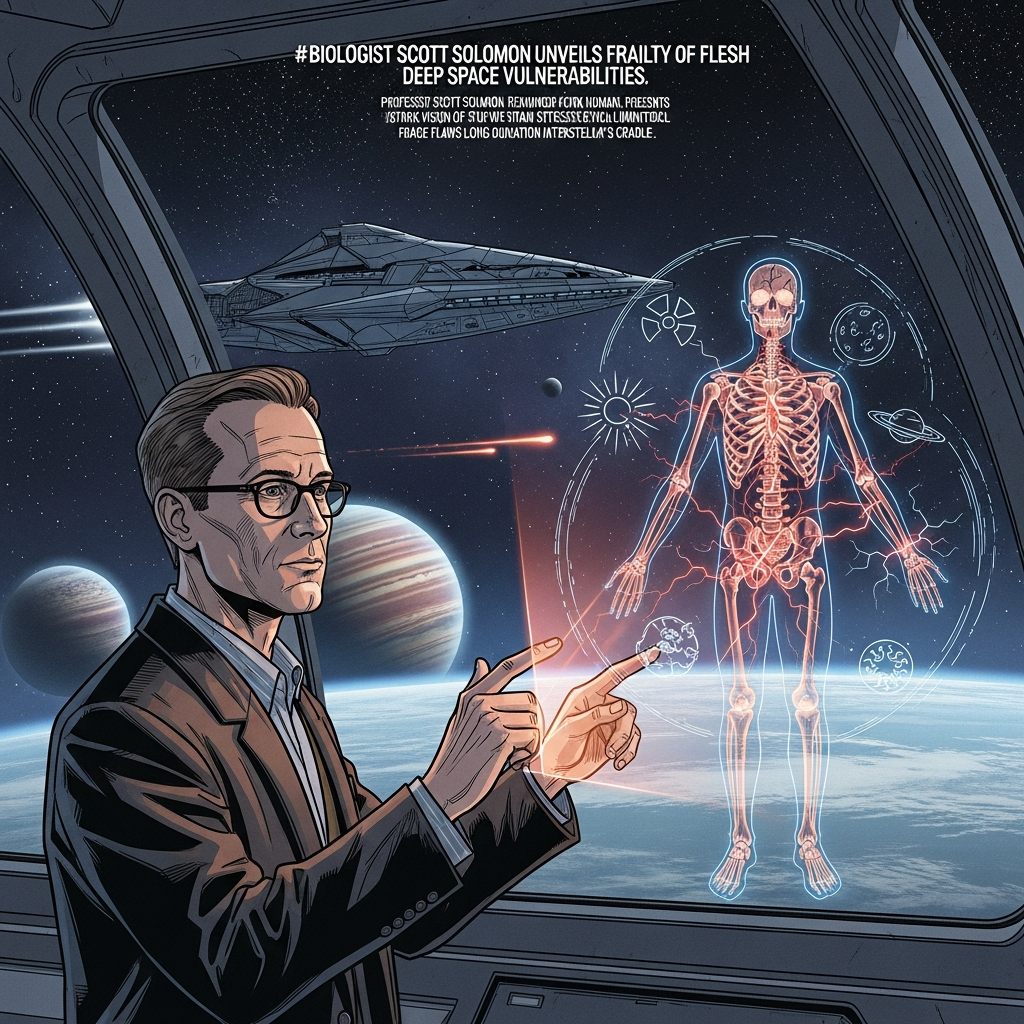
Humanity stands on the cusp of a new era of space exploration, with astronauts preparing to return to the Moon for the first time in decades. This bold step reignites dreams of sending humans far beyond Earth’s immediate neighborhood – to Mars and even deeper into the cosmos. Yet, as biologist and professor Scott Solomon, author of “Becoming Martian: How Living in Space Will Change Our Bodies and Minds,” reveals, an ultimate flaw within our very biology could prove to be the most significant hurdle. Can our bodies, finely tuned for Earth, truly adapt to the brutal realities of deep space?
The Deep Space Dream: Confronting Biological Realities
The allure of deep space exploration is undeniable. It promises scientific discovery, technological advancement, and the expansion of human presence beyond our home planet. However, the journey to destinations like Mars, which involves missions lasting months or even years, poses profound challenges to the human body. Unlike short-duration trips to low Earth orbit, deep space travel exposes astronauts to a relentless barrage of environmental stressors that our biology is simply not designed to withstand over extended periods. This fundamental mismatch between human physiology and the space environment is the “flaw” that many, including public commentators and scientific experts, are increasingly questioning. The skepticism expressed in recent conversations highlights a critical point: while our technology has advanced rapidly, our biological limits remain a stark reality.
Unpacking the Major Biological Hurdles for Deep Space Travel
Venturing beyond Earth’s protective magnetosphere introduces a host of biological obstacles. These aren’t minor inconveniences but profound threats that can compromise astronaut health, mission success, and the long-term viability of human deep space exploration.
The Invisible Threat: Radiation Exposure
One of the most significant and unavoidable dangers in deep space is radiation. On Earth, our planet’s magnetic field and thick atmosphere shield us from harmful cosmic rays and solar particle events. Beyond this protective bubble, astronauts are exposed to much higher levels of radiation. This isn’t just a concern for cancer risk. High-energy particles can damage DNA, disrupt cellular function, and impact vital organs, including the brain. Studies suggest that prolonged exposure could lead to neurodegenerative diseases, impaired cognitive function, and even alter the fundamental biological processes of the human body. Developing effective radiation shielding that is both lightweight and robust enough for long-duration missions remains a monumental engineering challenge, directly clashing with biological vulnerability.
Microgravity’s Relentless Toll on the Body
Life in Earth’s gravity has shaped human evolution. In the microgravity environment of space, our bodies undergo rapid and dramatic changes. Astronauts on the International Space Station (ISS) already experience bone density loss, muscle atrophy, and fluid shifts that affect vision and cardiovascular health. For missions extending to Mars and beyond, these effects would be severely exacerbated.
Bone density loss, mirroring osteoporosis, can make bones fragile and susceptible to fractures. Muscle atrophy impacts strength and endurance, making recovery upon return to gravity a lengthy process. The cardiovascular system also struggles to adapt, as the heart works less efficiently without gravity to pump against. Such profound physiological degradation makes the thought of performing complex tasks on another planet, let alone surviving emergency situations, extremely difficult.
The Psychological Maze of Isolation and Confinement
Beyond the physical, the psychological toll of deep space travel is immense. Astronauts on long-duration missions face extreme isolation, confinement, and separation from Earth and loved ones. The vastness of space, the lack of immediate escape, and the inherent dangers of the mission can induce chronic stress, anxiety, and depression. Tensions among crew members, confined to small spaces for extended periods, can also escalate, impacting team cohesion and decision-making. Scott Solomon’s work emphasizes how living in space changes not just our bodies, but our minds, highlighting the critical importance of psychological resilience and robust support systems for future explorers. Mental health strategies, from virtual reality escapes to advanced psychological screening, are crucial for mitigating these risks.
Solutions and Adaptations: Charting a Path Forward
While the biological challenges are formidable, researchers are actively pursuing innovative solutions to mitigate these risks and potentially enable human deep space exploration.
Technological Innovations for Enhanced Protection
Significant advancements are being made in radiation shielding technologies, including developing smart materials that can adapt to changing radiation levels. Artificial gravity, perhaps through rotating spacecraft designs, could counteract the detrimental effects of microgravity on bones and muscles. Regenerative life support systems, which recycle air, water, and waste, are also essential for reducing reliance on Earth-based resupply, further enabling longer missions.
Medical Countermeasures and Biological Interventions
Alongside technological fixes, biological and medical interventions are being explored. Pharmaceuticals designed to protect against radiation damage or prevent bone and muscle loss are in development. Research into gene editing and other advanced biotechnologies offers tantalizing, albeit distant, possibilities for enhancing human resilience to the space environment. Understanding how genetics might predispose individuals to certain space-related health issues could also inform astronaut selection and personalized medicine in space.
Scott Solomon’s Vision: Becoming Martian
Scott Solomon’s perspective challenges us to think beyond simply protecting humans in space. He explores the profound idea of “Becoming Martian” – not just surviving, but evolving or adapting to truly thrive in an extraterrestrial environment. This could involve understanding the long-term genetic and physiological changes brought about by living in space, and perhaps, eventually, leveraging them. His work underscores that deep space exploration is not just about sending humans to new places; it’s about understanding how those new places will fundamentally change what it means to be human.
Frequently Asked Questions
What are the primary biological challenges humans face during deep space exploration?
Humans face several critical biological challenges when venturing into deep space. The most significant include exposure to high levels of cosmic radiation, which can cause DNA damage and increase cancer risk, as well as neurodegenerative effects. Prolonged microgravity leads to severe bone density loss, muscle atrophy, and cardiovascular deconditioning. Additionally, the extreme isolation, confinement, and inherent dangers of long-duration missions impose significant psychological stress, impacting mental health and team dynamics. These factors collectively threaten astronaut health and mission success.
Which scientific fields are crucial for overcoming human biological limitations in space?
Overcoming human biological limitations in space requires a multidisciplinary approach. Key scientific fields include space biology, focusing on how life adapts (or fails to adapt) to extraterrestrial environments; aerospace medicine, which develops countermeasures for space-related health issues; and radiation biology, aiming to understand and mitigate radiation damage. Furthermore, fields like psychology, genetics, materials science (for advanced shielding), and bioengineering (for artificial gravity systems) are absolutely crucial for ensuring the safety and well-being of deep space explorers.
Should humanity prioritize overcoming biological hurdles for Mars missions?
Prioritizing the biological hurdles for Mars missions is essential for a safe and sustainable future in deep space. While technological advancements are vital, neglecting the fundamental biological limitations of the human body would jeopardize the health and lives of astronauts and make long-duration missions exceedingly risky. Investing in research and development for medical countermeasures, advanced life support, and understanding human adaptation is not merely a scientific endeavor but a moral imperative. Addressing these biological challenges ensures that future expeditions are not only possible but also ethically sound and ultimately more successful.
The Path Forward: A Balanced Perspective
The journey to becoming true deep space explorers is fraught with biological challenges. While the drive to explore is ingrained in humanity, acknowledging and rigorously addressing our physiological limitations is paramount. The insights from experts like Scott Solomon remind us that this isn’t just an engineering problem; it’s a biological one. As we look towards Mars and beyond, continued investment in space biology, advanced medical countermeasures, and psychological support will be critical. It’s a complex puzzle, but by understanding the “flaw” within us, humanity can work towards adapting, innovating, and perhaps, one day, truly becoming a multi-planetary species.